- Panera Bread is privately owned by JAB Holding Company, a Luxembourg-based investment firm that acquired the company in 2017 for about $7.5 billion and took it off the public stock market.
- The restaurant chain operates under Panera Brands, a restaurant platform created in 2021 that groups Panera Bread with Caribou Coffee and Einstein Bros. Bagels, with Panera serving as the flagship brand.
- JAB Holding Company controls Panera Bread through its investment funds, which provide capital, appoint leadership, and guide long-term strategy across the restaurant portfolio.
- The Reimann family is the ultimate controlling shareholder of JAB Holding Company, meaning they indirectly control Panera Bread through their majority ownership in the global investment group.
Panera Bread is an American fast-casual restaurant chain known for its bakery-café concept. The brand combines freshly baked bread with café-style dining. Its menu includes sandwiches, soups, salads, pastries, coffee, and breakfast items.
The company positions itself between traditional fast food and casual dining. Customers receive quick service while enjoying higher-quality ingredients and a comfortable café environment. This model helped Panera become one of the pioneers of the fast-casual restaurant segment in the United States.
Fresh bread baking is central to the brand. Many locations bake bread and pastries throughout the day. The restaurants are designed to feel like neighborhood cafés where customers can dine, work, or meet friends.
Panera also built its reputation around clean ingredients. The company removed many artificial additives from its menu and promoted transparency in food preparation. This strategy strengthened its image as a healthier alternative to traditional fast food.
Technology plays a major role in Panera’s operations. The company introduced mobile ordering, self-service kiosks, and a large digital loyalty program. These systems allow customers to order quickly and personalize their experience.
Panera Bread operates through both company-owned restaurants and franchise partners. Together, they run thousands of bakery-café locations across North America. The brand continues to focus on convenience, fresh food, and a relaxed dining atmosphere.
Founders of Panera Bread
Panera Bread’s origins come from the merger of two bakery concepts. The modern company developed through the expansion of Au Bon Pain and the acquisition of Saint Louis Bread Company. Two individuals played the most important roles in building the brand.
Louis Kane
Louis Kane co-founded Au Bon Pain in 1981. His goal was to introduce European-style bakery cafés to the American market. The company focused on fresh pastries, artisan bread, and café meals.
Au Bon Pain expanded quickly in shopping centers, airports, and city locations. This early growth created the corporate structure that later supported the development of Panera Bread.
Although Kane eventually stepped away from daily leadership, his role in building Au Bon Pain laid the foundation for what would become Panera Bread.
Ron Shaich
Ron Shaich is considered the key figure behind the creation of the modern Panera Bread brand. He co-founded Au Bon Pain with Louis Kane and later led the company’s transformation.
In 1993, the company acquired Saint Louis Bread Company, a small bakery-café chain in Missouri. Shaich saw strong potential in the concept. He shifted the company’s focus toward expanding this bakery-café model.
During the late 1990s, the company sold the Au Bon Pain brand and renamed itself Panera Bread. Shaich then led the national expansion of the chain.
His strategy focused on fresh bread baking, high-quality ingredients, and comfortable café-style restaurants. These ideas helped Panera become one of the most successful fast-casual restaurant brands in the United States.
Ownership History
Panera Bread has experienced several ownership changes since its early beginnings. The company evolved from a small bakery concept into a major fast-casual restaurant brand through acquisitions, corporate restructuring, and private equity investments.
Early Roots in Au Bon Pain (1981–1993)
The story of Panera Bread begins with the creation of Au Bon Pain in 1981. The company was founded by Ron Shaich and Louis Kane. Their goal was to introduce European-style bakery cafés to the American market.
Au Bon Pain quickly expanded in urban locations such as malls, airports, and downtown areas. The brand focused on fresh pastries, sandwiches, and coffee. During the 1980s, the company grew into a successful bakery chain and began looking for new growth opportunities.
A key moment came in 1993 when Au Bon Pain acquired Saint Louis Bread Company. This small bakery-café chain operated several restaurants in the St. Louis, Missouri region. The acquisition would later transform the company’s entire business strategy.
Transformation into Panera Bread (1993–1999)
After acquiring Saint Louis Bread Company, Ron Shaich recognized that the bakery-café model had strong potential. The restaurants offered freshly baked bread, soups, sandwiches, and a relaxed dining environment.
The concept was different from traditional fast food. Customers could enjoy higher-quality meals in a café-style setting. Shaich decided to expand this format across the country.
During the mid-1990s, Au Bon Pain began opening more bakery-café locations under the Panera name. The concept proved highly successful in suburban markets.
In 1999, the company made a major strategic decision. It sold the Au Bon Pain bakery chain and focused entirely on the Panera Bread brand. After the sale, the company officially renamed itself Panera Bread Company.
This shift marked the true beginning of Panera Bread as a national restaurant brand.
Public Company Growth (1999–2017)
After becoming Panera Bread Company, the business entered a period of rapid growth. The company expanded its bakery-café concept across the United States through both company-owned restaurants and franchise partnerships.
Panera Bread became a publicly traded company on the NASDAQ stock exchange. Its shares were owned by a mix of institutional investors, mutual funds, and individual shareholders.
During the 2000s and early 2010s, Panera continued expanding its restaurant network. The company also introduced several innovations that helped strengthen its position in the fast-casual market.
These innovations included:
- A focus on clean ingredients and food transparency
- Large investments in digital ordering systems
- Loyalty programs and mobile apps
- Menu expansion with healthier options.
Under CEO Ron Shaich and later Blaine Hurst, Panera became one of the most successful fast-casual chains in the United States.
Acquisition by JAB Holding Company (2017)
A major ownership change occurred in April 2017. The European investment firm JAB Holding Company announced it would acquire Panera Bread Company in a major private equity deal.
JAB purchased the company for approximately $7.5 billion. The transaction included both equity and debt and represented one of the largest restaurant acquisitions at the time.
After the acquisition was completed, Panera Bread was taken private. This meant its shares were no longer traded on the public stock market.
JAB Holding Company specializes in investing in consumer brands, particularly coffee and restaurant chains. The firm already owned several well-known companies in the food and beverage sector.
The acquisition allowed Panera Bread to operate without the pressure of quarterly public market reporting. It also positioned the company within a larger global restaurant investment strategy.
Formation of Panera Brands (2021–Present)
In 2021, JAB Holding Company created a new restaurant holding group called Panera Brands. This structure brought together several of its bakery and coffee chains under a single corporate umbrella.
Panera Brands includes three major restaurant companies:
- Panera Bread
- Caribou Coffee
- Einstein Bros. Bagels.
Panera Bread became the flagship brand within this group. The combined structure allows the companies to share technology, supply chains, digital platforms, and operational strategies.
JAB Holding Company remains the ultimate owner through its investment funds. However, Panera Brands manages the day-to-day strategic coordination between the restaurant chains.
This ownership structure continues today. Panera Bread operates as part of a global restaurant portfolio while maintaining its identity as a leading fast-casual bakery-café brand.
Who Owns Panera Bread?
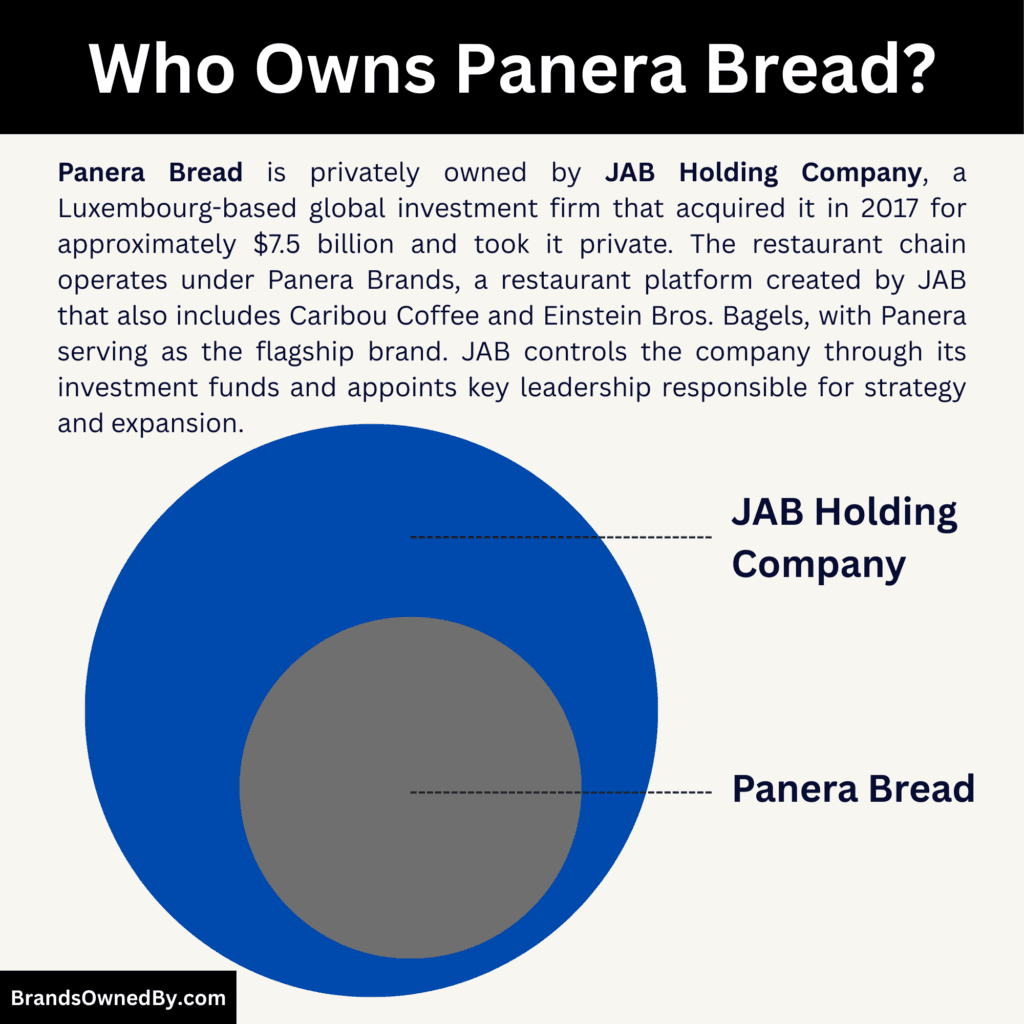
Panera Bread is privately owned and operates under a layered ownership structure. The brand is controlled by Panera Brands, a restaurant platform that groups several fast-casual chains together. Panera Brands itself is owned by the Luxembourg-based investment firm JAB Holding Company, which acquired Panera Bread in a major takeover in 2017.
Because the company is privately held, it does not have publicly traded shareholders like companies listed on stock exchanges. Instead, ownership is concentrated among private investors and holding companies connected to JAB.
The structure works as follows:
- Panera Bread operates as a restaurant brand.
- It is managed under the umbrella of Panera Brands.
- Panera Brands is controlled by JAB Holding Company.
- JAB Holding Company is largely owned by the Reimann family investment structure.
This means that ultimate control of Panera Bread sits with JAB and its controlling investors. The ownership model allows the company to operate without public market pressure while still benefiting from large private investment backing.
JAB Holding Company
JAB Holding Company is the primary shareholder and controlling owner of Panera Bread. The Luxembourg-based investment group acquired the restaurant chain in 2017 for approximately $7.5 billion, taking it private and removing it from public stock markets.
The firm specializes in consumer brands, particularly in food, coffee, and restaurant businesses. Over the past decade, JAB has built a global portfolio of well-known brands across the beverage and restaurant industries.
After acquiring Panera Bread, JAB reorganized its restaurant holdings to create a larger platform. This eventually led to the formation of Panera Brands, which groups several café-style restaurant companies together.
As the controlling shareholder, JAB determines long-term strategy, capital investments, and expansion plans. The firm also appoints board members and senior leadership across the restaurant platform.
JAB’s broader portfolio includes companies in coffee, beverages, consumer goods, and restaurants. Major brands connected to the firm include Krispy Kreme, Pret A Manger, Keurig Dr Pepper, and Peet’s Coffee.
Through its investment funds, JAB holds a dominant stake in Panera Brands and therefore maintains effective control of Panera Bread.
Panera Brands
Panera Brands acts as the direct parent company of Panera Bread. It was created in 2021 to combine several restaurant chains with similar business models under one structure.
The platform includes three major brands:
- Panera Bread
- Caribou Coffee
- Einstein Bros. Bagels.
This structure allows the companies to share operational systems, digital technology, and supply chains while still maintaining separate brand identities.
Panera Bread is the largest and most influential brand within this group. It acts as the flagship concept and generates the majority of revenue for the platform.
Panera Brands also provides centralized leadership, strategy development, and technology infrastructure for the restaurants. By integrating these brands, JAB aimed to create one of the largest fast-casual restaurant platforms in North America.
Although Panera Brands manages operations, the company itself remains controlled by JAB Holding Company.
The Reimann Family
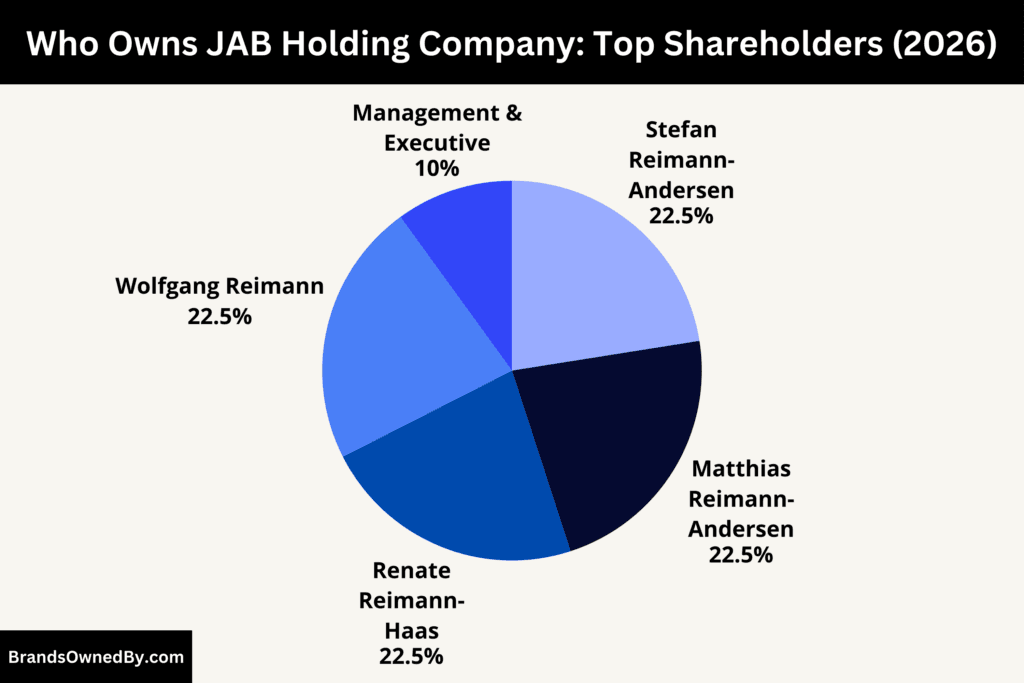
Behind JAB Holding Company is the Reimann family, a German billionaire family that serves as the ultimate controlling shareholder of the investment group.
The family’s wealth originates from a long-standing industrial business called Joh. A. Benckiser. Over time, this business evolved into the modern JAB investment structure.
Through family investment vehicles and holding entities, the Reimann family maintains a dominant ownership position in JAB Holding Company. As a result, they indirectly control the companies within JAB’s portfolio, including Panera Bread.
The Reimann family is considered one of the wealthiest families in Europe. Their investment strategy focuses heavily on consumer brands with strong global recognition.
Under their ownership, JAB expanded aggressively into the food and beverage sector. The acquisition of Panera Bread was part of a broader strategy to build a global café and restaurant empire.
Today, the family continues to influence long-term investment decisions while professional executives manage the daily operations of the businesses within the JAB portfolio.
Institutional Investors and JAB Investment Funds
Although JAB Holding Company is the controlling shareholder, its capital structure includes multiple investment funds and financial partners.
These funds raise capital from institutional investors such as pension funds, sovereign wealth funds, and large asset managers. The capital is then deployed across JAB’s portfolio companies.
Through these investment vehicles, institutional investors indirectly hold exposure to Panera Bread. However, they typically do not control operations or strategic decisions.
Decision-making authority remains concentrated with JAB’s leadership team and its controlling shareholders.
This structure is common in large private equity-style investment groups. It allows companies like Panera Bread to access large pools of capital while maintaining centralized control.
Overall, the ownership structure ensures that Panera Bread operates as part of a much larger global investment ecosystem focused on consumer brands and restaurant chains.
Competitor Ownership Comparison
Panera Bread operates in the fast-casual restaurant industry, where it competes with sandwich chains, coffee cafés, and quick-service restaurants. These companies have very different ownership structures. Some are publicly traded corporations with thousands of shareholders, while others are controlled by private equity firms or large investment groups.
As of March 2026, Panera Bread itself is privately owned by JAB Holding Company through Panera Brands. Its competitors, however, follow several different ownership models. Comparing these structures helps explain how control, investment, and expansion strategies differ across the restaurant industry.
| Company | Ownership Type | Current Owner(s) (as of 2025) | Ownership Structure | Key Details |
|---|---|---|---|---|
| Panera Bread | Private company | JAB Holding Company (through Panera Brands) | Private investment ownership | Acquired by JAB Holding Company in 2017 for about $7.5 billion. Operates under Panera Brands alongside Caribou Coffee and Einstein Bros. Bagels. The company is privately held and not listed on any stock exchange. |
| Chipotle Mexican Grill | Publicly traded company | Institutional investors such as The Vanguard Group, BlackRock, and State Street | Public shareholder ownership | Listed on the New York Stock Exchange. Institutional investors hold the majority of shares, giving them strong influence over corporate governance and board decisions. |
| Starbucks | Publicly traded company | Institutional investors including Vanguard Group, BlackRock, and State Street | Public shareholder ownership | Listed on NASDAQ. Ownership is widely distributed among institutional investors, mutual funds, and retail shareholders. Institutional investors control most of the voting power. |
| Subway | Private equity owned | Roark Capital | Private equity ownership | Acquired by Roark Capital in a major deal completed in 2024. The company is privately owned and operates through a large global franchise network. |
| Pret A Manger | Private company | JAB Holding Company | Private investment ownership | Acquired by JAB Holding Company in 2018. Operates as part of JAB’s global coffee and café portfolio alongside brands such as Panera Bread and Peet’s Coffee. |
| McDonald’s | Publicly traded company | Institutional investors including Vanguard Group, BlackRock, and State Street | Public corporation with franchise system | Listed on the New York Stock Exchange. The majority of restaurants are operated by franchise partners, while the parent company remains publicly owned by global investors. |
Chipotle Mexican Grill
Chipotle Mexican Grill is one of the closest competitors to Panera Bread in the fast-casual dining segment. The company specializes in Mexican-inspired meals such as burritos, tacos, and bowls.
Chipotle operates as a publicly traded company listed on the New York Stock Exchange. Ownership is distributed among institutional investors, mutual funds, and individual shareholders.
Institutional investors control the majority of the company’s shares. Major shareholders include The Vanguard Group, BlackRock, State Street Corporation, T. Rowe Price, and JPMorgan Chase. Together, institutional investors hold close to 90% of Chipotle’s shares, meaning financial institutions have significant influence over the company’s governance and board decisions.
This structure contrasts with Panera Bread’s private ownership model. Chipotle must report quarterly financial results and respond to shareholder expectations, while Panera operates under a private investment framework.
Starbucks
Starbucks is another major competitor in the café and bakery category. The company sells coffee, breakfast items, pastries, and light meals that overlap with Panera Bread’s menu.
Starbucks is also a publicly traded corporation listed on the NASDAQ stock exchange. Its ownership is widely distributed across institutional investors and retail shareholders.
Large asset management firms dominate the shareholder base. The biggest shareholders include Vanguard Group, BlackRock, State Street Corporation, and Geode Capital Management. Institutional investors collectively own roughly three-quarters of the company’s shares, giving them strong influence over corporate governance and long-term strategy.
Unlike Panera Bread, Starbucks must operate within public market expectations. Strategic decisions are influenced by shareholder voting rights, stock market performance, and analyst evaluations.
Subway
Subway is one of Panera Bread’s most direct competitors in the sandwich market. The chain operates tens of thousands of restaurants worldwide and focuses on made-to-order sandwiches and quick meals.
For decades, Subway was privately owned by its founding families. However, the ownership structure changed dramatically when private equity firm Roark Capital acquired the company.
The acquisition was announced in 2023 and completed in 2024. As of 2026, Subway is fully owned by funds managed by Roark Capital. The company is no longer controlled by its founding family and does not trade on public stock exchanges.
Roark Capital specializes in restaurant and franchise businesses. Its broader portfolio includes companies connected to brands such as Arby’s, Sonic Drive-In, Buffalo Wild Wings, Dunkin’, and Jimmy John’s. This ownership model places Subway within a large private restaurant investment portfolio.
Pret A Manger
Pret A Manger is a café-style restaurant chain known for sandwiches, coffee, and ready-to-eat meals. It competes with Panera Bread in the bakery and café dining category, especially in urban markets.
Interestingly, Pret A Manger shares the same parent investor as Panera Bread. The company was acquired by JAB Holding Company in 2018 as part of the firm’s strategy to build a global coffee and café empire.
Because both companies belong to the same investment group, they operate within JAB’s broader restaurant portfolio. However, they are managed independently with separate leadership teams and brand strategies.
This situation is not unusual in the restaurant industry. Large investment firms often own multiple brands that compete in similar segments.
McDonald’s
McDonald’s is one of the largest quick-service restaurant chains in the world and competes with Panera Bread in breakfast, coffee, and quick-meal categories.
The company is a publicly traded corporation listed on the New York Stock Exchange. Its shares are widely held by institutional investors and financial institutions.
The largest shareholders include The Vanguard Group, BlackRock, State Street Corporation, JPMorgan Chase, and Morgan Stanley. These institutions collectively own a significant portion of McDonald’s stock, while the remaining shares are held by retail investors and other institutions.
Unlike Panera Bread, McDonald’s relies heavily on a franchise business model. Most of its restaurants are operated by independent franchise owners who pay licensing fees and royalties to the parent company.
Key Differences in Ownership Models
The ownership comparison shows that major restaurant chains operate under several different structures.
Panera Bread represents the private investment ownership model, where a single investment group controls the brand. JAB Holding Company maintains full ownership and strategic control through Panera Brands.
Chipotle and Starbucks represent the public corporation model, where shares are traded on stock markets and ownership is distributed among institutional investors.
Subway represents the private equity model, where a financial investment firm owns the company and focuses on restructuring and expansion.
McDonald’s represents the public franchise corporation model, combining public ownership with a global franchise system.
These ownership models shape how companies raise capital, expand internationally, and make long-term strategic decisions. Panera Bread’s placement within JAB’s global food and beverage portfolio allows it to operate with private investment backing while competing with both publicly traded and private restaurant giants.
Who Controls Panera Bread?
Panera Bread operates under a multi-layered leadership and governance structure. While the company is ultimately owned by the investment firm JAB Holding Company, operational control is handled by executives and corporate leadership within Panera Brands and Panera Bread itself.
As of March 2026, control of Panera Bread is divided across three main levels: the company’s CEO and executive team, the leadership of Panera Brands, and strategic oversight from JAB Holding Company. This structure allows the brand to operate independently while still aligning with the long-term strategy of its parent investor.
Control of Panera Bread follows a layered corporate structure:
- JAB Holding Company – ultimate owner providing strategic oversight and investment capital
- Panera Brands – corporate platform coordinating strategy across restaurant brands
- Panera Bread CEO and executive team – responsible for daily operations and brand management.
This structure allows Panera Bread to combine private investment backing with operational independence. It also enables the company to leverage shared resources across JAB’s broader restaurant portfolio while focusing on its own bakery-café business model.
Paul Carbone (Chief Executive Officer)
Paul Carbone is the Chief Executive Officer of Panera Bread and Panera Brands. He assumed the role in 2025 after previously serving as the company’s Chief Financial Officer.
Carbone leads the overall strategy, operations, and growth initiatives of the Panera Bread brand. His responsibilities include overseeing restaurant operations, digital ordering systems, marketing, franchise partnerships, and product innovation across the company’s bakery-café network.
Under his leadership, Panera launched a major operational transformation strategy known as Panera RISE, which focuses on improving food quality, modernizing restaurants, and strengthening the customer experience.
Carbone also coordinates strategy across Panera Brands’ restaurant portfolio, ensuring that shared resources such as technology platforms, supply chains, and loyalty systems benefit multiple brands.
Panera Bread Executive Leadership Team
Panera Bread’s daily operations are managed by a senior executive leadership team reporting to the CEO. This team oversees key departments across the organization.
Major leadership roles include:
- Chief Financial Officer overseeing financial strategy and budgeting
- Chief Legal Officer responsible for regulatory and corporate governance
- Chief Operating Officer managing restaurant operations and franchise support
- Chief Information and technology leaders managing digital platforms.
These executives supervise critical areas such as menu development, marketing campaigns, restaurant expansion, digital ordering systems, and customer loyalty programs.
The leadership team also manages the company’s large network of corporate-owned and franchised bakery-cafés across North America.
Panera Brands Leadership and Board Oversight
Panera Bread operates within Panera Brands, a restaurant platform that also includes Caribou Coffee and Einstein Bros. Bagels. The platform coordinates strategy across these brands while allowing each company to maintain its own management team.
The Panera Brands leadership structure includes a corporate board and senior executives who supervise cross-brand initiatives such as technology infrastructure, digital loyalty systems, and supply chain operations.
In 2025, restaurant industry executive José Cil was appointed chairman overseeing JAB’s fast-casual restaurant platform, including Panera Brands and related café chains. His role focuses on guiding strategy, operational alignment, and long-term growth across these brands.
This governance structure ensures that Panera Bread’s leadership decisions align with the broader goals of the restaurant portfolio.
Strategic Control by JAB Holding Company
Ultimate control of Panera Bread rests with JAB Holding Company, the Luxembourg-based investment firm that acquired the company in 2017.
JAB owns Panera Bread through Panera Brands and maintains significant influence over the company’s long-term strategy. The investment firm appoints board members, approves major strategic initiatives, and provides capital for expansion and transformation programs.
JAB manages a large portfolio of consumer and restaurant brands worldwide, including Krispy Kreme, Pret A Manger, Caribou Coffee, and Einstein Bros. Bagels.
Within this portfolio, Panera Bread serves as one of the flagship fast-casual restaurant brands. JAB provides financial backing and strategic oversight while allowing the company’s executive leadership to manage daily operations.
Panera Bread Annual Revenue and Net Worth
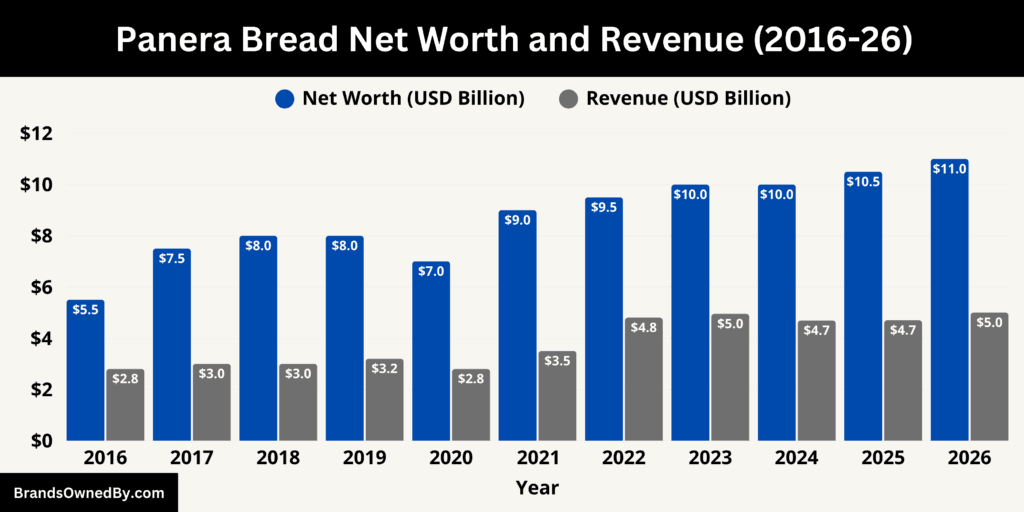
Panera Bread generates billions of dollars annually through its bakery-café restaurant network, franchise royalties, catering services, and digital ordering ecosystem. As of March 2026, the company produces around $6 billion in annual systemwide sales across more than 2,200 restaurants in North America.
The brand reached its highest recorded sales level in 2023 with roughly $6.5 billion, before experiencing a slight decline in 2024 due to industry competition and slower transaction growth.
Because Panera Bread operates as a privately owned company under JAB Holding Company, detailed profit and balance sheet figures are not publicly released. However, based on the company’s sales scale, market position, and the $7.5 billion acquisition price paid in 2017, analysts estimate the brand’s enterprise value now exceeds $11 billion within the broader Panera Brands platform.
Panera Bread Revenue in 2026
As of 2026, Panera Bread continues to generate approximately $6.0–$6.1 billion in annual systemwide sales, placing it among the largest fast-casual restaurant chains in the United States.
The company operates a network of about 2,200 bakery-café restaurants, including both company-owned locations and franchised stores. Each restaurant generates an average of $2.6–$2.8 million in annual sales, reflecting strong demand for Panera’s soups, salads, sandwiches, and bakery items.
Revenue is generated through several key operational channels.
Restaurant sales account for the majority of total income. These include dine-in purchases, take-away orders, drive-through service, and rapid pick-up orders. Restaurants remain the core revenue driver for the company.
Digital and off-premise sales represent a major share of Panera’s revenue. Digital channels such as the mobile app, website ordering, kiosks, and delivery platforms account for more than 50% of total sales, highlighting the company’s strong digital adoption.
Catering and large-order services also contribute to revenue, particularly through corporate meetings and office catering programs.
In addition, franchise royalties and licensing fees provide a consistent revenue stream because franchise operators pay ongoing fees to use the Panera brand and operating system.
Revenue Structure and Key Performance Metrics
Panera Bread’s revenue structure reflects the evolution of the fast-casual restaurant industry toward digital and off-premise consumption.
More than 50% of total systemwide sales now come from digital ordering channels, including mobile apps, online ordering, and kiosks.
Earlier in the company’s digital transformation, digital sales accounted for around 24% of total transactions, demonstrating how rapidly technology has reshaped the business.
Off-premise dining also plays a significant role in Panera’s revenue model. Approximately 80% of sales occur outside traditional dine-in service, including delivery, rapid pick-up, drive-through, and catering orders.
These operational changes have allowed Panera to handle millions of weekly transactions through digital channels and maintain strong customer engagement.
Net Worth and Brand Valuation
Panera Bread’s estimated net worth is determined by its revenue scale, restaurant network, and brand value within the fast-casual dining market.
The company was acquired by JAB Holding Company in 2017 for about $7.5 billion, establishing a baseline valuation for the brand. Since then, Panera Bread has expanded its restaurant network, strengthened its digital ecosystem, and integrated into the Panera Brands restaurant platform.
Based on current revenue levels of roughly $6 billion annually, industry analysts estimate Panera Bread’s enterprise value now exceeds $11 billion.
Several factors contribute to this valuation:
The company operates more than 2,200 bakery-café locations, making it one of the largest fast-casual restaurant chains in North America.
Panera Bread ranks among the top 15 restaurant chains in the United States by systemwide sales, demonstrating its strong market position.
The brand also benefits from a large digital ecosystem, with millions of transactions processed through mobile apps, kiosks, and online platforms each week.
These factors collectively contribute to the company’s multibillion-dollar valuation within JAB Holding Company’s global consumer brand portfolio.
Revenue Trends and Market Performance
Panera Bread’s revenue growth over the past decade reflects both strong expansion and recent industry challenges.
The company steadily increased its systemwide sales during the late 2010s and early 2020s, driven by menu innovation and digital ordering adoption.
Sales peaked in 2023 at around $6.5 billion, before declining slightly to about $6.1 billion in 2024, representing a drop of roughly 5% year-over-year.
Despite this temporary slowdown, the company remains one of the largest fast-casual restaurant brands in the United States and continues to invest in restaurant modernization and menu upgrades.
Future Revenue Forecast (2026–2030)
Panera Bread is currently implementing a long-term transformation plan designed to restore growth and increase systemwide sales over the next several years. The company’s strategic goal is to significantly expand revenue through operational improvements, restaurant modernization, and menu innovation.
Expected revenue projections based on industry estimates include:
- 2027: Sales projected to reach about $6.5 billion, driven by improved same-store sales and expanded menu offerings under the Panera RISE strategy.
- 2028: Company targets more than $7 billion in systemwide sales, representing roughly 15–17% growth from current revenue levels.
- 2029: Revenue could reach $7.4–$7.6 billion if restaurant expansion and digital adoption continue at current growth rates.
- 2030: Analysts estimate sales could exceed $8 billion annually, supported by new restaurant openings, improved digital ordering infrastructure, and expansion of catering and off-premise services.
If these projections are achieved, Panera Bread would strengthen its position as one of the largest fast-casual restaurant brands in North America while significantly increasing its long-term enterprise valuation.
Brands Owned by Panera Bread
As of 2026, Panera Bread operates multiple brands and internal business units that extend the company beyond its traditional bakery-café restaurants. These entities help the company generate additional revenue streams, expand its customer reach, and strengthen its position in the fast-casual restaurant industry.
| Company / Brand / Entity | Type | Year Introduced | Description | Role in Panera Bread Business |
|---|---|---|---|---|
| Panera Bread Bakery-Café Restaurants | Core restaurant brand | 1997 (brand renamed from Saint Louis Bread Company) | Network of fast-casual bakery-café restaurants serving bread, sandwiches, soups, salads, pastries, coffee, and breakfast items. Most locations bake bread daily using dough supplied by regional facilities. | Main revenue driver and core business operation with more than 2,200 restaurants across North America. |
| Panera Bread At Home | Retail packaged food brand | 2013 | Consumer packaged goods line that sells Panera products in grocery stores. Products include soups, macaroni and cheese, salad dressings, bread, and coffee. | Expands the Panera brand into the grocery retail market and generates additional revenue outside restaurants. |
| Panera Catering | Catering service division | Early 2000s | Large-order food service designed for offices, meetings, and events. Offers sandwich trays, salad bowls, breakfast platters, boxed lunches, and bakery packages. | Generates high-value group orders and corporate food sales, increasing average transaction sizes. |
| Panera Bread Digital Platform | Technology and ordering ecosystem | 2010s | Digital infrastructure including mobile apps, website ordering, self-service kiosks, loyalty accounts, and payment systems used across Panera restaurants. | Enables online ordering, customer data collection, digital payments, and operational efficiency across the restaurant network. |
| MyPanera Loyalty Program | Customer loyalty platform | 2010 | Rewards program offering personalized promotions, discounts, and purchase-based rewards to customers. | Encourages repeat visits and collects customer behavior data for targeted marketing. |
| Panera Unlimited Sip Club | Beverage subscription program | 2020 | Monthly subscription service allowing members to receive unlimited coffee, tea, iced coffee, and fountain beverages. | Increases customer visit frequency and strengthens long-term customer loyalty. |
| Panera Rapid Pick-Up | Order fulfillment system | Mid-2010s | Dedicated pickup shelves and ordering system allowing customers to order through the app or website and pick up food without waiting in line. | Improves operational efficiency and supports high volumes of digital and off-premise orders. |
| Panera Delivery | Food delivery service | 2015 | Delivery service allowing customers to order food through Panera’s digital platforms for home or office delivery. | Expands off-premise dining and competes with other restaurant delivery services. |
| Panera Fresh Dough Facilities | Production and supply chain units | 1990s | Regional production centers that prepare fresh dough for bread and bakery products used in Panera restaurants. | Ensures consistent quality and supplies fresh dough daily to bakery-café locations. |
| Panera To Go | Off-premise ordering concept | 2010s | Operational model focused on takeout and rapid pickup orders with dedicated counters and packaging areas. | Supports growing demand for takeout, digital ordering, and convenience-focused dining. |
Panera Bread Bakery-Café Restaurants
Panera Bread Bakery-Cafés are the company’s core business. These restaurants form the largest portion of the company’s operations and revenue.
The bakery-café concept combines freshly baked bread with café-style dining. Restaurants serve soups, sandwiches, salads, breakfast items, pastries, coffee, and beverages. Most locations bake bread and pastries daily using dough prepared in regional fresh dough facilities.
As of 2026, Panera Bread operates more than 2,200 bakery-café locations across the United States and Canada. These restaurants operate under a mix of company-owned stores and franchise locations.
The bakery-café format helped pioneer the fast-casual restaurant segment. It offers higher-quality food than traditional fast food while maintaining quick service and affordable pricing.
Panera Bread At Home
Panera Bread At Home is the company’s consumer packaged food brand. It allows customers to purchase Panera-branded products in grocery stores and supermarkets.
This retail division includes packaged versions of popular Panera menu items such as soups, macaroni and cheese, salad dressings, coffee, and refrigerated meals. These products are distributed through major grocery chains across the United States.
Panera Bread At Home expands the brand beyond restaurants and allows customers to enjoy Panera products at home. The retail division has grown steadily and has become one of the largest restaurant-based packaged food brands in the grocery industry.
The products are typically manufactured through licensed food production partners while Panera maintains control over branding, recipes, and product standards.
Panera Catering
Panera Catering is the company’s dedicated large-order and corporate catering business. This division focuses on providing meal solutions for offices, events, meetings, and group gatherings.
The catering service offers sandwich platters, salad bowls, breakfast packages, bakery trays, boxed lunches, and beverage bundles. Many businesses use Panera Catering for corporate meetings and employee lunches.
The catering business represents an important revenue stream because it allows Panera to serve large group orders that generate higher average transaction values than regular restaurant orders.
Panera Catering also integrates with the company’s digital ordering system. Customers can place large catering orders through the Panera website or mobile app.
Panera Bread Digital Platform
Panera Bread operates a large digital ordering ecosystem that supports millions of transactions each week. This platform includes the company’s website ordering system, mobile applications, and in-store kiosks.
Digital ordering allows customers to place orders ahead of time and pick them up through rapid pick-up shelves, drive-through lanes, or delivery services. The digital system helps reduce waiting times and improves restaurant efficiency.
Panera was one of the earliest restaurant companies to invest heavily in digital ordering infrastructure. As of 2026, digital orders account for more than half of the company’s total transactions, making this platform a critical part of its operations.
The digital platform also powers the company’s loyalty program, customer accounts, and payment systems.
MyPanera Loyalty Program
MyPanera is the company’s customer loyalty and rewards program. It is one of the largest restaurant loyalty programs in the United States.
Customers earn rewards based on their purchases and receive personalized offers, discounts, and menu promotions. The program also collects customer data that helps Panera improve marketing campaigns and personalize menu recommendations.
Millions of customers are enrolled in the MyPanera program. The loyalty system plays a major role in driving repeat purchases and long-term customer engagement.
The program is fully integrated with the company’s mobile app and digital ordering system.
Panera Unlimited Sip Club
Panera Unlimited Sip Club is the company’s beverage subscription program. It allows customers to pay a monthly fee and receive unlimited drinks such as coffee, tea, iced coffee, and fountain beverages.
The subscription program was introduced to increase customer visits and strengthen brand loyalty. Members often visit restaurants more frequently, which increases overall food sales alongside beverage purchases.
The program has attracted millions of subscribers since its launch. It represents one of the most successful subscription programs in the restaurant industry.
Panera Rapid Pick-Up
Panera Rapid Pick-Up is a specialized ordering and fulfillment system designed to speed up customer service. It allows customers to place orders through the mobile app or website and pick them up from designated shelves inside the restaurant.
This system eliminates waiting in line and improves operational efficiency for restaurants. Rapid Pick-Up became especially popular as off-premise dining increased.
Many Panera locations now feature dedicated pickup shelves and separate ordering areas for rapid pickup customers.
Panera Delivery
Panera Delivery is the company’s in-house delivery system integrated with its digital ordering platform. Customers can order food directly from Panera’s website or mobile app and have it delivered to their homes or offices.
The company initially experimented with its own delivery drivers before expanding partnerships with third-party delivery platforms. Delivery services now represent a significant portion of off-premise sales.
Panera Delivery helps the company compete with other restaurant chains that rely heavily on online food delivery platforms.
Panera Fresh Dough Facilities
Panera Fresh Dough Facilities are regional production centers that prepare dough for the company’s bakery products. These facilities supply fresh dough to restaurants across their geographic regions.
The facilities produce dough for the company’s signature breads, bagels, and pastries. Dough is delivered daily to Panera restaurants, where it is baked on site.
This centralized production model ensures consistent quality and flavor across thousands of bakery-café locations.
The fresh dough facilities play a crucial role in maintaining Panera’s reputation for freshly baked bread.
Panera To Go
Panera To Go refers to the company’s off-premise ordering concept focused on takeout and rapid pickup orders. This model emphasizes convenience for customers who prefer to take their meals home or back to work.
Many Panera restaurants now include separate pickup counters, drive-through lanes, and dedicated packaging areas to support high volumes of takeout orders.
This business segment has grown significantly as consumer behavior shifted toward convenience and digital ordering.
Together, these brands, platforms, and business divisions form the operational ecosystem of Panera Bread. While the company primarily operates as a restaurant chain, these entities help extend the brand into retail products, catering services, digital technology, and subscription programs, strengthening its position in the modern fast-casual restaurant market.
Final Words
Panera Bread is owned by Panera Brands, which is controlled by the global investment firm JAB Holding Company. The company became privately owned after a major acquisition in 2017. Since then, Panera Bread has operated as the flagship restaurant brand within a broader portfolio of coffee and bakery chains.
The brand continues to grow through digital innovation, menu development, and expansion across North America. With billions in annual sales and strong consumer recognition, Panera Bread remains one of the most influential fast-casual restaurant chains in the industry.
FAQs
Who founded Panera?
Panera Bread’s origins trace back to Au Bon Pain, which was founded in 1981 by Ron Shaich and Louis Kane. The modern Panera brand emerged after Au Bon Pain acquired Saint Louis Bread Company in 1993. Ron Shaich later transformed this regional bakery chain into Panera Bread and led its nationwide expansion.
Who owns the Panera Bread company?
Panera Bread is owned by Panera Brands, a restaurant platform controlled by JAB Holding Company, a Luxembourg-based private investment firm. JAB acquired Panera Bread in 2017 and remains the company’s ultimate owner through its investment funds.
Who bought Panera?
JAB Holding Company purchased Panera Bread in April 2017 for approximately $7.5 billion. The acquisition took the company private and integrated it into JAB’s portfolio of global food and beverage brands.
Who started Panera Bread?
Panera Bread was developed from Saint Louis Bread Company, which was founded in 1987 by Ken and Linda Rosenthal in St. Louis, Missouri. After acquiring the company in 1993, Ron Shaich expanded the concept and eventually rebranded the chain as Panera Bread.
Who makes Panera Bread?
Panera Bread’s food and bakery products are prepared in its bakery-café restaurants using dough supplied by the company’s regional fresh dough facilities. These production centers make the dough that is delivered to restaurants, where bread and pastries are baked daily.
Does Panera own Krispy Kreme?
No, Panera Bread does not own Krispy Kreme. Both companies are owned by JAB Holding Company, but they operate as separate businesses within the firm’s food and beverage investment portfolio.
Who is the CEO of Panera?
As of 2026, the CEO of Panera Bread and Panera Brands is Paul Carbone. He assumed the role after previously serving as the company’s Chief Financial Officer and now oversees strategy, operations, and growth across the Panera restaurant network.