
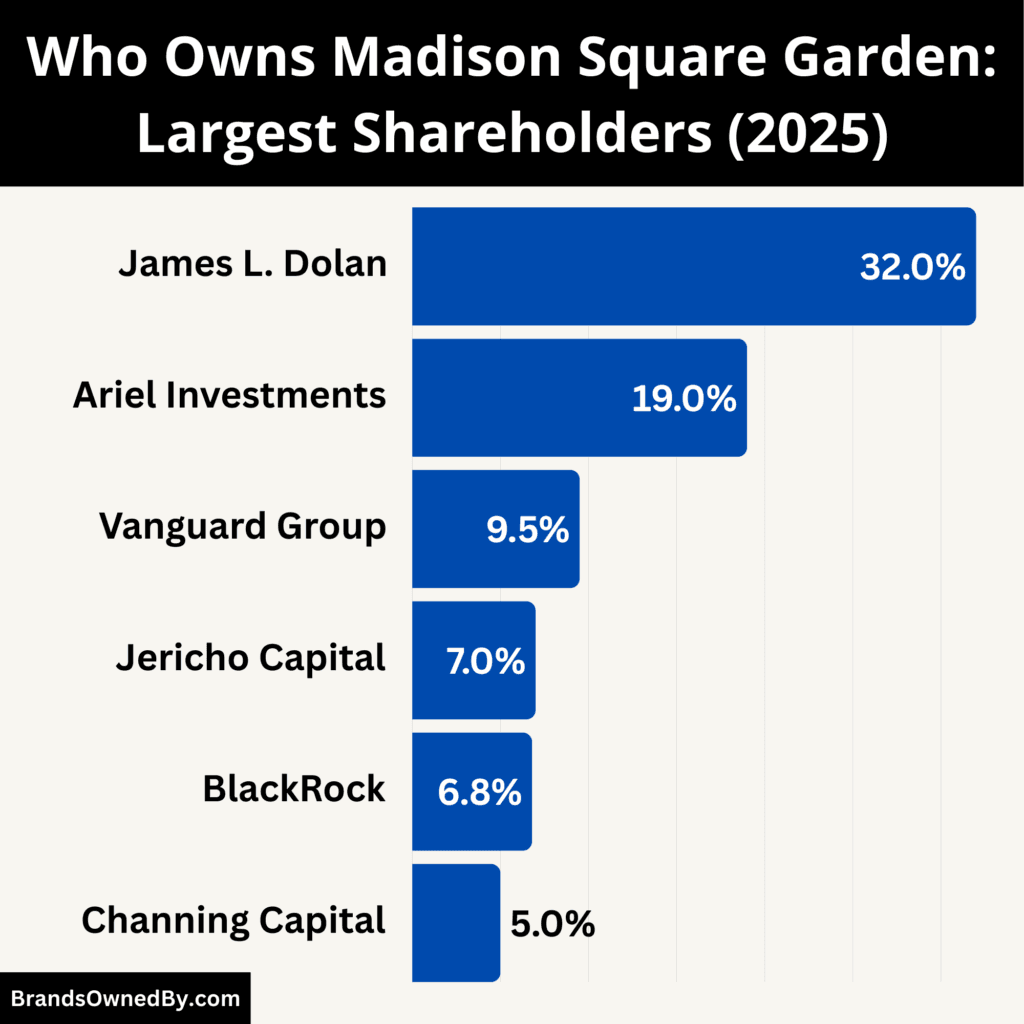
- Madison Square Garden Arena is majority-controlled by the Dolan family, with James L. Dolan holding approximately 33% of the shares and family trusts collectively controlling over 60% of the voting power.
- Institutional investors, including Ariel Investments (19%), Vanguard (9.5%), BlackRock (6.8%), Jericho Capital (7%), and Channing Capital (5%), hold significant economic stakes but do not control strategic or operational decisions.
- The ownership structure allows James Dolan and the Dolan family trusts to retain decisive governance authority, including board appointments, executive oversight, and long-term strategic direction, despite the arena being publicly traded.
- Smaller insiders and public shareholders participate mainly through economic investment and governance votes, collectively holding the remaining ~10–12%, with limited influence over day-to-day operations or major corporate decisions.
Madison Square Garden refers both to the physical arena in New York City and the corporate entity that operates it and other entertainment venues. Known as “The World’s Most Famous Arena,” it hosts concerts, live entertainment, special events, and professional sports. The current venue opened in 1968 and has become a cultural landmark. The company that owns and manages the arena’s business and related assets is Madison Square Garden Entertainment Corp. This overview avoids financial figures and focuses on history, identity, and evolution.
Madison Square Garden Entertainment Corp. (often called MSG Entertainment) is a publicly traded live entertainment and venue management company headquartered in New York City. It owns and operates several iconic venues, including the Madison Square Garden arena itself, Radio City Music Hall, Beacon Theatre, The Theater at Madison Square Garden, and The Chicago Theatre. The company produces live events and experiences ranging from concerts and family shows to sports and theatrical productions.
MSG Entertainment’s mission centers on creating and hosting live experiences that draw global audiences. Its brand portfolio includes the Christmas Spectacular Starring the Radio City Rockettes, a long-standing holiday production, and various entertainment festivals and partnerships.
Founders
The Madison Square Garden name originated in 1879, when the first venue was developed by William Kissam Vanderbilt. He converted the former New York and Harlem Railroad depot at Madison Avenue and 26th Street into an entertainment venue. Vanderbilt’s involvement established the Garden as a central location for public spectacles, exhibitions, and sports.
In the early 20th century, the Garden’s growth was shaped by influential sports promoters. The most notable was Tex Rickard, who played a major role in developing the third Madison Square Garden in 1925. Rickard transformed the venue into a global boxing and entertainment powerhouse, helping define the Garden’s reputation for hosting headline events.
The modern corporate lineage of Madison Square Garden is tied to Cablevision Systems Corporation, led by Charles Dolan, a pioneering media entrepreneur. Under Cablevision, Madison Square Garden became part of a broader media and sports empire that included cable television, regional sports networks, and professional sports teams.
James L. Dolan, son of Charles Dolan, became the central figure in MSG’s modern history. He oversaw major restructurings, spin-offs, and governance changes. While not the original founder of the venue, James Dolan is effectively the founder of the current Madison Square Garden Entertainment Corp. structure, established after multiple corporate separations. He continues to control and lead the business as Executive Chairman and CEO.
Major Milestones
- 1874: The site near Madison Square is first used as an open-air venue for public events, laying the groundwork for what would become Madison Square Garden.
- 1879: The first Madison Square Garden officially opens at Madison Avenue and 26th Street after William Kissam Vanderbilt converts a former railroad depot into an entertainment space.
- 1880: The venue gains early prominence by hosting boxing matches, cycling races, and large public exhibitions.
- 1890: The original structure is demolished to make way for a larger and more architecturally ambitious arena.
- 1891: The second Madison Square Garden opens, designed by architect Stanford White, featuring a 32-story tower that becomes a New York landmark.
- 1906: Stanford White is shot inside Madison Square Garden, an event that becomes a significant moment in American cultural history.
- 1925: The third Madison Square Garden opens at Eighth Avenue and 50th Street under sports promoter Tex Rickard, shifting the venue’s identity toward major professional sports and boxing.
- 1927: Madison Square Garden hosts some of the most high-profile boxing matches of the era, establishing itself as a global boxing center.
- 1934: The first National Hockey League game is played at Madison Square Garden, strengthening its role in professional sports.
- 1940: Madison Square Garden becomes the regular home for major sports franchises, reinforcing its dual role as a sports and entertainment venue.
- 1950: The arena hosts the NBA Finals for the first time, further expanding its sports legacy.
- 1964: Plans are finalized to relocate Madison Square Garden to a new location above Pennsylvania Station.
- 1968: The current Madison Square Garden opens above Penn Station, introducing a modern circular arena design.
- 1972: Madison Square Garden hosts landmark concerts by global music artists, accelerating its reputation as a premier live music venue.
- 1982: Cablevision Systems Corporation, led by Charles Dolan, acquires a controlling interest in Madison Square Garden.
- 1991: A major interior renovation upgrades seating, luxury suites, and broadcast infrastructure.
- 1994: Madison Square Garden hosts both the Stanley Cup Finals and the NBA Finals in the same year, a rare milestone.
- 1997: Additional technological upgrades are implemented to support large-scale televised events.
- 2011: A multi-year transformation project begins to modernize the arena while keeping it fully operational.
- 2013: The Madison Square Garden Company separates its cable television business, narrowing focus on sports and entertainment assets.
- 2016: The final phase of the arena’s transformation is completed, enhancing concourses, premium seating, and digital systems.
- 2020: The business splits into Madison Square Garden Sports Corp. and Madison Square Garden Entertainment Corp., separating teams from venues.
- 2021: Madison Square Garden completes another round of fan-experience upgrades following the return of live events.
- 2023: Madison Square Garden Entertainment Corp. is finalized in its current corporate structure after internal reorganization.
- 2024: The company expands its live entertainment strategy while maintaining Madison Square Garden as its flagship venue.
- 2025: Madison Square Garden continues operations as one of the world’s most iconic arenas, focused on concerts, special events, and cultural programming under centralized Dolan family control.
Who Owns Madison Square Garden in 2025?
Madison Square Garden is not owned by a city authority, a sports team, or a private individual outright. The arena is owned and operated by Madison Square Garden Entertainment Corp., a publicly traded live entertainment company.
Although MSG Entertainment is listed on the stock market, control of Madison Square Garden is not evenly distributed among shareholders. The ownership structure is designed to separate economic ownership from decision-making power.
The Dolan family, led by James L. Dolan, exercises effective control over Madison Square Garden. This control is achieved through concentrated insider ownership and governance rights rather than simple share majority. As a result, strategic decisions related to the arena, including renovations, event strategy, partnerships, and long-term vision, are centralized.
Public shareholders, including large institutional investors, own significant economic stakes. However, they do not control the arena’s direction. Their influence is limited to shareholder voting on governance matters rather than operational authority.
In practical terms, Madison Square Garden operates under a controlled public company model, where one family retains long-term authority while the business remains publicly traded.
Parent Company: Madison Square Garden Entertainment Corp.
The parent company of Madison Square Garden is Madison Square Garden Entertainment Corp., often referred to as MSG Entertainment.
MSG Entertainment was created through a series of corporate restructurings aimed at separating different business lines under the broader Madison Square Garden brand. The most important restructuring occurred in 2020, when the original Madison Square Garden Company split into two independent public companies. Sports franchises were placed under Madison Square Garden Sports Corp., while venues and live entertainment assets were placed under MSG Entertainment.
MSG Entertainment focuses exclusively on live entertainment, venue operations, and original productions. Madison Square Garden is its flagship property and most valuable asset. The company also owns and operates other iconic venues, including Radio City Music Hall, Beacon Theatre, The Theater at Madison Square Garden, and The Chicago Theatre.
The parent company’s leadership structure is highly centralized. James L. Dolan serves as Executive Chairman and Chief Executive Officer, giving him authority over corporate strategy, capital allocation, and major operational decisions. A professional management team handles daily operations, but final authority rests with Dolan and the board he effectively controls.
MSG Entertainment’s business model prioritizes premium live experiences, long-term venue ownership, and brand-driven events. The company does not operate sports teams, which clearly distinguishes it from its sister company, Madison Square Garden Sports Corp.
Below is a list of major shareholders of Madison Square Garden Entertainment as of December 2025:
James L. Dolan
James L. Dolan is the most influential shareholder in Madison Square Garden Entertainment. As Executive Chairman and CEO, he combines executive authority with ownership power. As of December 2025, Dolan beneficially owns just over 30% of the company’s outstanding shares when his direct holdings and indirect interests are combined. While this does not represent an absolute majority of economic ownership, it is enough to make him the single largest individual shareholder.
More importantly, his stake provides effective control over corporate governance. Dolan influences board composition, executive appointments, and long-term strategic decisions. His role is not symbolic. He is directly involved in shaping the company’s direction, particularly around venue strategy, live entertainment investments, and capital allocation.
Dolan Family Trusts
In addition to James Dolan’s personal holdings, multiple Dolan family trusts collectively own a significant portion of Madison Square Garden Entertainment. These trusts are associated with immediate family members and are structured to act in alignment with the broader family interest.
As of December 2025, the combined ownership of these trusts represents well over half of the company’s outstanding shares when aggregated with James Dolan’s stake. This consolidated family ownership ensures that the Dolan family retains decisive voting power even when institutional shareholders act together. The trusts are long-term holders and are designed to preserve control across generations rather than to trade shares for short-term gains.
Ariel Investments, LLC
Ariel Investments is the largest outside institutional shareholder in Madison Square Garden Entertainment. By late 2025, Ariel owns close to one-fifth of the company’s outstanding Class A shares, making it the most financially exposed public investor.
Despite the size of its stake, Ariel does not control company operations. Its influence is exercised through shareholder engagement, proxy voting, and governance oversight. Ariel’s investment reflects confidence in MSG Entertainment’s assets and brand value, but strategic authority remains firmly with the Dolan family.
The Vanguard Group, Inc.
Vanguard is one of the largest passive institutional holders of MSG Entertainment stock. As of December 2025, Vanguard owns just under 10% of the company’s outstanding shares through index funds and long-term investment vehicles.
Vanguard’s ownership represents broad market exposure rather than active control. Its voting power is meaningful in governance matters, but it does not influence daily operations or long-term strategy. Like most passive investors, Vanguard’s role is centered on shareholder rights, transparency, and governance standards.
BlackRock, Inc.
BlackRock holds a substantial institutional position in Madison Square Garden Entertainment. By the end of 2025, its ownership stands at just under 7% of outstanding shares, spread across multiple funds and investment products.
BlackRock’s stake gives it visibility and voting participation, but not control. Its role aligns with its broader institutional strategy of holding diversified positions in major public companies while advocating for long-term shareholder value and governance discipline.
Jericho Capital Asset Management
Jericho Capital is a notable hedge fund shareholder in MSG Entertainment. As of December 2025, it owns a stake slightly above 7% of the company’s outstanding shares.
Jericho’s position reflects an active investment thesis around MSG Entertainment’s asset value and strategic positioning. While it does not exert direct operational influence, its ownership allows it to participate in shareholder votes and engage management on strategic and capital-allocation issues.
Channing Capital Management
Channing Capital Management is another meaningful institutional investor. Its ownership, approaching 5% by late 2025, places it among the larger non-family shareholders.
Channing’s investment strategy emphasizes long-term value and stable business models. Its role in MSG Entertainment is primarily economic, with governance participation through standard shareholder mechanisms rather than direct control.
Other Institutional Shareholders
Beyond the largest named investors, Madison Square Garden Entertainment has a broad base of additional institutional shareholders. These include asset managers, pension funds, and hedge funds that each own smaller percentages of the company’s stock.
Individually, these investors do not hold enough shares to influence outcomes. Collectively, they contribute to market liquidity and governance participation. However, even when combined, their influence does not outweigh the concentrated ownership held by the Dolan family.
Aside from James Dolan, other executives and senior leaders at MSG Entertainment own relatively small amounts of company stock. These holdings are designed to align management incentives with shareholder interests rather than to provide governance control.
Their ownership does not materially affect voting outcomes but signals internal confidence in the company’s long-term strategy and performance.
Who is the CEO of Madison Square Garden?
James L. Dolan serves as the Executive Chairman and Chief Executive Officer of Madison Square Garden Entertainment Corp. (MSG Entertainment). He holds ultimate responsibility for the company’s vision, strategy, and overall operations. His leadership extends across the entire portfolio of live entertainment venues that MSG Entertainment owns and manages, including the iconic Madison Square Garden arena, Radio City Music Hall, Beacon Theatre, The Theater at Madison Square Garden, and The Chicago Theatre.
In his role, Dolan sets long‑term strategic priorities, oversees major capital and operational decisions, and guides the company’s response to changes in the live entertainment market.
Dolan’s influence stems both from his executive position and his ownership stake. Although the company is publicly traded, his role as CEO is closely aligned with his position as one of the most significant shareholders and the dominant voice in corporate governance. This arrangement gives him a rare combination of executive authority and strategic control in a public company setting.
Leadership Role and Decision‑Making Structure
As CEO, Dolan operates within a combined leadership structure, serving simultaneously as Executive Chairman and CEO. This differs from a traditional model in which the roles are separate. In practice, this means he guides both the company’s board of directors and its executive leadership team. Independent directors are tasked with oversight in committee settings, but Dolan retains primary strategic influence and final authority on key decisions, reflecting the company’s status as a controlled public entity.
In addition to MSG Entertainment, Dolan holds similar executive leadership at related Dolan‑family controlled enterprises, including Madison Square Garden Sports Corp. and Sphere Entertainment Co., broadening his impact across the family’s entertainment and media enterprises.
Compensation and Salary
Dolan’s compensation as CEO of MSG Entertainment reflects both base salary and performance incentives tied to company results:
- His base salary for fiscal 2025 is set at $1.5 million per year under his employment agreement. This base pay is the guaranteed component of his compensation package.
- In addition to base salary, Dolan is eligible for an annual target bonus equal to 200% of his base salary, contingent on performance measures determined by the board.
- He also participates in long‑term incentive plans, including performance stock units (PSUs) and restricted stock units (RSUs) with multi‑year vesting criteria tied to company performance and stock price movement. These long‑term awards significantly increase his total compensation in years when performance targets are met or exceeded.
- For fiscal 2025, Dolan’s total reported compensation exceeded $14 million, a figure that includes base salary, annual bonus payout, and equity awards. This level of pay places him above the typical compensation for CEOs of similarly sized entertainment and venue companies.
Overall, his compensation is structured to reward results, aligning his incentives with both short‑term operational performance and long‑term shareholder value creation.
Past Leadership and Tenure
James L. Dolan has held executive leadership positions across various Madison Square Garden‑related companies for many years. Before MSG Entertainment’s current corporate structure, he was chief executive of the legacy Madison Square Garden Company and earlier served as CEO of Cablevision Systems Corporation, the Dolan family’s original media enterprise.
His career spans decades in entertainment, media, and venue management, providing continuity and strategic experience.
Under his leadership, MSG Entertainment has navigated multiple restructurings, venue renovations, and expansions of its live entertainment portfolio. This track record has positioned him as a central figure in both the company’s operational leadership and its public identity.
Net Worth
Estimating the net worth of a CEO with extensive holdings in multiple family‑controlled companies is complex. Public estimates for James L. Dolan’s personal net worth in 2025 vary, with some assessments placing his wealth at around $2 billion. This wealth reflects his inherited family assets, stakes in Madison Square Garden Entertainment and related entities, and other investments built over a long career in media and entertainment.
While exact figures differ by source, it is clear that Dolan’s personal wealth is substantial and derived largely from long‑standing family control and ownership roles across a suite of public and private companies. His holdings across MSG Entertainment, MSG Sports, MSG Networks, Sphere Entertainment, and other related entities contribute materially to his financial profile.
Madison Square Garden Annual Revenue and Net Worth

As of December 2025, Madison Square Garden (the arena) remains one of the world’s most iconic live entertainment venues. Its financial performance reflects ticket sales, premium suites, sponsorships, and event-driven revenues. The arena itself generates annual revenue exceeding $310 million, driven by concerts, sports events, theatrical productions, and special events. Its net worth, derived from both tangible assets and brand value, is estimated at around $1.2 billion, reflecting its historic significance, prime Manhattan location, and status as a flagship entertainment venue.
Revenue of Madison Square Garden
Madison Square Garden’s revenue in 2025 is primarily sourced from live events and venue operations. Ticket sales for concerts, professional sports, family shows, and award ceremonies contribute the majority of the top line. Premium seating, luxury suites, and hospitality packages further enhance revenue, as VIP experiences are in high demand. Sponsorship deals and partnerships with brands for event promotions also provide significant incremental income.
The arena hosts a full calendar of events throughout the year, including NBA and NHL games, major concerts, and other live performances. Special productions, such as high-profile boxing matches or large-scale award shows, add spikes to revenue, particularly in peak months. Operational management focuses on maximizing venue utilization while maintaining premium fan experiences, which helps smooth seasonal revenue fluctuations.
Revenue growth in 2025 has been supported by higher ticket prices for premium events, increased sponsorship agreements, and expanded fan experiences such as digital engagement, hospitality services, and enhanced concessions.
Net Worth of Madison Square Garden
The net worth of Madison Square Garden as a standalone venue includes both its physical assets and its brand value. The building itself, located in Midtown Manhattan above Penn Station, is a high-value real estate asset with strategic importance. In addition, the Madison Square Garden brand adds intangible value, reflecting its cultural and historical significance in sports and entertainment.
As of 2025, the estimated net worth of the arena is approximately $1.2 billion. This valuation considers current revenues, operating profitability, brand strength, and the arena’s ability to attract high-profile events. The venue’s market value is also influenced by long-term lease agreements, sponsorship deals, and the premium pricing of its suites and event tickets.
Strategic Drivers of Revenue and Value
Revenue and net worth are driven by Madison Square Garden’s iconic status, central location, and diverse event calendar. High-profile concerts, sports events, and cultural productions attract global audiences, ensuring strong ticket demand. Investments in premium seating, hospitality suites, and fan experiences enhance profitability while maintaining the arena’s reputation for luxury and exclusivity.
The combination of tangible assets, operational performance, and brand prestige supports both the arena’s revenue and its long-term net worth. Its continued relevance as a cultural and entertainment hub ensures that Madison Square Garden remains a high-value asset in 2025.
Brands Owned by Madison Square Garden
Madison Square Garden arena itself, while part of MSG Entertainment, operates as a flagship venue with associated brands and entities under its direct control. These include subsidiary venues, event-specific brands, and in-house entertainment services that the arena manages directly. Each of these contributes to the arena’s operations, revenue, and brand equity as of 2025.
Madison Square Garden Arena
The Madison Square Garden arena is the primary venue itself, located in Midtown Manhattan. It hosts NBA and NHL games, concerts, family shows, and large-scale cultural events. The arena is known for its premium seating, luxury suites, and VIP hospitality offerings, which generate significant revenue. It operates under its own ticketing and event management divisions, controlling all aspects of event scheduling, venue logistics, and on-site services. The Madison Square Garden brand is iconic, giving it global recognition and high market value.
Radio City Music Hall
Radio City Music Hall, located within the Rockefeller Center complex, is directly operated by Madison Square Garden arena as one of its subsidiary venues. It is famous for the Christmas Spectacular Starring the Rockettes, concerts, live shows, and special performances. The arena manages all aspects of the venue, from ticketing to sponsorship agreements. Its integration with Madison Square Garden arena allows coordinated scheduling and cross-promotional events, enhancing brand value and operational efficiency.
The Theater at Madison Square Garden
The Theater at Madison Square Garden is a smaller, flexible performance space within the arena complex. It hosts intimate concerts, comedy shows, award ceremonies, and corporate events. The arena maintains full operational control, including programming, ticketing, and sponsorship arrangements. This venue allows Madison Square Garden to diversify event offerings and cater to audiences that prefer smaller-scale performances while maintaining the Madison Square Garden brand association.
Beacon Theatre
Beacon Theatre in Manhattan is another venue directly operated by Madison Square Garden arena. Known for concerts, Broadway-style shows, and special events, the Beacon Theatre benefits from the arena’s event management expertise. Madison Square Garden handles all operational aspects, including technical production, ticket sales, marketing, and sponsorships. Its inclusion under the arena’s management broadens the arena’s live event portfolio and reinforces its brand dominance in New York City entertainment.
The Chicago Theatre
The Chicago Theatre, located in downtown Chicago, is a historic venue acquired and directly operated by Madison Square Garden arena. It hosts concerts, theatrical performances, and community events, all managed through the arena’s centralized operations team. Madison Square Garden oversees programming, marketing, ticketing, and technical operations, ensuring the theater aligns with the company’s standards for premium live experiences. Its acquisition expands the arena’s geographic reach beyond New York City.
In-House Event and Production Brands
Madison Square Garden arena operates several in-house production and event brands that manage specific shows, sports events, and seasonal performances. These brands include event-specific management teams responsible for concert promotions, theatrical productions, family shows, and holiday events. Each brand functions under the arena’s direct control, ensuring consistent quality, operational efficiency, and revenue generation.
Premium Suites and Hospitality Services
The arena also directly manages its premium suites, VIP boxes, and hospitality services. These services are branded under Madison Square Garden’s name and include personalized concierge services, catering, and exclusive experiences for high-value clients. These brands enhance the arena’s revenue streams and contribute to its iconic status as a luxury live entertainment destination.
Sponsorship and Partnerships
Madison Square Garden arena directly operates venue-specific sponsorship and partnership brands. These include corporate partnerships for arena naming rights, suite sponsorships, and in-event branding opportunities. By controlling these agreements directly, the arena maximizes revenue, maintains brand integrity, and leverages its historic status for strategic marketing collaborations.
Holiday and Seasonal Productions
The arena owns and operates seasonal entertainment brands, including the Rockettes’ Christmas Spectacular and other holiday-themed productions. These events are produced entirely in-house and are closely associated with the Madison Square Garden brand. Management includes programming, marketing, ticketing, and event execution, all controlled by the arena itself rather than its parent company.
Conclusion
Who owns Madison Square Garden is ultimately a question of control rather than simple share ownership.
Madison Square Garden is owned by Madison Square Garden Entertainment Corp. James L. Dolan controls the company through super-voting shares. Public investors participate financially but not strategically.
This ownership model has kept Madison Square Garden under consistent leadership for decades. It also ensures the venue remains a cornerstone of global live entertainment.
FAQs
Who is the owner of the Madison Square Garden?
Madison Square Garden arena is primarily owned and controlled by the Dolan family, with James L. Dolan as the largest individual shareholder. The family holds majority voting power through a combination of James Dolan’s direct ownership and family trusts, giving them decisive control over operations, governance, and strategic decisions.
How many seats in Madison Square Garden?
Madison Square Garden has a seating capacity of approximately 20,000 for concerts and large-scale events. The capacity varies depending on the type of event, with slightly fewer seats for basketball, hockey, or theater-style configurations due to stage setups and floor arrangements.
What does the Dolan family own?
The Dolan family owns Madison Square Garden arena, the surrounding subsidiary venues (Radio City Music Hall, Beacon Theatre, The Theater at Madison Square Garden, The Chicago Theatre), MSG Sports, MSG Networks, and Sphere Entertainment Co., among other media and live entertainment assets. They also hold controlling stakes in Madison Square Garden Entertainment Corp., giving them broad influence over live events, venue operations, and entertainment brands.
Does James Dolan own Madison Square Garden?
Yes, James Dolan is the largest individual shareholder of Madison Square Garden arena and, together with family trusts, effectively controls the venue. He also serves as Executive Chairman and CEO, overseeing operations and strategic decisions.
Who originally owned Madison Square Garden?
The original Madison Square Garden was owned by Tex Rickard, a famous boxing promoter, when it first opened in 1925. Over the decades, ownership transitioned through several corporate and private entities before eventually coming under the control of the Dolan family through Cablevision and the later formation of MSG Entertainment Corp.
Is Madison Square Garden closing?
No, Madison Square Garden is not closing. It continues to operate as a premier live entertainment venue. The arena regularly hosts concerts, sporting events, and special productions, and has undergone renovations and upgrades to maintain its status as a world-class entertainment destination.