

- DC Comics is owned by Warner Bros. Discovery and does not operate as an independent company. Ownership is indirect and flows through the publicly traded parent corporation.
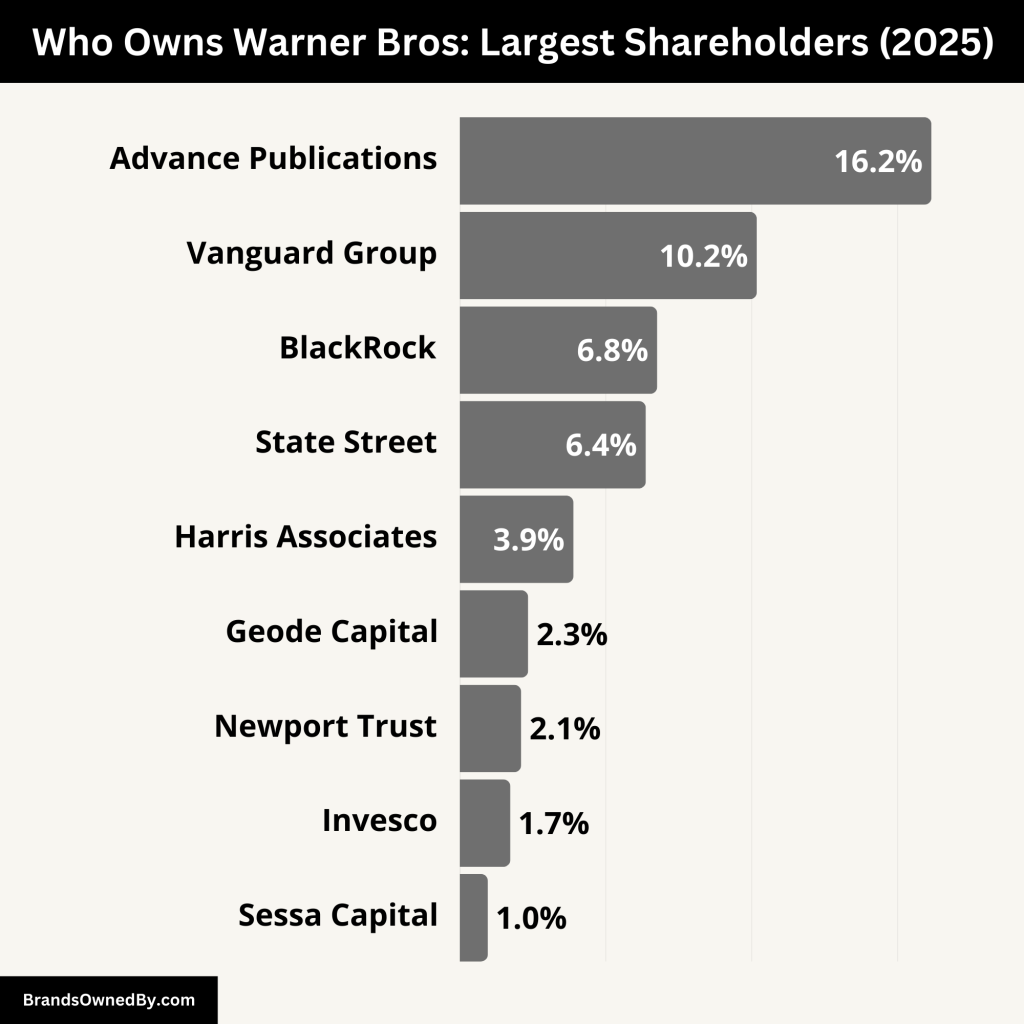
- The largest shareholders of the company’s parent are institutional investors led by Vanguard Group, BlackRock, and State Street, which together control a substantial portion of voting power.
- Creative leadership (publishing and media) runs daily operations, but budgets, restructuring, and long-term strategy are approved by the corporate group under shareholder oversight.
DC Comics is one of the oldest and most influential American comic book publishers. It was born out of a desire to create original comic-book stories rather than simply reprint newspaper strips.
Over decades, DC has shaped the superhero genre and created globally iconic characters such as Superman, Batman, and Wonder Woman. Its imprint spans from comics to films, TV, licensing, and media — making it a cultural powerhouse.
DC Comics began under a different name and through a series of reorganizations. Its earliest corporate identity was under National Allied Publications, founded in 1934.
Over time, it absorbed or merged with other publishing entities. The corporate lineage passed through names like National Comics Publications and National Periodical Publications before finally adopting the name “DC Comics” in 1977. Headquarters today sit in Burbank, California, under the larger parent company Warner Bros. Discovery.
DC Comics publishes a broad range of genres beyond superheroes — fantasy, science fiction, adventure, and more. It runs various imprints and divisions to handle different content styles and target audiences. The company remains active and continues to release new comics, relaunch major lines, and adapt properties into other media formats.
Founders
The origin of DC Comics traces back to writer and entrepreneur Malcolm Wheeler‑Nicholson. In 1934, he founded National Allied Publications to produce original comic-book content. His first major release under that banner was New Fun #1 in February 1935, the first comic book featuring entirely new material rather than reprints of existing comic strips.
Financial pressure forced Wheeler-Nicholson to partner with publisher and distributor Harry Donenfeld and accountant/businessman Jack Liebowitz in 1937. Together, they formed Detective Comics, Inc. to publish a new magazine, Detective Comics.
Soon, the company evolved through mergers and reorganizations, eventually becoming what we now know as DC Comics.
Some historical accounts also cite another name, Max Gaines, among early contributors influential in the company’s formative years.
Major Milestones
- 1934: Malcolm Wheeler-Nicholson establishes National Allied Publications, which becomes the foundation of DC Comics.
- 1935: New Fun #1 is published and becomes the first comic book in history to contain only original content.
- 1936: New Comics #1 launches, later rebranded as Adventure Comics, becoming one of DC’s longest-running series.
- 1937: Detective Comics, Inc. is formed after Wheeler-Nicholson partners with Harry Donenfeld and Jack Liebowitz.
- 1938: Action Comics #1 introduces Superman and creates the superhero genre.
- 1939: Batman debuts in Detective Comics #27, transforming DC into a household publishing name.
- 1940: Robin is introduced, establishing the “sidekick” concept in comics.
- 1941: Wonder Woman debuts in All Star Comics #8, setting a precedent for female superheroes.
- 1944: DC characters appear in major animated theatrical shorts, expanding into motion pictures.
- 1956: The modern Flash is introduced, marking the beginning of the Silver Age of Comics.
- 1960: The Justice League of America forms and redefines superhero team storytelling.
- 1966: DC gains mainstream success through the Batman television series.
- 1969: The company formally reorganizes as National Periodical Publications.
- 1971: Green Lantern and Green Arrow introduce social and political themes in mainstream comics.
- 1977: The company officially adopts the DC Comics name.
- 1985: Crisis on Infinite Earths resets DC continuity across multiple storylines.
- 1989: Batman releases in theaters, launching DC into blockbuster cinema.
- 1993: The Death of Superman becomes one of the best-selling comic events ever.
- 2001: DC Entertainment is formed to centralize film, television, and licensing operations.
- 2006: DC expands its digital publishing initiatives.
- 2011: The New 52 reboots the DC universe with modern continuity.
- 2013: Man of Steel launches a new motion picture era.
- 2016: DC’s cinematic universe expands with ensemble film projects.
- 2020: DC restructures leadership and focuses heavily on streaming services.
- 2022: Warner Bros. merges with Discovery, forming Warner Bros. Discovery as DC’s parent company.
- 2023: DC Studios is launched under James Gunn and Peter Safran.
- 2024: A new long-term story structure is announced for DC film and television properties.
- 2025: DC All In expands its publishing strategy with a stronger integration of legacy and new characters.
Who Owns DC Comics in 2025?
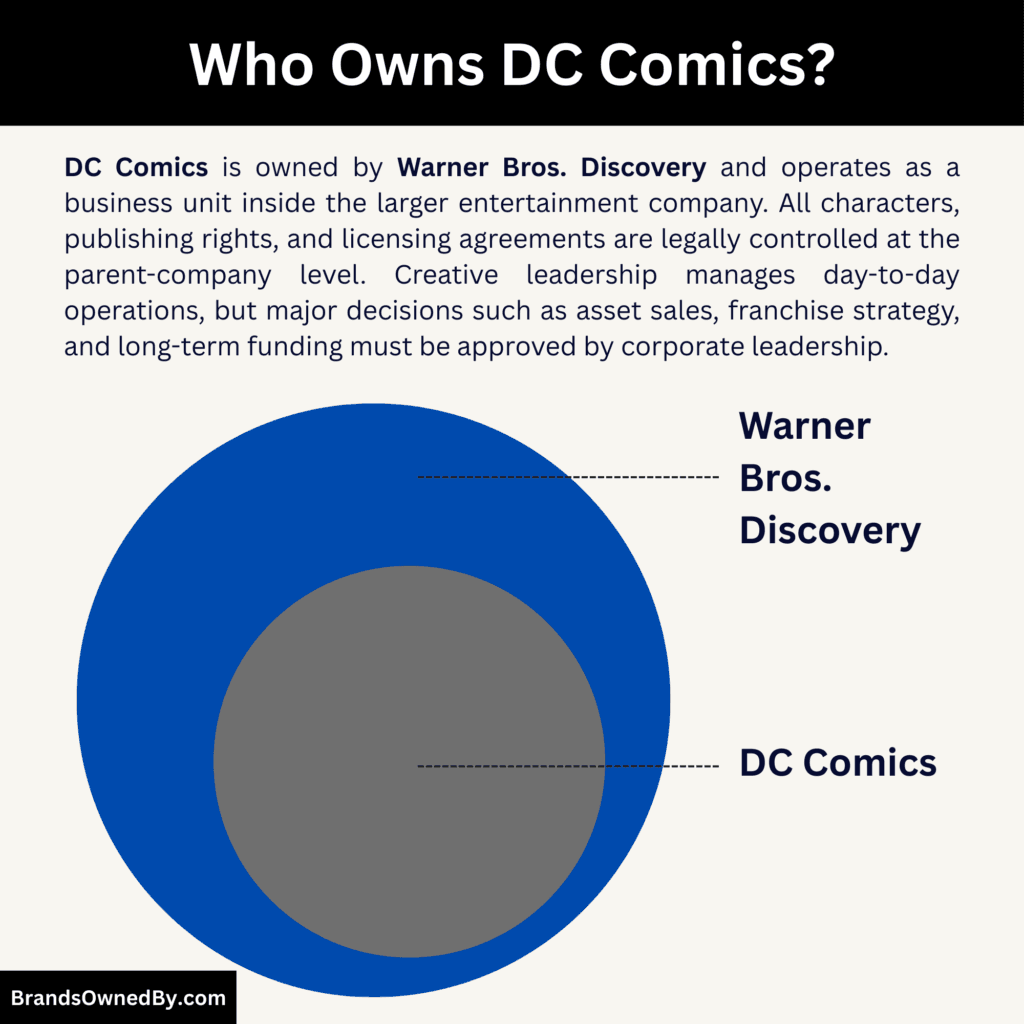
DC Comics is owned by Warner Bros. Discovery, a global media conglomerate that controls film studios, television networks, and streaming platforms. The company does not operate as a separate legal entity. All ownership and authority flow through Warner Bros. Discovery’s corporate structure.
Warner Bros. Discovery is a publicly traded company. That means ownership is divided among institutional investors and individual shareholders. No founder, celebrity, or executive owns the company outright. Control rests with a board of directors elected by shareholders. Strategic decisions are ultimately approved at the parent company level.
Three investment giants dominate ownership: Vanguard Group, BlackRock, and State Street. Together, they hold a large portion of voting power. While they do not manage daily operations, their influence over board elections, executive pay, and corporate policies gives them real control over long-term direction.
The creative and publishing teams run daily business activities. However, funding, leadership changes, and investment decisions must align with the goals of Warner Bros. Discovery and its major shareholders.
Parent Company: Warner Bros. Discovery
Warner Bros. Discovery is the parent company that owns and controls DC Comics. The company was created in April 2022 through the merger of WarnerMedia and Discovery, Inc. This merger brought together one of the largest collections of entertainment brands under a single roof. The result was a global media group spanning film studios, cable networks, streaming services, and digital platforms.
The company’s headquarters is based in New York City, while many of its operational divisions are managed from Burbank, California. Warner Bros. Discovery operates as a publicly traded corporation, which means ownership is distributed among institutional and retail shareholders instead of being held by one individual or family.
What Warner Bros. Discovery Owns
Warner Bros. Discovery controls a broad portfolio of media assets that gives it reach across television, film, and digital streaming. Its business operates through major divisions that function independently but align under one corporate strategy.
The Warner Bros. division manages film and television production. It includes Warner Bros. Pictures, Warner Bros. Television, and Warner Bros. Animation. This division handles major movie franchises, scripted television, and animation production.
HBO and Max fall under a dedicated entertainment segment. HBO produces high-end television series and documentaries. Max serves as the company’s global streaming platform and central distribution channel for content across brands.
The Discovery division controls a large group of documentary and reality networks including Discovery Channel, TLC, Animal Planet, HGTV, Food Network, and Investigation Discovery. These networks dominate factual and lifestyle content across multiple international markets.
CNN is also owned by Warner Bros. Discovery. It remains one of the most recognizable global news networks and operates independently from the entertainment brands.
DC Comics fits into this structure as an intellectual-property powerhouse. Its characters and stories supply content across film, television, games, merchandise, and streaming productions.
Corporate Structure and Leadership
Warner Bros. Discovery is managed by a centralized executive leadership team rather than autonomous subsidiaries. The Chief Executive Officer of the company is David Zaslav. He oversees all divisions and the major corporate strategy. His office approves content investment levels, leadership changes, and restructuring initiatives across the business.
The company is governed by a board of directors that represents shareholder interests. This board has authority over executive appointments, corporate governance policy, and strategic direction. Major business actions such as asset sales, mergers, or structural changes require board approval.
Each major division has its own executives who manage operations. However, budgets and long-term programs are approved at the group level. For DC Comics, creative leadership is handled internally, but financing and expansion depend on corporate approval.
Role in DC’s Business Direction
Warner Bros. Discovery determines how DC properties are used across the company’s platforms. This includes where films are released, how shows are distributed, and which projects receive funding.
When DC Studios was formed, the move came directly from the parent company. The leadership restructuring was initiated to unify storytelling across film and television. Warner Bros. Discovery also controls licensing decisions, merchandise programs, and distribution agreements.
If budgets are reduced or expanded, those decisions originate at the parent level. That means DC’s future is tied not just to creative success but to corporate strategy and shareholder expectations.
Corporate Vision as of 2025
Warner Bros. Discovery’s focus is on intellectual property monetization, franchise expansion, and streaming platform growth. The company prioritizes recognizable franchises with long-term brand value.
DC sits among the company’s most valuable creative assets. Its characters are treated as long-term investments across multiple revenue channels including movies, television, animation, gaming, and merchandise.
The parent company also emphasizes cost control and corporate restructuring. Business units are constantly evaluated based on strategic performance rather than creative output alone.
Who is the CEO of DC Comics?
DC Comics does not have a single executive operating under the title “CEO.” The company functions through a dual leadership structure that separates publishing from film and television operations, while strategic authority remains with the parent corporation. This model reflects DC’s evolution from a comic book publisher into a multi-platform franchise system rather than a traditional standalone business.
Head of DC Comics Publishing: Jim Lee
Jim Lee is the senior executive in charge of DC’s publishing operation. He holds the titles of President, Publisher, and Chief Creative Officer. In practice, he serves as the highest authority over DC’s comic book business.
He controls the editorial strategy of DC’s publishing line. This includes storyline development, talent recruitment, and continuity planning. He also oversees special imprints such as Black Label and legacy publishing initiatives. All major publishing events pass through his office for approval.
Jim Lee is also deeply involved in protecting DC’s brand identity within comics. His role includes safeguarding creative consistency across titles and managing relationships with writers, artists, and licensors. He represents DC in licensing negotiations related to publishing and serves as one of the public faces of the brand worldwide.
Leadership of DC’s Film and Television Division: DC Studios
Movie and television operations are run separately under DC Studios. This entity exists independently from comic publishing and reports directly to the Warner Bros. film business.
DC Studios is headed by:
- James Gunn, Co-Chairman and Co-CEO
- Peter Safran, Co-Chairman and Co-CEO.
James Gunn is responsible for creative decisions. He directs character usage, story structure, and the long-term cinematic roadmap. His role is similar to a chief architect of the DC screen universe.
Peter Safran oversees business operations. He manages production budgets, hiring, timelines, and execution. His responsibilities ensure financial discipline and the delivery of projects at scale.
Together, they control all film and television approvals. They decide which projects move forward and which are cancelled. They also define how screen content connects across movies, series, and animation.
Where Ultimate Authority Resides
Although Jim Lee, James Gunn, and Peter Safran hold operational authority, they do not own DC Comics and are not the ultimate decision-makers on funding or ownership matters. All approvals for major investments, leadership changes, or franchise sales come from Warner Bros. Discovery.
That includes:
- Approval of film budgets
- Executive appointments
- Distribution strategy
- Licensing deals above a certain threshold
- Corporate restructuring.
How DC’s Leadership Model Actually Works
DC Comics functions more like a studio network than a traditional corporation. There is no central CEO controlling everything. Instead, decision-making is split by discipline.
Publishing reports to Jim Lee.
Film and television report to Gunn and Safran.
Corporate strategy flows from the parent company.
This structure allows DC to maintain creative focus within each channel while still operating under centralized financial oversight.
DC Comics Annual Revenue and Net Worth
As of December 2025, DC Comics is widely estimated to generate around $425 million in annual revenue, once you include publishing, licensing tied directly to the comics business, and related activities.
The net worth of DC’s brand, catalog, and character IP is around $9.5 billion as of late 2025.
Annual Revenue
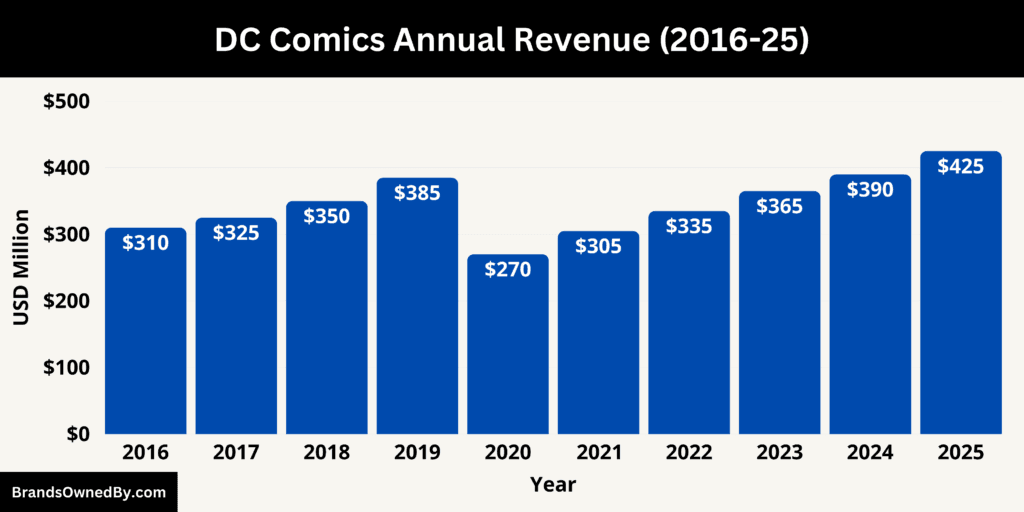
One widely cited dataset estimates DC Comics’ annual revenue at approximately $440.5 million.
This figure is based on headcount, revenue-per-employee ratios, and comparative analysis against similar entertainment and publishing companies.
Another dataset, focusing primarily on core comic-book publishing, reports DC’s annual revenue at about $160 million, which appears to reflect only traditional publishing (single issues, trades, and graphic novels) without fully capturing licensing and ancillary income that flows through the comics division.
A separate strategic analysis summarises these sources by noting that DC’s overall revenue likely sits in the low-hundreds-of-millions range annually, with a higher figure when licensing is included and a lower figure when only publishing is counted.
Putting these strands together, a conservative and defensible working estimate for DC Comics’ total annual revenue as of 2025 is roughly $400 million, with a plausible band of about $300–450 million depending on whether you count certain licensing streams and internal cross-charges. That range acknowledges the uncertainty of third-party models while still giving a clear, concrete number you can use in an overview.
Publishing vs. Licensing Contribution
The gap between the $160 million and $440.5 million estimates is best explained by the difference between “pure publishing” and the broader comics-related business.
Core publishing revenue comes from monthly issues, limited series, collected editions, and graphic novels sold through comic shops, bookstores, and digital platforms. This is likely in the $150–200 million per year range as of 2025, given DC’s share of the North American comics and graphic-novel market and its position as one of the two largest U.S. publishers.
On top of this sits licensing and other comics-tied income: character usage in merchandise, consumer products that are contracted specifically through the comics/character side, and fees for certain uses of logos, artwork, and story material.
Historical disclosures have shown that DC-related merchandise alone has generated several billions of dollars in retail sales in strong years, even if that revenue is booked across multiple divisions.
While not all of that flows through DC’s own books, it underlines that the comics group is attached to a very large commercial ecosystem.
In short, publishing revenue likely accounts for something like one-third to one-half of DC’s effective annual revenue footprint, with the rest tied to licensing and character-based activity that is closely associated with the comics operation.
Net Worth and Brand Value

As of December 2025, the estimated net worth of DC Comics is around $9.5 billion.
Some pop-culture and fan discussions have floated figures around $1.3 billion for DC’s net worth, but these are generally rule-of-thumb calculations rather than formal valuations and tend to understate the true value of the brand and its catalog.
To get a more realistic picture, you have to look at the earning power and commercial reach of DC’s major franchises.
Individual DC properties, such as Batman, have been estimated to generate tens of billions of dollars in cumulative retail and media revenue across box office, home video, merchandise, and other channels.
Historical licensing disclosures have shown DC-related consumer products hitting multi-billion-dollar sales in strong years.
When you consider the full catalog of evergreen characters—Superman, Batman, Wonder Woman, the Justice League, and many others—plus thousands of exploitable storylines and designs, the long-term cash-flow potential of DC’s IP is very high.
Taking these factors together, it is reasonable to treat DC Comics’ economic value as being in the multi-billion-dollar range. A cautious, mid-range working estimate for 2025 would place DC’s brand and IP “net worth” somewhere around $8–10 billion.
That figure is not a formal appraisal and sits between the low, informal numbers sometimes quoted in fan spaces and the much higher values implied by franchise-level revenue estimates. It reflects what a sophisticated buyer might plausibly pay to acquire DC as a distinct asset, given its lifetime earnings power and strategic importance.
Brands Owned by DC Comics
DC Comics is not just a publisher. It operates as a network of specialized business units focused on publishing, digital platforms, licensing, intellectual-property control, and creative development.
Below is a list of the brands owned by DC Comics as of December 2025:
| Company / Brand / Division | Year Established | Primary Function | Core Responsibilities | Strategic Role within DC |
|---|---|---|---|---|
| DC Publishing | 1934 | Core publishing division | Comic books, graphic novels, continuity control, licensing coordination | Engine of all publishing operations |
| DC Black Label | 2018 | Mature-audience publishing imprint | Prestige storytelling, standalone titles, non-canon releases | Brand expansion into adult markets |
| DC Universe Infinite | 2020 | Digital comics platform | Subscription services, digital archives, reader analytics | Global distribution and data engine |
| DC Graphic Novels (Kids & YA) | 2019 | Bookstore and education publishing | School titles, youth readership, library distribution | Market expansion beyond comic shops |
| DC Horror | 2022 | Genre-focused imprint | Supernatural stories, psychological titles | Niche genre control |
| Milestone Media | 1993 (revived 2020) | Co-owned imprint | Publishing, multicultural narratives | Cultural expansion |
| Vertigo (library ownership) | 1993 | Legacy imprint | Adult fiction IP ownership | Evergreen content monetization |
| DC Comics International | N/A | International publishing | Localization, licensing, translation | Global market expansion |
| DC Licensing & Merchandising | N/A | Consumer products division | Merchandising, brand use approvals | Revenue amplification |
| DC Talent Development | N/A | Creative recruitment | Artist mentorship and training | Long-term talent pipeline |
| DC Animation Creative Oversight | N/A | Brand continuity authority | Animation approval, script review | Creative consistency |
| DC Archives & Continuity | N/A | IP governance | Canon management, legal protection | Rights preservation |
| DC Publishing Services | N/A | Operations infrastructure | Print logistics, vendor management | Supply chain reliability |
| WildStorm (IP library) | 1992 (acquired 1999) | IP holding division | Legacy catalog control | Reboot and adaptation resource |
| DC Custom Publishing | N/A | Corporate publishing arm | Educational and branded comics | Brand extension and protection |
DC Publishing
DC Publishing is the operational core of the company and the primary engine behind all printed and digital comic output. This division manages long-form editorial planning over multi-year cycles, aligning individual titles with larger narrative arcs and crossover events. It sets continuity rules, approves character changes, and controls how storylines evolve across series. The division also runs contract negotiations with creators, manages royalties, schedules releases, and oversees editorial standards to ensure visual and narrative consistency.
It is also the business interface with retailers and distributors. DC Publishing forecasts print runs, plans variant cover strategies, coordinates reprints, and manages back-catalog monetization. Editorial leadership typically works several years ahead, especially for publishing “event” series and character reboots.
DC Black Label
DC Black Label is designed for prestige storytelling rather than serialized publishing. It operates independently from the main canon and allows creators to reinterpret characters without restriction from long-standing continuity rules. This imprint is where DC explores darker subject matter, political commentary, adult psychology, and alternative universes.
The division operates more like a boutique publisher within DC. Project approvals are selective. Production timelines are longer. Creators often receive premium contracts and greater creative autonomy. The commercial goal is to attract literary-minded readers and drive book-market sales instead of relying on traditional comic stores alone.
DC Universe Infinite
DC Universe Infinite is DC’s digital publishing infrastructure and archival system combined into one platform. It functions as both a subscription service and a reader analytics engine. In addition to providing access to tens of thousands of issues, it enables DC to control formatting, release scheduling, and international availability.
The platform plays a strategic role in testing new characters and story formats before print release. It also provides insight into consumer preferences through reading behavior, completion rates, and subscription activity. This data increasingly influences print decisions, including spin-offs and relaunches.
DC Graphic Novels for Young Adults and Kids
This division focuses on evergreen publishing rather than monthly serialization. Titles are designed for classrooms, libraries, and bookstores rather than comic shops. The books are frequently distributed through educational channels and school programs.
Internally, this division operates under a book-publishing model instead of a comic-shop release cycle. Editorial development is slower and story arcs are self-contained. DC uses this unit to introduce readers to characters through accessible, modern formats that require no prior canon knowledge.
DC Horror
DC Horror operates as a crossover genre division. While tied to DC’s intellectual property, it integrates horror conventions that differ from traditional superhero storytelling. It includes supernatural, psychological, and occult-focused titles.
Editorial direction here prioritizes atmosphere and storytelling tension rather than shared continuity. This imprint also acts as an experimentation platform where DC explores darker storytelling formats without placing stress on the main superhero brand identity.
Milestone Media
Milestone Media is unique within DC because it operates under a co-ownership and cultural stewardship model. While DC handles publishing and international distribution, creative authority remains tied to Milestone itself. This ensures authenticity, voice integrity, and cultural preservation.
Characters from Milestone are occasionally integrated into broader DC stories but maintain editorial independence within their own narrative framework. The partnership also plays a key role in expanding the company’s cultural reach and creator diversity.
Vertigo
Vertigo is no longer publishing new content under its own label, but its intellectual property portfolio remains one of DC’s most valuable libraries. Vertigo brands continue to generate sales through reprints, deluxe editions, adaptations, and digital distribution.
Internally, Vertigo titles are treated as premium evergreen assets. They are strategically reissued with updated artwork and collector formats. The imprint’s legacy attracts adult readers and literary audiences long after individual series ended.
DC Comics International Publishing
DC International handles global localization and foreign market penetration. This division controls licensing approvals, translation rights, and printing guidelines for international partners. It ensures canon rules, visual standards, and character usage agreements are respected worldwide.
International releases are scheduled separately from U.S. launches in many regions. This division also negotiates regional exclusives and oversees content revisions for censorship and cultural alignment.
DC Licensing and Merchandising Division
This division manages brand monetization directly connected to the comics portfolio. It governs character usage in consumer goods, packaging approvals, and visual branding.
It also controls the licensing of artwork for fashion, collectibles, and exhibition products. Contracts are negotiated regionally and globally, depending on the manufacturer. This unit coordinates with creative teams to ensure brand consistency in all consumer products.
DC Talent Development Programs
This unit exists to ensure continuity of creative leadership. It operates internal mentorship pipelines and training programs that identify emerging writers and artists. Development includes editorial training, storyboarding workshops, and long-term talent contracts.
The goal is not short-term production, but generation-level talent cultivation. Many editorial leaders and top artists have come through internal development structures.
DC Animation In-House Creative Unit
This internal unit serves as DC’s central authority over all animated content based on its characters. While DC does not operate large animation studios directly, it controls the creative architecture behind every animated project. This includes long-form animated films, television series, direct-to-video releases, and web-based animation initiatives.
The group is responsible for approving storylines, character behavior, costume designs, and character voice portrayals before production begins. This avoids contradictions with comic canon, prevents continuity damage, and maintains a unified brand philosophy across animated platforms. The team also ensures that animated adaptations do not undermine licensing agreements, film continuity, or publishing plans.
The unit develops and manages internal reference systems including visual archives, script guidelines, historical design libraries, and characterization rules. These documents dictate how a character can evolve visually and narratively, ensuring that animation teams across different vendors maintain continuity even when studios change.
Creative leadership also evaluates how animated projects align with broader publishing plans. If an animation storyline introduces a major concept, DC ensures publishing has alignment rights or veto authority when conflicts arise.
DC Archives and Continuity Management
This division is DC’s internal intellectual-property authority. It exists to safeguard continuity, authorship, trademarks, and ownership of story elements across decades of publication history. It functions as both a legal and creative gatekeeper.
The team maintains master records for every character held by DC. This includes creation history, rights ownership, variant versions, usage permissions, and canonical relationships. It tracks every character appearance, storyline branch, universe classification, and reboot iteration.
Copyright and trademark enforcement flows through this division. If another producer attempts to use a character incorrectly or contradict established terms, this unit has authority to block or modify usage.
The group also oversees estate claims and contractual legacy disputes involving creators from earlier publishing eras. These processes protect DC’s rights while honoring historical agreements.
From a creative perspective, the division prevents canon conflicts. If two publishing teams propose contradictory origin stories or timelines, this unit adjudicates continuity.
DC Publishing Services
DC Publishing Services is the operational spine of the company’s publishing business. It manages the systems that turn editorial planning into physical and digital products.
This division controls manufacturing contracts with printing vendors. It negotiates paper supply pricing, manages print volumes, and oversees quality assurance inspections before distribution. Rising print costs over the last decade have made this function increasingly strategic.
Distribution strategy is also run here. DC Publishing Services coordinates with global distributors, shipping contractors, and warehouse networks. It controls forecasting tools to avoid inventory dead stock and manages reprint authorization.
This unit also manages relationships with comic retailers. It defines discount structures, promotional incentives, variant policies, and subscription programs. If a retailer receives a special cover or exclusive printing, this group approves and schedules it.
The division leads crisis planning as well. When printers fail, shipments are delayed, or distribution routes are disrupted, Publishing Services reroutes logistics and maintains business continuity.
WildStorm Productions
DC owns WildStorm completely and treats it as an intellectual-property asset group rather than an active imprint. Its properties form part of DC’s long-term acquisition strategy rather than monthly output.
WildStorm is evaluated on adaptation potential rather than comic revenue. DC conducts periodic internal audits of WildStorm characters to assess suitability for reboots, television integration, and cinematic usage.
Characters such as those from Stormwatch, The Authority, and Gen13 remain valuable because they offer darker storytelling options and mature themes distinct from mainstream heroes. DC preserves these properties with revision authority solely controlled in-house.
The IP library is also evaluated for licensing opportunities. If a creator or external producer wishes to revive a WildStorm project, DC’s creative team must approve usage, storyline direction, and brand alignment.
In practice, WildStorm functions like a content vault. It is dormant only in printed form, not as a commercial asset.
DC Custom Publishing
DC Custom Publishing operates as an internal publishing agency with production authority. It handles projects that do not fit into standard comic distribution.
This division creates:
- Educational comics
- Museum and exhibition publications
- Corporate training comics
- Limited-run B2B storytelling campaigns
- Government and nonprofit educational material.
DC licenses characters for academic publishing via this unit rather than the main editorial line. It ensures educational adaptations are age-appropriate, accurate, and brand-aligned.
It also produces internal franchise content for corporate licensing clients under custom contracts. Every customized story remains controlled and approved by DC’s legal and creative departments.
Revenue from this division is not massive, but strategically, it protects DC’s brand integrity by preventing unauthorized corporate usage of characters.
Acquisitions Completed by DC
DC expanded its empire primarily through intellectual-property acquisition rather than market consolidation.
Fawcett Comics contributed evergreen characters that remain commercially viable decades later. Charlton Comics expanded DC’s catalog with a huge range of heroes and storylines, many later integrated into modern continuity.
Quality Comics provided the foundation for multiple Golden Age heroes whose stories are still reprinted and monetized.
WildStorm gave DC entry into creator-owned-style storytelling. It also modernized the publisher’s character design philosophy.
Milestone provided long-term partnership ownership rather than a traditional acquisition. DC shares rights while retaining publishing authority.
These acquisitions were not short-term purchases. Each permanently altered DC’s long-range franchise portfolio.
Final Thoughts
Who owns DC Comics comes down to corporate control, not a single shareholder. Warner Bros. Discovery owns DC. Institutional investors own Warner Bros. Discovery. Creative direction is split between corporate leadership and DC’s studio heads.
For fans, this means strategy can change with corporate priorities. For investors, it means DC’s value sits inside a larger entertainment ecosystem. The brand remains one of the industry’s crown jewels. Its stories still shape popular culture worldwide.
FAQs
Who owns DC movies?
DC movies are owned and controlled by Warner Bros. Discovery. The film rights are managed through DC Studios, which operates under the Warner Bros. film division.
Who owns DC Comics?
DC Comics is owned by Warner Bros. Discovery. It is not an independent company and has no separate shareholders.
What company owns DC Comics?
Warner Bros. Discovery is the parent company that legally owns DC Comics and all related intellectual property.
Is DC owned by Marvel?
No. DC and Marvel are competitors. DC is owned by Warner Bros. Discovery, while Marvel is owned by Disney.
Who created the DC Comics?
DC Comics originated from Malcolm Wheeler-Nicholson, who founded the company that would later evolve into DC.
Who founded DC Comics?
Malcolm Wheeler-Nicholson founded what became DC Comics in 1934 under the name National Allied Publications.
Who created the DC comic universe?
No single person created the entire DC universe. It was built over decades by multiple writers and artists. Key early contributors include Jerry Siegel and Joe Shuster (Superman) and Bob Kane with Bill Finger (Batman).
Who owns the rights to DC Comics?
Warner Bros. Discovery owns all legal rights to DC Comics characters, stories, trademarks, and licensing.
Does Disney own DC or Marvel?
Disney owns Marvel. Disney does not own DC.
Who are the Big 4 of DC?
The commonly accepted “Big Four” characters are Superman, Batman, Wonder Woman, and The Flash (with some lists replacing Flash with Green Lantern depending on era).
What does DC stand for?
DC stands for Detective Comics, named after the comic series Detective Comics.
Does James Gunn own DC?
No. James Gunn does not own DC. He is Co-CEO of DC Studios and manages creative direction for films and television only.