- Chili’s Grill & Bar is owned by Brinker International, a publicly traded restaurant company, meaning ownership is distributed among institutional investors, mutual funds, and public shareholders rather than a single private owner.
- The largest shareholders are major global investment firms such as The Vanguard Group, BlackRock, and State Street, which hold significant stakes through managed funds and represent millions of individual investors.
- Strategic control of Chili’s is exercised by Brinker International’s board of directors and executive leadership, while shareholders influence governance through voting rights rather than direct operational control.
- Chili’s operates as the flagship and primary value driver within its corporate structure, contributing the majority of revenue and operating income, which makes it the most important asset for shareholders.
Chili’s Grill & Bar is a casual dining restaurant brand specializing in Tex-Mex cuisine, American comfort food, and bar-style beverages. The brand is widely recognized for its burgers, ribs, fajitas, and margaritas. It positions itself as an affordable, family-friendly dining destination with a lively and informal atmosphere.
Chili’s operates through a mix of company-owned and franchised restaurants. Its core market is the United States, but the brand also maintains a strong international footprint through franchise partners across Asia, the Middle East, and Latin America. The company focuses on consistency, standardized recipes, and streamlined kitchen operations. It has also embraced digital transformation, including online ordering, delivery integration, and table-side technology.
The brand’s identity revolves around casual hospitality, bold flavors, and value-driven menu bundles. Over time, Chili’s has evolved its restaurant design, modernized kitchens, and simplified menus to improve operational efficiency and customer experience. Despite industry competition, the brand maintains strong recognition in the global casual dining segment.
Chili’s Founder
Chili’s was founded by Larry Lavine in 1975 in Dallas, Texas. Larry Lavine was an entrepreneur with a vision to create a relaxed dining space that served high-quality burgers and simple Southwestern-style food at affordable prices. His concept was different from traditional restaurants of the time. He focused on informal dining, bold flavors, and a social atmosphere.
Lavine opened the first Chili’s location in a converted postal station on Greenville Avenue in Dallas. The restaurant quickly gained popularity due to its unique positioning between fast food and full-service dining. The menu initially focused on gourmet-style burgers, chili dishes, and simple Tex-Mex items. The casual setting, combined with flavorful food, helped the brand grow rapidly.
As the concept gained traction, Chili’s attracted the attention of larger restaurant operators. This led to its acquisition by what later became Brinker International in the early 1980s. Although Larry Lavine eventually stepped away from daily operations, his original concept shaped the brand’s long-term identity. His vision of casual, energetic, and accessible dining remains central to Chili’s culture today.
Lavine is widely credited for pioneering elements of the modern casual dining model. These include themed interiors, informal service style, and a menu designed for broad consumer appeal. His founding philosophy continues to influence Chili’s brand positioning decades after its creation.
Ownership History
Chili’s ownership history began in 1975 when founder Larry Lavine opened the first location in Dallas, Texas. In 1983, the brand was acquired by Norman Brinker’s restaurant group, which later became Brinker International. Today, Chili’s is fully owned by Brinker International, a publicly traded restaurant company, with ownership distributed among institutional and retail shareholders.
Founding and Early Private Ownership (1975–1983)
Chili’s Grill & Bar was founded in 1975 by Larry Lavine in Dallas, Texas. In its earliest years, the company operated as a privately owned business under Lavine’s control. The first location was opened in a converted postal station. The concept quickly gained traction.
Lavine’s ownership model was straightforward. He focused on rapid store openings and brand consistency. The restaurant’s informal service style and bold menu helped it stand out. As demand increased, expansion required capital and operational scale. This created the foundation for a future acquisition.
During this early stage, Chili’s remained entrepreneur-led. Strategic decisions were centralized around the founder and a small leadership team. Growth was organic and driven by rising customer popularity.
Acquisition by Norman Brinker (1983)
In 1983, Chili’s was acquired by a restaurant group led by Norman Brinker. This transaction marked a turning point in the company’s ownership history.
Norman Brinker was already a prominent restaurant executive. He saw strong national expansion potential in the Chili’s concept. After the acquisition, the company gained access to structured corporate systems, better supply chain management, and national marketing capabilities.
This shift moved Chili’s from founder-led private ownership to being part of a larger corporate entity. It also accelerated expansion across the United States.
Formation of Brinker International
Following the acquisition and subsequent corporate restructuring, the parent company evolved into Brinker International. The organization adopted this name to reflect its expanding restaurant portfolio and long-term global ambitions.
Chili’s became the flagship brand within the company. Over time, other restaurant concepts were added. However, Chili’s remained the core revenue driver and strategic focus.
Under Brinker International, ownership transitioned into a public shareholder structure. The company became publicly traded on the New York Stock Exchange. This move distributed ownership among institutional investors, mutual funds, and retail shareholders.
Public Company Era and Shareholder Structure
Once Brinker International became publicly traded, Chili’s ownership became indirect. Investors who purchased shares of Brinker effectively became partial owners of Chili’s.
This public ownership model brought several changes. Governance became overseen by a board of directors. Financial transparency increased due to regulatory requirements. Strategic decisions required alignment with shareholder interests.
Large institutional investors gradually became significant stakeholders. These included global asset management firms such as The Vanguard Group and BlackRock. Their ownership stakes represent pooled investments from millions of individuals and institutions.
No single private individual controls Chili’s today. Ownership is diversified across public markets.
Strategic Portfolio Streamlining
Over the decades, Brinker International owned multiple restaurant concepts. However, the company gradually streamlined its portfolio. It divested smaller or underperforming brands to concentrate on its strongest assets.
This strategic narrowing reinforced Chili’s importance within the organization. The company chose to focus capital allocation, marketing investment, and operational improvements primarily on Chili’s and one additional core brand.
This decision strengthened Chili’s position as the dominant brand within the corporate structure.
Modern Ownership Structure
As of 2026, Chili’s remains fully owned by Brinker International. The company operates under a publicly traded structure with institutional investors holding significant portions of outstanding shares.
Corporate governance follows a standard public-company framework. The board of directors oversees executive leadership. Management is responsible for operations, growth strategy, and shareholder value creation.
The ownership journey of Chili’s reflects a common pattern in the restaurant industry. It began with entrepreneurial control. It transitioned to corporate acquisition. It then matured into a publicly traded ownership model with diversified shareholders.
Throughout these phases, the brand identity remained intact. While ownership evolved, the Chili’s concept continued to operate under the same core casual dining philosophy established in 1975.
Who Owns Chili’s Grill & Bar?
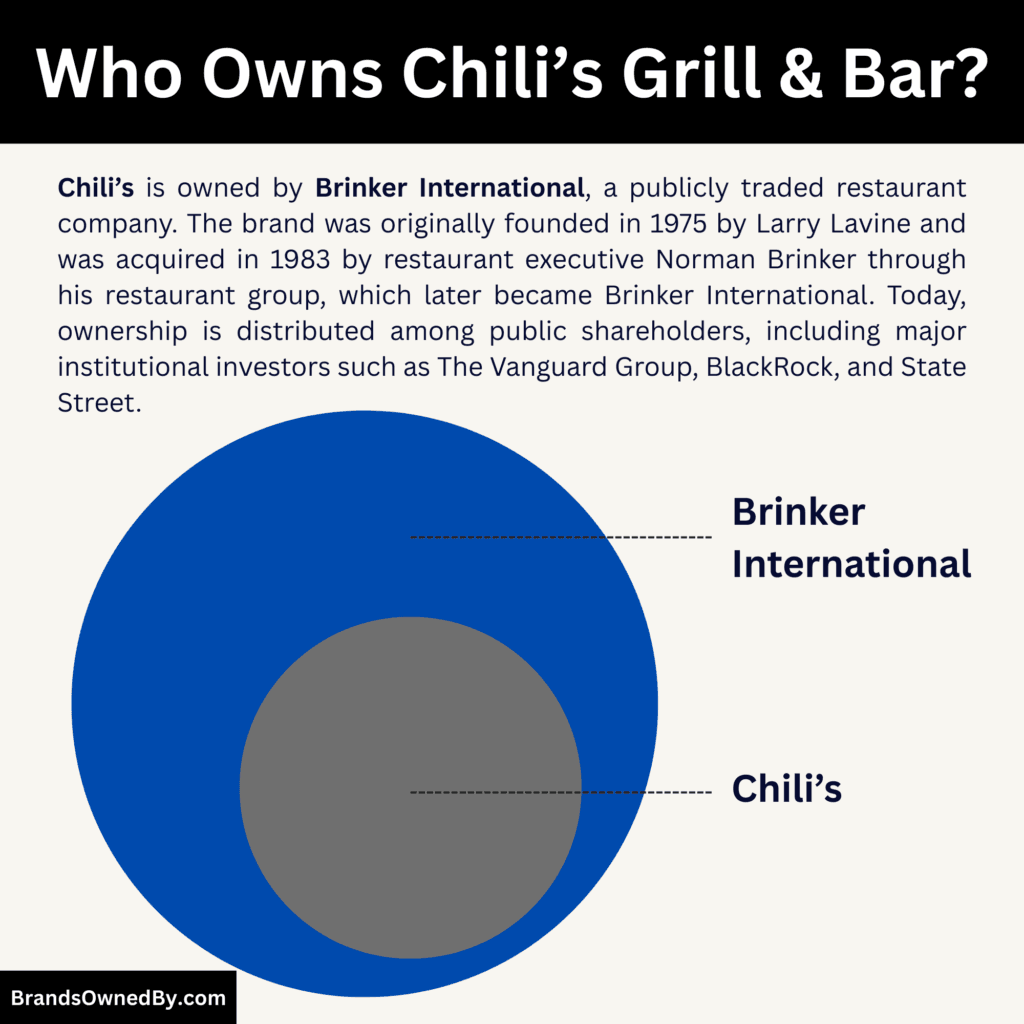
Chili’s Grill & Bar is owned by Brinker International, a publicly traded restaurant company headquartered in Dallas, Texas. This means Chili’s is not privately owned by a single individual or family. Instead, ownership is distributed among thousands of shareholders who hold stock in Brinker International. When investors buy shares of Brinker, they indirectly own a portion of Chili’s.
Brinker International operates Chili’s as its flagship brand. The company manages strategy, operations, brand positioning, and global expansion. Individual restaurant locations do not operate independently in terms of ownership. Corporate leadership controls key business decisions.
Parent Company: Brinker International
Brinker International is the direct parent company of Chili’s. The company was formed through the restaurant acquisitions and expansions led by Norman Brinker in the 1980s. It is headquartered in Dallas, Texas, the same city where Chili’s was founded.
Brinker operates as a full-service restaurant holding and operating company. It provides centralized leadership across several critical functions:
- Brand strategy and positioning
- Menu development and culinary innovation
- Supply chain management and procurement
- Technology systems and digital ordering infrastructure
- Franchise development and international expansion
- Corporate governance and compliance.
Chili’s is the flagship and dominant brand within Brinker’s portfolio. It represents the majority of the company’s restaurant footprint and operational focus. The parent company also owns Maggiano’s Little Italy, but Chili’s remains the core growth engine.
Brinker’s business model includes both company-owned restaurants and franchised locations. Franchise partners operate restaurants under licensing agreements while adhering to corporate standards. This hybrid structure allows the company to expand globally while maintaining brand consistency.
As a public corporation, Brinker International operates under U.S. Securities and Exchange Commission regulations. It files annual and quarterly reports, maintains audited financial statements, and is governed by an independent board of directors.
Acquisition of Chili’s: Strategic Turning Point
Chili’s was founded in 1975 by Larry Lavine. During its early years, the brand expanded successfully but remained privately controlled.
In 1983, Norman Brinker acquired Chili’s through his restaurant company. At the time of acquisition, Chili’s was still a growing regional chain. The acquisition was strategic. Brinker recognized the scalability of the casual dining concept and its potential for national expansion.
The deal integrated Chili’s into a more structured corporate system. This brought several advantages:
- Access to expansion capital
- Standardized operating procedures
- Professionalized management systems
- Stronger national marketing support
- Improved real estate site selection strategies.
Following the acquisition, the company expanded aggressively across the United States. Chili’s benefited from corporate-level leadership and operational discipline. The acquisition transformed the brand from founder-driven entrepreneurship into an institutional growth platform.
Over time, the parent organization evolved into Brinker International. The company later went public, further expanding its capital base and transitioning Chili’s into a publicly owned structure.
The acquisition is widely regarded as the moment that enabled Chili’s to become a national powerhouse in the casual dining industry.
Evolution Into a Public Ownership Model
After consolidating its restaurant holdings, Brinker International transitioned into a publicly traded corporation. This move fundamentally changed Chili’s ownership structure.
Instead of private control, ownership became equity-based and dispersed across the public markets. Institutional investors gained significant influence due to large shareholdings. Retail investors also participate through brokerage accounts and retirement funds.
Public ownership introduced higher accountability standards. Executive leadership must report performance metrics. Strategic decisions must align with shareholder interests. The board of directors oversees governance, compensation, and long-term strategy.
This structure also gives Brinker access to public capital markets. It can raise funds through equity or debt offerings to support remodeling programs, technology upgrades, or strategic initiatives.
Governance and Decision-Making Authority
Although shareholders technically own the company, operational authority rests with executive management. The CEO leads corporate strategy. Senior executives oversee operations, finance, marketing, supply chain, and development.
The board of directors represents shareholder interests. Board members are elected by shareholders and provide oversight of executive decisions. Major corporate actions, such as mergers or structural changes, require board approval and, in some cases, shareholder votes.
Individual Chili’s restaurant managers do not hold ownership stakes in the parent company unless they personally invest in Brinker stock. Operational authority flows from corporate headquarters down to regional management and then to local restaurants.
Strategic Importance of Chili’s Within Brinker
Chili’s is the centerpiece of Brinker International’s portfolio. Over the years, Brinker has streamlined its brand holdings to focus primarily on Chili’s and Maggiano’s Little Italy. This focused strategy allows greater capital allocation toward restaurant renovations, kitchen upgrades, and digital transformation within Chili’s.
The brand’s scale provides operational leverage. Supply chain efficiencies, marketing campaigns, and technology investments are concentrated on strengthening Chili’s competitive position.
Because Chili’s represents the majority of Brinker’s systemwide presence, its performance directly impacts shareholder value and corporate stability.
Competitor Ownership Comparison
Understanding how Chili’s competitors are owned helps explain its position in the casual dining industry. Chili’s is owned by Brinker International, a publicly traded restaurant company, while its main competitors operate under different ownership models including franchise-heavy corporations, diversified restaurant groups, and private ownership. These ownership structures influence brand control, expansion strategy, and corporate focus across the casual dining market.
| Brand | Parent Company | Ownership Type | Portfolio Focus | Key Ownership Insight |
|---|---|---|---|---|
| Chili’s Grill & Bar | Brinker International | Publicly traded | Highly concentrated on Chili’s | Flagship brand with strong corporate focus and mixed franchise model |
| Applebee’s | Dine Brands Global | Publicly traded | Franchise-heavy multi-brand (Applebee’s + IHOP) | Majority franchised, lower direct corporate control |
| Olive Garden | Darden Restaurants | Publicly traded | Diversified multi-brand portfolio | Mostly company-owned, capital spread across many brands |
| TGI Fridays | Private ownership / restructuring history | Primarily private | Single-brand focus with ownership changes | Experienced multiple ownership transitions affecting stability |
| Outback Steakhouse | Bloomin’ Brands | Publicly traded | Multi-brand restaurant group | Largest brand but capital shared with other concepts |
| Texas Roadhouse | Texas Roadhouse Inc. | Publicly traded | Focused core brand strategy | Strong operational control with company-owned model |
Applebee’s Ownership vs Chili’s
Applebee’s is one of Chili’s closest competitors in the casual dining segment. Applebee’s is owned by Dine Brands Global, a publicly traded restaurant operator.
Dine Brands follows a heavily franchise-focused model. Most Applebee’s locations are franchise-owned rather than corporate-operated. This reduces operating costs for the parent company but limits direct operational control. In contrast, Chili’s under Brinker International uses a balanced mix of company-owned and franchised restaurants. This allows tighter control over brand consistency, menu execution, and customer experience.
Both Chili’s and Applebee’s operate under public ownership. However, Chili’s benefits from being the dominant brand in Brinker’s portfolio, while Applebee’s shares corporate attention with IHOP under Dine Brands.
Olive Garden Ownership vs Chili’s
Olive Garden competes with Chili’s in the broader casual dining category, although its cuisine differs. Olive Garden is owned by Darden Restaurants, one of the largest full-service restaurant companies in the United States.
Darden operates multiple major brands including LongHorn Steakhouse, The Capital Grille, and others. Unlike Brinker, which is highly concentrated on Chili’s, Darden has a diversified portfolio. This spreads risk but divides capital allocation across multiple brands.
Darden primarily operates company-owned restaurants rather than relying heavily on franchising. This model is similar to Chili’s in terms of operational control but differs in portfolio diversification. Chili’s receives more focused corporate investment because it represents the core of Brinker’s business.
TGI Fridays Ownership vs Chili’s
TGI Fridays historically competed directly with Chili’s in the bar-and-grill segment. However, its ownership structure differs significantly.
TGI Fridays has gone through multiple ownership transitions, including private equity control and restructuring. Unlike Chili’s, which operates under a stable publicly traded parent company, TGI Fridays has experienced ownership instability over time. This has impacted its expansion, brand positioning, and financial performance.
Chili’s benefits from long-term corporate backing and consistent governance, while TGI Fridays has operated under shifting strategic priorities due to ownership changes.
Outback Steakhouse Ownership vs Chili’s
Outback Steakhouse is owned by Bloomin’ Brands, a publicly traded restaurant group. Bloomin’ Brands operates multiple concepts including Carrabba’s Italian Grill and Bonefish Grill.
Like Brinker International, Bloomin’ Brands follows a multi-brand strategy. However, its portfolio is more diversified compared to Brinker’s Chili’s-focused structure. Outback is the largest brand within Bloomin’, similar to Chili’s within Brinker, but capital allocation is still spread across several restaurant concepts.
Chili’s often benefits from more concentrated operational focus and brand investment compared to Outback.
Texas Roadhouse Ownership vs Chili’s
Texas Roadhouse operates under Texas Roadhouse Inc., a publicly traded company that primarily focuses on one core brand, similar to Brinker’s focus on Chili’s.
Both companies maintain strong corporate control over operations and emphasize company-owned locations. However, Texas Roadhouse follows a steakhouse specialization model, while Chili’s operates as a broader casual dining brand offering Tex-Mex and American cuisine.
The similarity lies in focused brand strategy and centralized corporate governance. Both companies rely heavily on operational efficiency and a consistent dining experience.
Key Differences in Ownership Models
Chili’s operates under a concentrated corporate ownership structure within Brinker International. This gives the brand a strong strategic focus and centralized decision-making. Many competitors operate under diversified restaurant groups, franchise-heavy systems, or private ownership structures.
Publicly traded ownership, like Chili’s, provides access to capital markets, governance transparency, and institutional investment. Franchise-heavy competitors may expand faster but often sacrifice direct operational control. Privately owned competitors may move quickly but can face capital constraints.
Chili’s ownership model combines corporate control, public-market funding, and focused brand investment. This structure has helped maintain long-term stability and consistent positioning in the competitive casual dining industry.
Who Controls Chili’s?
Control of Chili’s extends beyond simple ownership. While the brand is owned by a public company, the authority to set strategy, guide operations, and make executive decisions rests with structured corporate governance and senior leadership. As of February 2026, several specific systems and leaders ensure Chili’s is managed effectively across its 1,600 + restaurants.
Chili’s control is structured to balance public-company governance with operational efficiency:
- Ownership: Public shareholders own Brinker International.
- Governance: A board of directors oversees strategy and leadership accountability.
- Management: The CEO and executive team control corporate operations and strategic execution.
- Restaurant Operations: Local teams implement corporate priorities at individual locations.
Corporate Governance and Shareholder Influence
Chili’s is fully owned by its parent company, Brinker International, a publicly traded corporation based in Dallas, Texas. Because Brinker’s stock trades on the open market, shareholders collectively own the company that controls Chili’s. Decisions on broader governance matters are made through established corporate procedures:
- Shareholders vote annually for members of the board of directors.
- Shareholder voting follows standard public-company rules (one vote per share).
- Major strategic proposals, such as changes in executive compensation or board composition, are subject to shareholder approval.
No individual shareholder controls a majority stake. Instead, ownership is dispersed across institutional investors (such as mutual funds and asset managers) and retail investors, which necessitates formal board oversight of leadership.
The Board of Directors and Strategic Oversight
The board of directors of Brinker International plays a central role in controlling Chili’s strategic direction. Unlike day-to-day management, the board sets broad priorities and oversees the executive team. Key board responsibilities include:
- Appointing and evaluating senior executives.
- Approving major corporate strategies such as brand expansion, mergers, and capital investments.
- Monitoring shareholder interests and governance policies.
The board is chaired by Joseph M. DePinto. Kevin Hochman, the CEO, also serves on the board, linking executive leadership with governance oversight.
Executive Leadership and Operational Control
While shareholders and the board determine high-level strategy, active control of Chili’s operations is handled by Brinker International’s executive leadership team. As of 2026:
- Kevin Hochman serves as President and Chief Executive Officer of Brinker International and President of Chili’s. He leads overall strategy, brand positioning, and performance execution.
- The executive leadership team includes other senior leaders, such as the Chief Financial Officer (Mika Ware), Executive Vice Presidents, and operational heads responsible for marketing, technology, and franchise management.
These executives guide Chili’s direction by allocating resources, shaping operations, refining menus, and developing promotional strategies. Their decisions affect day-to-day restaurant performance and long-term brand initiatives.
How Decisions Are Made
Control within Chili’s flows through a clear organizational hierarchy:
- Shareholders exercise ownership rights through stock ownership and voting.
- Board of Directors oversees corporate governance, approves executive appointments, and sets policies.
- CEO and Executive Leadership manage strategic execution and operational priorities for Chili’s and other brands under Brinker.
- Regional and Field Leaders implement corporate strategies at restaurant and market levels, ensuring consistency and performance quality across locations.
This structure separates ownership from operational control while maintaining accountability. It allows shareholders to influence major decisions without directly managing daily restaurant operations.
Operational Leadership Focus (2026)
Brinker’s executive leadership has increasingly emphasized clear operational goals for Chili’s. These include:
- Streamlining menus to improve kitchen efficiency.
- Enhancing value-oriented offerings to drive customer traffic and repeat visits.
- Investing in digital and marketing initiatives to increase guest engagement.
This focus reflects a controlled, top-down approach where corporate leadership sets performance targets and standards implemented across the restaurant network.
Local vs. Corporate Control
Individual Chili’s restaurant managers manage local operations such as staffing, service quality, and guest experience. However:
- Pricing strategies, major menu changes, brand advertising, and major initiatives come from corporate leadership.
- Franchise operators are responsible for their individual locations but must adhere to corporate standards and systems established by Brinker International.
This means that while local managers execute operational control in their restaurants, the brand’s strategic direction is centrally governed.
Chili’s Annual Revenue and Net Worth
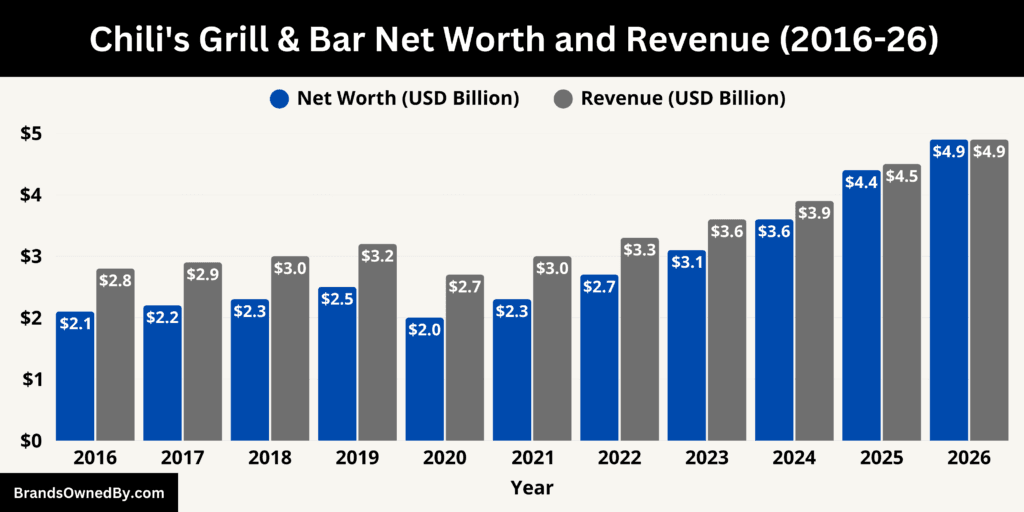
As of February 2026, Chili’s generates an estimated $4.9 billion in annual revenue and holds an estimated brand net worth of approximately $4.9 billion. These figures are derived from its revenue contribution share, restaurant footprint of more than 1,600 locations worldwide, and its operating weight within the broader corporate structure.
Chili’s contributes roughly 84% of total corporate revenue and more than 85% of operating income, making it the primary value driver. With total corporate revenue trending near $5.8 billion annualized in fiscal 2026, Chili’s revenue aligns near the $4.9 billion level.
Revenue Structure and Operational Economics
Chili’s revenue is generated through a mix of company-operated restaurant sales and franchise royalties.
Company-owned restaurants represent the largest portion of revenue. With more than 1,200 domestic company-operated locations, and average unit volumes exceeding $3.5 million per restaurant, company-operated revenue contributes approximately $3.6–$3.8 billion annually.
Franchise operations account for the remaining revenue contribution. Chili’s operates over 350 franchised restaurants internationally, primarily in the Middle East, Asia-Pacific, and Latin America. Franchise royalty rates typically range between 4% and 6% of gross sales, generating approximately $700–$800 million in royalty and related revenue annually.
Digital and off-premise sales represent a structural revenue component. Off-premise transactions account for roughly 22%–25% of systemwide sales, equating to more than $1.1 billion in consumer transaction volume flowing through delivery and curbside channels. This improves top-line stability and reduces dependence on dine-in traffic cycles.
Average guest check has increased through moderate annual pricing adjustments in the 2%–3% range, combined with improved product mix, particularly in beverage sales, which account for nearly 20% of restaurant-level revenue and carry higher margins than food items.
Net Worth and Brand Valuation
Chili’s does not operate as a separately listed company and therefore does not publish an independent balance sheet. Its net worth is best understood as brand value derived from revenue scale, operating strength, and long-term market position.
Based on annual revenue of approximately $4.9 billion, stable operating margins, and valuation benchmarks commonly applied to mature full-service restaurant brands, Chili’s estimated brand net worth in 2026 stands at approximately $4.9 billion.
This valuation reflects the brand’s global scale, consistent customer demand, strong restaurant-level economics, and sustained revenue growth since the pandemic recovery period. Over the past decade, Chili’s brand value has nearly doubled, rising from an estimated range near $2.2 billion to $2.5 billion in the mid-2010s to nearly $5.0 billion in 2026.
Revenue Forecast Through 2030
Chili’s revenue outlook through 2030 remains stable with moderate growth expected from higher restaurant productivity rather than rapid expansion. The brand operates as a mature concept, so future growth is primarily driven by same-store sales, pricing discipline, and operational improvements.
Projected revenue trajectory:
- 2027: $5.15 billion
- 2028: $5.35 billion
- 2029: $5.60 billion
- 2030: $5.90 billion.
This forecast assumes average annual revenue growth of approximately 3.5% to 4.5%, supported by steady traffic, moderate pricing adjustments, and continued digital ordering expansion. Average unit volumes are expected to approach $3.9 million per restaurant by 2030, reflecting higher productivity across the restaurant network.
If operating performance remains stable, Chili’s brand value could reach approximately $6.0 billion by 2030, driven by higher revenue scale and sustained profitability.
Brands Owned by Chili’s Grill & Bar
Chili’s operates as a focused single-brand restaurant enterprise. It controls several structured operating entities, franchise networks, proprietary platforms, and branded sub-concepts that function as distinct commercial units within the brand ecosystem. As of 2026, the following are the key brands and entities operated directly under the Chili’s business:
| Entity / Brand | Type | Core Function | Scale and Key Data | Revenue Contribution Role |
|---|---|---|---|---|
| Chili’s Grill & Bar | Core Restaurant Brand | Full-service casual dining focused on Tex-Mex, burgers, ribs, and beverages | Over 1,600 restaurants globally including 1,200+ company-operated locations; average unit volume above $3.5 million per restaurant | Primary revenue generator producing approximately $4.9 billion annually |
| Chili’s International Franchise Network | Franchise Operating Entity | Manages international franchised restaurants and licensing agreements | More than 350 franchised restaurants across Middle East, Asia-Pacific, Latin America, and other regions; royalty rates 4%–6% | Generates roughly $750 million annually through royalties and related income |
| Chili’s To-Go and Off-Premise Division | Operational Division | Handles curbside pickup, delivery, and takeout operations | Off-premise orders represent about 24% of system sales; over $1.1 billion in consumer transaction volume annually | Supports revenue growth and improves sales stability beyond dine-in traffic |
| Chili’s Digital and Mobile Ordering Platform | Technology and Ordering Entity | Online ordering system, mobile app, and integrated delivery ecosystem | Processes hundreds of millions of dollars in digital transactions annually; growing share of total orders | Enhances sales efficiency and drives repeat customer engagement |
| Chili’s Bar and Beverage Program | Internal Revenue Division | Manages beverage innovation, margarita promotions, and drink strategy | Beverage sales contribute around 20% of restaurant-level revenue and provide higher profit margins | Significant contributor to restaurant profitability and customer traffic |
| Chili’s Intellectual Property and Licensing Entity | Brand and Legal Entity | Controls trademarks, menu intellectual property, and brand licensing | Oversees brand protection, merchandise, and licensing partnerships globally | Supports brand value and long-term commercial rights rather than direct large revenue |
| Chili’s Supply Chain and Procurement Operations | Operations and Logistics Entity | Centralized sourcing, vendor management, and distribution | Supports more than 1,600 global restaurants with standardized ingredient and logistics systems | Improves operational efficiency and protects restaurant margins |
Chili’s Grill & Bar
Chili’s Grill & Bar is the core operating brand and primary revenue-generating entity. The concept operates more than 1,600 restaurants globally, including over 1,200 company-operated locations in the United States and more than 350 franchised restaurants internationally.
The brand focuses on Tex-Mex cuisine, American grill items, burgers, ribs, fajitas, and a strong beverage program. Average unit volumes exceed $3.5 million per restaurant, and the concept generates approximately $4.9 billion in annual revenue as of 2026. Chili’s Grill & Bar is the only full-service dining concept directly operated under the Chili’s business identity.
Chili’s International Franchise Network
Chili’s operates a large-scale international franchise entity covering markets in the Middle East, Asia-Pacific, Latin America, and parts of Europe. This franchise structure operates under long-term development agreements and territory licenses.
There are more than 350 international franchised locations, with royalty fees typically ranging between 4% and 6% of gross sales. The franchise division contributes approximately $750 million in annual revenue through royalties and related agreements. Franchise partners are required to follow standardized operating procedures, supply chain protocols, and brand guidelines.
This entity allows Chili’s to expand globally without deploying significant capital while maintaining centralized brand control.
Chili’s To-Go and Off-Premise Operations
Chili’s To-Go is an internal operating division focused on off-premise dining, including curbside pickup, delivery partnerships, and online ordering. Off-premise transactions account for approximately 24% of total system sales, representing more than $1.1 billion in annual consumer transaction volume.
Dedicated kitchen workflows, packaging systems, and digital integration platforms support this segment. The off-premise entity has become a permanent structural revenue channel rather than a temporary pandemic-driven feature.
Chili’s Digital and Mobile Ordering Platform
Chili’s operates a proprietary digital ordering ecosystem that includes its website ordering system, mobile application, and integrated third-party delivery channels. This digital entity processes hundreds of millions of dollars in annual transactions.
Digital penetration has steadily increased since 2020 and now forms a core part of the business model. The platform integrates loyalty-driven promotions, menu customization tools, and centralized data analytics, enabling Chili’s to track consumer behavior and optimize menu pricing.
Chili’s Bar and Beverage Program
The Chili’s bar and beverage program operates as a distinct internal revenue engine. Beverage sales account for approximately 20% of restaurant-level revenue and carry higher margins compared to food categories.
Signature margarita promotions, seasonal drink menus, and value-focused beverage campaigns are centrally developed and rolled out across all locations. The beverage entity significantly enhances restaurant profitability and brand identity.
Chili’s Intellectual Property and Licensing Entity
Chili’s controls its trademarks, brand assets, menu intellectual property, and proprietary recipes through its internal licensing and brand protection structure. This entity manages:
- Brand licensing agreements
- Trademark registrations
- Co-branded promotional partnerships
- Branded merchandise initiatives.
Although not a large standalone revenue contributor, this entity protects the brand’s commercial identity and supports long-term brand valuation.
Chili’s Supply Chain and Procurement Operations
Chili’s maintains centralized procurement and vendor management systems to support more than 1,600 global restaurants. This operational entity manages ingredient sourcing, food quality control, logistics coordination, and cost management.
Standardized supply agreements allow the brand to maintain consistent menu pricing and protect restaurant-level margins. Centralized procurement contributes significantly to operational efficiency and scalability.
Final Thoughts
Chili’s operates as a globally recognized casual dining brand with a centralized ownership and control structure that supports consistency and long-term growth. For those asking who owns Chili’s, the answer lies in its corporate framework, disciplined management, and focused single-brand strategy. The company continues to strengthen its position through operational efficiency, franchise expansion, and steady revenue performance. Its structured governance and scalable model provide stability while allowing the brand to adapt to changing consumer preferences in the competitive restaurant industry.
FAQs
Who owns Chili’s restaurant?
Chili’s restaurant is owned by Brinker International, a publicly traded restaurant operator. Ownership is distributed among public shareholders rather than a single private owner.
What company owns Chili’s?
Chili’s is owned and operated by Brinker International, which manages the brand as its flagship restaurant concept.
Is Chili’s a public company?
Chili’s itself is not a separate public company. However, its parent company, Brinker International, is publicly traded on the New York Stock Exchange, meaning Chili’s is indirectly owned by public shareholders.
Who is the CEO of Chili’s?
Chili’s operates under Brinker International. As of 2026, the CEO is Kevin Hochman, who oversees corporate strategy, operations, and brand performance.
Are Chili’s and Applebee’s owned by the same company?
No, Chili’s and Applebee’s are not owned by the same company. Chili’s is owned by Brinker International, while Applebee’s is owned by Dine Brands Global.
What does Brinker International own?
Brinker International owns and operates two main restaurant brands: Chili’s Grill & Bar and Maggiano’s Little Italy. These brands form the core of its restaurant portfolio.