
- CeraVe is fully owned by L’Oréal and does not operate as an independent company, making all strategic, financial, and operational decisions part of L’Oréal’s corporate control.
- L’Oréal is a publicly traded company, and its largest shareholder is the Bettencourt Meyers family, followed by Nestlé and major institutional investors, which means CeraVe is ultimately controlled by a small group of powerful stakeholders.
- CeraVe was acquired by L’Oréal in 2017, a move that transformed it from a niche dermatology brand into a global skincare leader through expanded research funding, worldwide distribution, and large-scale marketing.
- There are no individual owners or minority investors in CeraVe; ownership flows entirely through L’Oréal’s shareholder structure, not through private or celebrity ownership.
CeraVe is a global skincare brand known for dermatologist-developed products focused on repairing and protecting the skin barrier. The brand is widely recognized for its use of ceramides, gentle formulations, and accessibility across drugstores, clinics, and online platforms.
CeraVe’s identity is built around science-first skincare rather than luxury appeal. Its products are designed for long-term skin health, not quick cosmetic results. This medical-focused positioning has made it one of the most trusted brands among dermatologists and consumers alike.
As of 2025, CeraVe operates in over 100 countries and continues to expand its product range for acne-prone skin, aging skin, eczema care, and general hydration. It remains closely associated with clinical research and skin barrier science, which has become central to its reputation globally.
Founders and Early Development
CeraVe was founded in 2005 in the United States by a group of dermatologists and skincare scientists. Rather than focusing on luxury packaging or beauty trends, the founders aimed to solve a medical problem shared by many skin conditions.
Their research showed that damaged skin barriers were the root cause of issues like dryness, irritation, eczema, and acne. To address this, they developed formulas centered on ceramides, which are natural lipids found in healthy skin.
The founders introduced a proprietary delivery system called MVE Technology, short for MultiVesicular Emulsion. This allowed ingredients to release gradually over time instead of being absorbed all at once. The result was longer-lasting hydration and stronger barrier protection.
The brand name “CeraVe” reflects this philosophy. “Cera” represents ceramides, while the rest of the name signals care and healing through science. From the beginning, CeraVe positioned itself as a medicine-backed skincare solution rather than a cosmetic product line.
Major Milestones
- 2005: CeraVe officially launched in the United States with dermatologist-developed cleansers and moisturizers focused on restoring the skin barrier.
- 2006: The brand introduced its foundational product system including Hydrating Cleanser, Moisturizing Lotion, and Moisturizing Cream, which later became long-term best sellers.
- 2009: CeraVe expanded into major drugstore chains across the United States, making the brand widely accessible to everyday consumers.
- 2012: The brand gained strong recognition among dermatologists, especially for sensitive skin, eczema support, and barrier-repair solutions.
- 2014: CeraVe was acquired by Valeant Pharmaceuticals, which increased its presence beyond the United States and into international markets.
- 2017: L’Oréal acquired CeraVe as part of its major skincare portfolio expansion, positioning the brand for global growth.
- 2018: CeraVe was integrated into L’Oréal’s Active Cosmetics Division alongside La Roche-Posay, Vichy, and SkinCeuticals.
- 2020: The brand experienced explosive growth due to social media exposure, particularly through skincare creators and dermatologists on video platforms.
- 2021: CeraVe became one of the most dermatologist-recommended skincare brands in the United States.
- 2023: The product range expanded with new serums, acne solutions, and targeted treatments for aging and barrier repair.
- 2025: CeraVe marked its 20th anniversary, celebrating two decades of dermatology-driven skincare and global expansion.
Who Owns CeraVe?
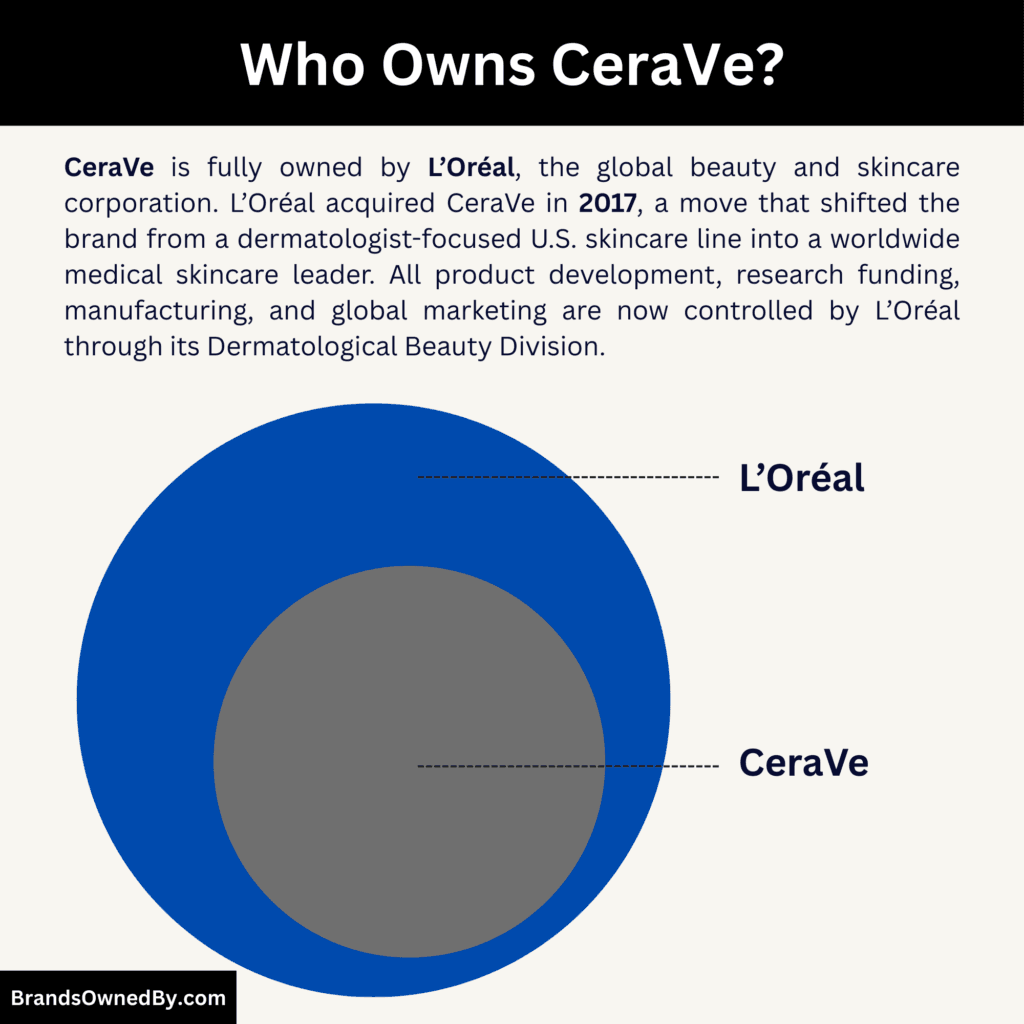
CeraVe is owned by L’Oréal, the French multinational beauty corporation. The brand is not independent and does not operate as a separate company. It is a fully controlled brand within L’Oréal’s global skincare business, with all major decisions on research, marketing, and expansion made at the corporate level.
Parent Company: L’Oréal

L’Oréal is the world’s largest beauty and skincare company. It operates across luxury, consumer, professional, and dermatological beauty categories. CeraVe is part of L’Oréal’s Dermatological Beauty Division, which is specifically designed for science-based and clinically tested skincare brands.
This division focuses on clinical effectiveness rather than cosmetic appearance. Brands in this group are positioned in pharmacies, dermatology clinics, and healthcare environments in addition to retail stores. This positioning fits directly with CeraVe’s original identity as a dermatologist-developed brand.
L’Oréal plays an active role in CeraVe’s development. It controls funding for product research, oversees laboratory testing, manages global supply chains, and defines pricing strategy. CeraVe does not approve products or launches independently. All decisions flow through divisional and corporate leadership.
Under L’Oréal, CeraVe gained access to international manufacturing facilities and research centers. This allowed the brand to scale production without lowering quality standards. The company also integrated CeraVe into its global marketing system, which includes medical education programs, dermatologist conferences, and healthcare partnerships.
Brand identity is also monitored centrally. L’Oréal ensures that CeraVe’s messaging stays focused on barrier repair, medical credibility, and skin health science. This protects the brand from drifting into trend-based skincare marketing.
Acquisition by L’Oréal
L’Oréal acquired CeraVe in 2017 from a pharmaceutical company that had built a portfolio of dermatology brands. The deal included multiple skincare properties, but CeraVe quickly became the standout acquisition.
The purchase was strategic. L’Oréal wanted to dominate medical skincare, not just beauty and cosmetics. CeraVe gave the company a powerful brand with built-in trust from dermatologists and consumers.
After the acquisition, L’Oréal restructured CeraVe’s growth strategy. Distribution expanded globally. Product development accelerated. Marketing investment increased heavily.
Within two years, CeraVe moved from limited international availability into dozens of new markets. The brand’s product range also widened, moving beyond cleansers and moisturizers into targeted treatments such as acne care, anti-aging, and skin barrier therapies.
L’Oréal also introduced CeraVe into its dermatologist education system. Medical professionals began receiving official product training and scientific documentation about product formulations.
The acquisition did not change the core formula logic or medical focus. Instead, L’Oréal scaled it. The company maintained the brand’s science-first approach while adding visibility and retail reach.
CeraVe’s dramatic growth in the early 2020s was directly linked to this acquisition. The infrastructure, capital, and marketing systems provided by L’Oréal allowed the brand to move from niche status into a dominant global position in dermatologist-backed skincare.
Who is the CEO of CeraVe?
CeraVe does not have its own CEO because it is not an independent company. It operates as a brand inside L’Oréal, which owns and controls all executive leadership.
The person ultimately responsible for CeraVe at the executive level is the CEO of L’Oréal – Nicolas Hieronimus. He serves as the top decision-maker for the entire company and oversees every global brand under L’Oréal, including CeraVe.
Current CEO: Nicolas Hieronimus
Nicolas Hieronimus has been the Chief Executive Officer of L’Oréal since May 2021. He is the sixth CEO in the company’s history. His leadership covers all brand strategy, research investment, global expansion, and supply chain operations across the group.
Although he does not manage CeraVe on a daily basis, the brand operates under the structure that he controls. Major decisions related to funding, development priorities, and regional growth are approved through leadership channels that ultimately report to him.
Career Background and Rise to CEO
Hieronimus joined L’Oréal in 1987 at an early stage in his career. He began in product marketing and gradually moved into international leadership roles. Over the years, he managed some of L’Oréal’s biggest consumer brands, including L’Oréal Paris and Garnier.
Later, he was placed in charge of the luxury and professional beauty divisions. His experience across both mass market and premium segments played a major role in his promotion to group-level leadership.
Before becoming CEO, he served as Deputy CEO and was responsible for several corporate divisions at once. His appointment to CEO reflected long-term internal leadership development rather than an outside hire.
How Decisions for CeraVe Are Made
CeraVe is managed through L’Oréal’s Dermatological Beauty Division. This division has its own executive team, including global brand directors, product development leaders, and regional managers.
These leaders handle day-to-day decisions such as:
- New product launches
- Marketing strategy
- Retail partnerships
- Medical education programs.
However, long-term strategy, budgets, and corporate direction are directed by L’Oréal’s central leadership team. That means Nicolas Hieronimus sits at the top of the decision chain even though he does not make brand-level marketing choices directly.
CEO Salary and Compensation
Nicolas Hieronimus is one of the highest-paid executives in the global beauty industry.
His fixed annual base salary is approximately €2 million.
In addition to that, he receives performance-based bonuses that are tied to company results. These bonuses typically range just above €2 million annually depending on financial performance and leadership targets.
He also receives long-term share-based compensation. This includes performance shares that vest over time based on company growth. In recent compensation cycles, the value of stock incentives awarded to him has exceeded €5 million.
When all compensation components are combined, his total annual pay package is estimated at approximately €9 to €10 million per year.
Nicolas Hieronimus does not disclose his full financial position publicly, but industry estimates place his personal net worth at approximately €40 million to €50 million.
This estimate includes:
- Salary earnings over many years
- Stock holdings in L’Oréal
- Performance share awards
- Other personal investments.
Because share awards vest over time, his wealth fluctuates with L’Oréal’s share price and long-term performance.
CeraVe Annual Revenue and Net Worth
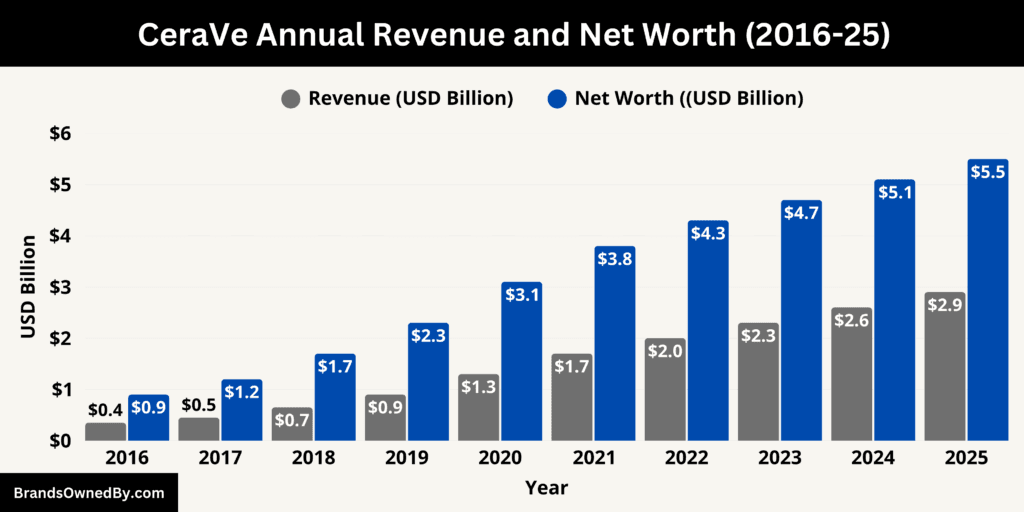
As of December 2025, CeraVe generates an estimated $2.9 billion in annual revenue, and its brand value and operational worth are estimated at over $5.5 billion. These figures reflect the brand’s rapid global growth, strong retail demand, and dominant position in dermatologist-recommended skincare.
CeraVe Revenue Performance
CeraVe’s revenue growth has been driven by three major factors: global expansion, product diversification, and strong consumer loyalty.
The brand now sells in more than 100 countries and has deep penetration across retail pharmacies, supermarkets, e-commerce platforms, and clinical settings. Its core products continue to dominate drugstore skincare shelves, especially in North America, Europe, and Asia.
In 2025, sales remain especially strong in cleansers, moisturizers, acne treatments, and ceramide-rich lotions. The company has also expanded into targeted serums and therapeutic solutions for eczema and sensitive skin, which contribute significantly to revenue growth.
Social media influence remains another major driver. CeraVe consistently benefits from dermatologist endorsements and user-generated product reviews, which translate directly into large-scale consumer demand without excessive advertising spend.
As part of L’Oréal’s Dermatological Beauty Division, CeraVe is one of the top revenue generators within the group, often performing alongside high-profile medical skincare brands in both growth and sales volume.
CeraVe Brand Net Worth and Valuation
CeraVe’s estimated net worth is based on brand equity, sales volume, market dominance, and long-term performance trajectory.
As of December 2025, the brand’s estimated valuation exceeds $5 billion, making it one of the most valuable mass-market skincare brands in the world. This figure reflects not only product sales, but also consumer trust, repeat purchases, clinical reputation, and intellectual property related to formulation technologies.
Unlike short-trend brands, CeraVe’s valuation is based on medical credibility and long-term stability. The brand has one of the highest rates of return customers in the drugstore skincare category.
L’Oréal considers CeraVe a long-term strategic asset. It is actively protected and expanded through research investment, laboratory innovation, and dermatologist partnerships.
Role of L’Oréal in Financial Growth
CeraVe’s financial success is tightly linked to L’Oréal’s corporate scale. The company benefits from centralized research facilities, advanced manufacturing systems, and international distribution agreements.
L’Oréal allocates major funding to CeraVe’s product innovation and market expansion. That includes clinical testing, formula upgrades, packaging efficiency, and localized product development for international markets.
CeraVe does not carry marketing risk alone. It operates under group-wide growth strategies controlled by L’Oréal executives, making its business model resilient to market downturns.
This backing reduces operational risk while accelerating growth, giving CeraVe a financial security level that independent skincare brands cannot match.
Long-Term Financial Outlook
CeraVe’s growth trajectory remains strong going forward. The brand continues to benefit from high demand for clinical skincare, simpler routines, and evidence-based products.
As skincare trends shift away from luxury-focused branding to functional health-driven formulas, CeraVe is positioned to remain a top performer.
With continued expansion in Asia, Latin America, and Europe, CeraVe is expected to cross higher revenue thresholds within the next few years.
Its financial future is supported not by hype, but by necessity. Consumers consistently require barrier-repair skincare. That makes CeraVe more durable than trend-driven competitors.
Brands Owned by CeraVe
Below is a list of the major brands and entities owned by CeraVe as of December 2025:
| Brand / Division Name | Type | Purpose | Market Focus | Ownership Structure |
|---|---|---|---|---|
| CeraVe Skincare (Core Brand) | Main brand | Primary product platform for all CeraVe items | Daily skincare | Internally operated, not a separate company |
| CeraVe Baby | Product division | Infant and toddler skincare | Pediatric care | Internal line |
| CeraVe Acne Control | Product division | Acne treatment and prevention | Teen and adult skin | Internal line |
| CeraVe Anti-Aging and Renewal | Product division | Wrinkle care and barrier renewal | Aging skin | Internal line |
| CeraVe Healing & Repair | Product division | Eczema and damaged skin solutions | Medical-grade care | Internal line |
| CeraVe Sun Protection | Product division | Sunscreens and UV skincare | Protection and hydration | Internal line |
| CeraVe Cleansing System | Product category | Various facial and body cleansers | Daily hygiene | Internal unit |
| CeraVe Moisturizing Series | Product category | Lotion and cream systems | Hydration and repair | Internal unit |
| MVE Technology Platform | Proprietary technology | Extended-release delivery | Formulation science | Exclusive IP |
| CeraVe Medical Education | Operational unit | Training and physician outreach | Dermatology professionals | Non-commercial internal entity |
CeraVe Skincare (Core Brand)
This is the main brand identity under which all CeraVe products are sold worldwide. It includes the company’s most recognized formulas, such as daily cleansers, moisturizers, and hydrating treatments.
The core brand is designed around barrier-repair principles. Every product under this label follows the same ideology: supporting the skin through ceramides, gentle cleansing systems, and long-lasting hydration technology. This consistency is a major reason CeraVe maintains consumer trust across many markets.
This central brand acts as the operational and strategic heart of the company.
CeraVe Baby
CeraVe Baby is a specialized internal division focused on infant and toddler skincare. It was developed for parents looking for clinically gentle solutions for delicate skin.
The formulas under this line are designed to avoid harsh ingredients and maintain moisture in developing skin barriers. This range operates as an extension of the brand’s medical focus and is often recommended by pediatric professionals.
Although it is marketed separately for families, it remains an internal product line, not a separate business.
CeraVe Acne Control
This internal division addresses acne and congested skin conditions.
It focuses on controlled treatment rather than aggressive formulas. Products are designed to reduce breakouts while maintaining the skin barrier instead of stripping oils. This medical approach separates CeraVe from trend-based acne products.
The division has grown rapidly because acne affects multiple age groups, and the line targets both teenagers and adults.
CeraVe Anti-Aging and Renewal Line
This collection focuses on aging skin, uneven texture, and early skin damage.
Products in this line include retinol-based formulas, peptide support, and repair-focused nighttime treatments. They are positioned as preventive care rather than cosmetic anti-aging.
This division allows CeraVe to compete with higher-end brands while keeping products accessible and clinically grounded.
CeraVe Healing and Repair Collection
This is where CeraVe serves consumers with severely dry, cracked, or irritated skin.
This collection focuses on intensive hydration and barrier recovery. It is commonly used by people with eczema-prone skin or chronic dryness. Products are often thicker, richer, and more concentrated.
The division blurs the line between everyday skincare and medical-grade treatment.
CeraVe Sun Protection
This division includes facial and body sunscreens.
Unlike cosmetic sunscreen brands, CeraVe treats sun protection as part of skin health. Formulas integrate ceramides and hydration technology to prevent damage while reinforcing the barrier.
It has grown as sun awareness rises globally.
MVE Technology (Internal Intellectual Property)
MVE Technology is CeraVe’s proprietary delivery system.
It ensures ingredients release gradually. This makes hydration last longer and improves tolerance for sensitive skin. It is a core intellectual asset exclusive to the brand.
Although consumers do not buy this directly, every product built with it is strengthened by this system.
Dermatology Education and Medical Partnerships
CeraVe operates internal education programs for dermatology professionals.
These programs provide formulation transparency, clinical documentation, and treatment guidance. This strengthens relationships with healthcare professionals and reinforces trust.
This internal function does not generate products. It generates credibility.
Final Thoughts
Understanding who owns CeraVe helps explain why the brand has grown from a dermatologist-developed skincare line into a global leader in barrier-focused products. With full ownership under L’Oréal, CeraVe operates with the backing of extensive research facilities, global distribution networks, and long-term investment in innovation. Yet the brand has managed to preserve its clinical identity and simplicity, which is why it remains trusted by both dermatologists and everyday users.
What sets CeraVe apart is not just ownership, but how that ownership has strengthened its mission to deliver effective, accessible skincare built on real science rather than marketing trends.
FAQs
Who created CeraVe?
CeraVe was created by a group of dermatologists and skincare scientists. It was not founded by one public individual. The brand was developed to focus on skin barrier repair using ceramides and clinically backed formulations rather than cosmetic trends.
When was CeraVe founded?
CeraVe was founded in 2005 in the United States. It started with a small range of dermatologist-developed products focused on restoring and maintaining the skin barrier.
Who manufactures CeraVe?
CeraVe products are manufactured under L’Oréal’s global production system. This includes company-owned laboratories and manufacturing facilities in multiple countries that follow L’Oréal’s quality and safety standards.
Is CeraVe owned by L’Oréal?
Yes. CeraVe is fully owned by L’Oréal. It is part of L’Oréal’s Dermatological Beauty Division and does not operate as an independent company.
Who owns CeraVe products?
All CeraVe products are owned by L’Oréal through its ownership of the CeraVe brand. Individual products are not owned by separate companies or franchises.
Who makes CeraVe products?
CeraVe products are made within L’Oréal’s manufacturing network. Formulation, production, testing, and packaging are all controlled by L’Oréal.
Are Cetaphil and CeraVe owned by the same company?
No. Cetaphil and CeraVe are owned by different companies. CeraVe is owned by L’Oréal, while Cetaphil belongs to another parent company.
Which country is CeraVe from?
CeraVe is an American brand. It was founded in the United States and continues to operate globally under L’Oréal’s international structure.