- Boar’s Head is a privately owned, family-controlled company. Ownership remains concentrated among founding family branches.
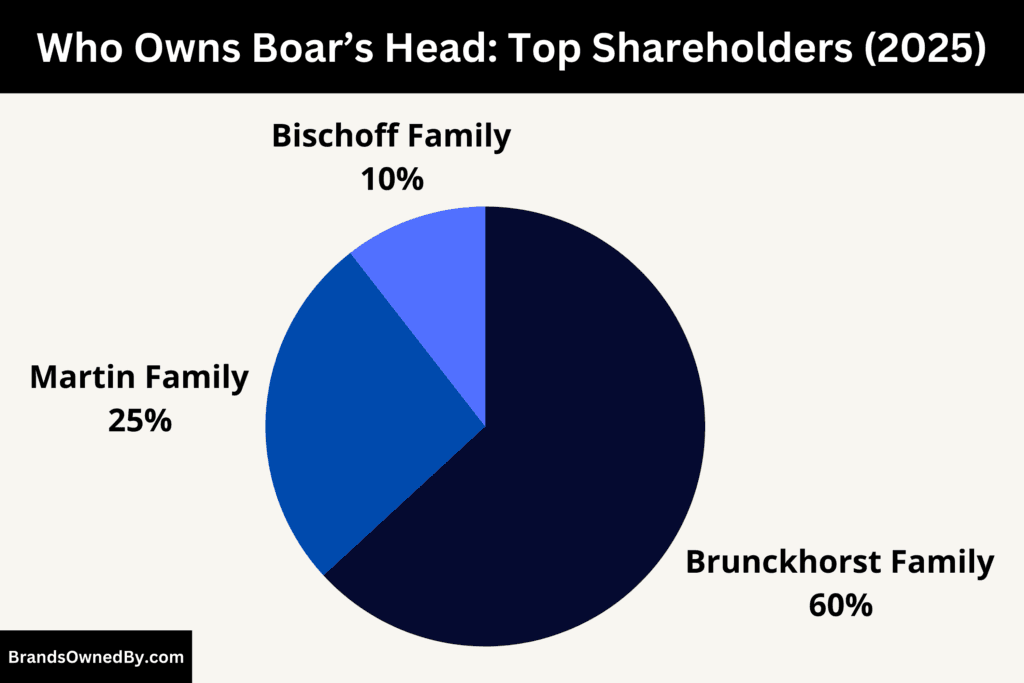
- The Brunckhorst family is the controlling shareholder group, holding an estimated majority stake of about 60%, which gives it decisive authority over strategy, governance, and long-term direction.
- Other significant family shareholders include the Martin family with roughly 25% ownership and the Bischoff family with about 10%, while the remaining shares are held through aligned family trusts and minimal executive equity.
- This concentrated family ownership explains why decisions at Boar’s Head are owner-led, why the company has no single traditional CEO, and why it has remained independent and acquisition-resistant as of 2025.
Boar’s Head is an American premium food company known for its high-quality delicatessen products. It produces and distributes a wide range of meats, cheeses, condiments, and related foods across the United States.
The brand has built its reputation on strict quality standards, using premium whole cuts of meat and avoiding artificial fillers or by-products in its core deli offerings. Its products are commonly found at grocery stores, specialty food retailers, and deli counters nationwide.
It remains privately held and is recognized for its artisanal approach within a competitive industry that often prioritizes scale over craftsmanship.
Boar’s Head Founder
Boar’s Head was founded in 1905 by Frank Brunckhorst in Brooklyn, New York. Frank Brunckhorst was a meat distributor by trade. He grew dissatisfied with the quality of hams he was sourcing for local customers.
This dissatisfaction drove him to craft his own products with ingredients he considered far superior. Rather than selling low-grade packaged meats, he focused on whole muscle cuts and hand-trimmed preparation. This emphasis on quality became the core identity of the brand from the very beginning.
Brunckhorst started by delivering his products directly to local delicatessens and retailers from a horse-drawn wagon, putting his name and the iconic boar logo on the side. The personal nature of these early deliveries established a direct connection with customers.
It also reinforced the artisanal and handcrafted reputation that would continue throughout the company’s history. The Boar’s Head name and crest were chosen to evoke traditional European quality and craftsmanship.
As the business grew, Frank enlisted the help of partners and family members. His original vision was preserved through carefully curated recipes and high standards that avoided artificial fillers or by-products.
In later decades, his descendants, including his son (also named Frank Brunckhorst), continued to shape the company’s direction, ensuring that this quality-first mindset remained central to operations.
Major Milestones
- 1905: Boar’s Head Brand is founded in Brooklyn, New York by Frank Brunckhorst. He begins distributing high-quality cold cuts made to his own uncompromising standards.
- 1933: Following steady growth in demand, the company opens its first dedicated processing facility in Brooklyn. This marks the shift from small-scale distribution to organized production.
- 1950s: Boar’s Head expands into regional supermarkets, moving beyond independent delicatessens and establishing a broader retail presence.
- 1970s: The brand begins expanding westward across the United States, reducing its dependence on the Northeast and becoming a regional powerhouse.
- 1980s: Boar’s Head broadens its product portfolio by adding premium cheeses alongside its meats, reinforcing its identity as a full-service deli brand.
- 1990s: The company introduces Ovengold® Turkey Breast, which becomes one of its most recognizable and best-selling products. Distribution partnerships with major grocery chains accelerate national growth.
- 2001: Boar’s Head relocates its corporate headquarters from Brooklyn, New York to Sarasota, Florida. The move supports nationwide logistics and long-term operational efficiency.
- 2009: The brand launches EverRoast® Chicken Breast, strengthening its position in premium roasted poultry products.
- 2012: Boar’s Head introduces the Boar’s Head Bold® line, featuring globally inspired meats and cheeses with more pronounced flavor profiles.
- 2017: Boar’s Head pickles gain widespread recognition, signaling the company’s successful expansion beyond traditional deli meats and cheeses.
- 2024: The company faces a major operational challenge linked to a listeria outbreak at one of its facilities. This leads to recalls, plant closure, and a company-wide reassessment of food safety practices.
- 2025: Boar’s Head continues implementing enhanced safety systems and operational controls while reinforcing its long-standing commitment to product quality and brand trust.
Who Owns Boar’s Head: Top Shareholders
Boar’s Head is privately owned by the Brunckhorst family. The family has controlled the company for generations.
The largest shareholder is Frank Brunckhorst and related family members.
This private ownership structure gives the family full control over strategy, operations, and brand positioning. It also allows long-term planning without pressure from public markets.
Below is a list of the major shareholders of Boar’s Head as of December 2025:
Brunckhorst Family
The Brunckhorst family holds the controlling ownership stake in Boar’s Head. As of 2025, their collective ownership is around 60%.
This majority ownership gives the Brunckhorst family decisive control over Boar’s Head. They dominate board representation and retain final authority over strategic decisions, executive appointments, capital investments, and long-term brand direction. Family ownership is reinforced through aligned trusts, which prevent dilution and ensure continuity across generations. Frank Brunckhorst’s position as President and CEO further consolidates ownership and operational control within the same family branch.
Martin Family
The Martin family represents the largest minority shareholder group. Their ownership stake is 25%.
This stake is substantial but non-controlling. The Martin family does not manage daily operations, but its ownership level gives it meaningful influence during major governance discussions. This includes succession planning, corporate restructuring, and dispute resolution within the ownership group. While the Martin family cannot override majority decisions, its shareholding is large enough to require consultation on significant matters.
Bischoff Family
The Bischoff family holds a smaller but still material ownership stake, estimated at 10%.
These shares are largely held through inheritance and estate trusts rather than direct operational ownership. Individual ownership within this group varies, and voting power is sometimes fragmented. As a result, the Bischoff family does not exercise unified control but remains a recognized stakeholder in governance matters. In recent years, trust-related legal proceedings have clarified portions of this ownership without materially altering overall control.
Family Trusts and Estate Holdings
An additional 4% of Boar’s Head ownership is held through family trusts that serve estate planning and succession purposes.
These trusts are typically aligned with the Brunckhorst family’s voting position. They exist to preserve long-term family ownership and to manage intergenerational transfers rather than to act as independent power centers. In practical terms, trust-held shares strengthen majority control rather than dilute it.
Executive and Management Ownership
Senior executives outside the founding families may hold minimal equity or economic participation rights, generally estimated at under 1% in aggregate.
These holdings are designed to align leadership incentives with company performance. They do not confer voting power sufficient to influence governance outcomes. Strategic control remains firmly in the hands of the family owners.
Who is the CEO of Boar’s Head?
Boar’s Head does not operate with a conventional, publicly identified chief executive officer. Unlike most large food companies, it follows a privately controlled, owner-led governance model. Executive authority is concentrated among family owners rather than assigned to a single corporate officer with a clearly defined CEO title.
As of 2025, leadership at Boar’s Head is effectively shared between two principal family figures who act as de facto chief executives, even though the company does not consistently present them under a single CEO designation.
Frank Brunckhorst III
Frank Brunckhorst III is a senior member of the founding Brunckhorst family and one of the most influential leaders at Boar’s Head. He plays a central role in setting company strategy, overseeing operations, and maintaining the brand’s long-standing quality standards.
His authority stems from both ownership and leadership responsibilities. Internally, he is widely viewed as one of the top decision-makers, with influence over manufacturing, product standards, and long-term planning. His role closely mirrors that of a traditional CEO, even if the title itself is not consistently used.
Robert S. Martin
Robert S. “Bob” Martin is the other key figure who effectively functions as a chief executive at Boar’s Head. He represents one of the major ownership branches of the company and has long been involved in guiding its direction.
Bob Martin shares responsibility for major corporate decisions alongside Frank Brunckhorst III. Together, they approve strategic initiatives, oversee senior management, and exercise ultimate authority over governance matters. This shared leadership structure places them at the top of the company’s decision-making hierarchy.
Role of the Martin Family in Day-to-Day Leadership
In addition to Bob Martin, Robert A. Martin (often referred to as Bob Martin Jr.) also plays an active leadership role within the company. While not always described as a co-CEO, he is involved in high-level management and ownership decisions. This reinforces the family-centric leadership model, where authority is distributed among closely related owners rather than delegated to outside executives.
Why Boar’s Head Has No Single CEO
Boar’s Head’s lack of a clearly defined CEO is intentional rather than accidental. As a privately held, family-controlled company, it does not face the same disclosure or governance requirements as publicly traded corporations.
Leadership decisions are made collectively by the controlling owners. Titles such as President, Chief Financial Officer, and other executive roles exist, but none singularly supersede the authority of the family owners. Even senior executives have acknowledged that the company does not operate with a clearly identified CEO in the traditional sense.
This structure allows the owners to retain direct control while avoiding rigid corporate hierarchies.
Executive Management Below the Ownership Level
Below the ownership-led leadership structure, Boar’s Head relies on a professional executive team to manage daily operations across the business. These executives are responsible for execution, coordination, and functional leadership, while strategic authority ultimately remains with the owner-leaders.
President: Carlos Giraldo
Though Boar’s Head lacks a clearly designated CEO title, the company does have senior executives with formal operational roles. As of 2025, Carlos Giraldo serves as President of Boar’s Head. His responsibilities include overseeing day-to-day operations, coordinating marketing and product initiatives, and managing execution across departments.
Carlos Giraldo succeeded longtime president Michael Martella, who retired in 2021. While the President manages execution and organizational performance, this role does not equate to acting as the sole chief executive in the conventional sense. Instead, the President works within the framework established by the principal family owners.
Chief Financial Officer: Steve Kourelakos
The Chief Financial Officer (CFO) of Boar’s Head is Steve Kourelakos. He is a long-serving finance executive with deep institutional knowledge of the company. Reports indicate that even he was uncertain about who the CEO was when asked directly, illustrating the unique lack of a singular CEO title in the company’s structure.
The CFO manages financial oversight, internal controls, budgeting, and reporting to the family ownership group. However, like the President, he does not serve as the ultimate strategic authority.
Boar’s Head Annual Revenue and Net Worth
As of December 2025, Boar’s Head remains one of the largest privately held premium deli brands in the United States. The company generates annual revenue of approximately $4.8 billion, while its estimated net worth is around $1.3 billion. This valuation reflects its private ownership structure, conservative growth approach, and focus on operational stability rather than aggressive leverage or public-market expansion.

Annual Revenue Performance in 2025
Boar’s Head generated an estimated $4.8 billion in revenue in 2025. This revenue is concentrated in a small number of high-volume categories rather than being spread across dozens of brands or business lines. The company’s revenue model is built on repeat purchases, dominant deli-counter placement, and premium pricing rather than rapid product churn.
Unlike publicly traded food companies, Boar’s Head does not disclose audited revenue breakdowns. However, industry reporting and retailer-level sales data provide a clear picture of where revenue is generated.
Deli Meats Revenue Contribution
Deli meats are the company’s largest revenue driver. As of 2025, approximately 65% of Boar’s Head’s total revenue, or about $3.1 billion, comes from deli meat products.
This category includes turkey, ham, roast beef, chicken breast, and specialty cured meats. Turkey products alone account for the single largest sub-segment within deli meats, driven by flagship items such as Ovengold Turkey and EverRoast Chicken. These products sell at a premium compared to private-label deli meats and maintain high weekly turnover at grocery deli counters.
The deli meat segment benefits from frequency. Consumers purchase sliced meats weekly rather than seasonally, which creates stable and predictable revenue throughout the year.
Cheese Revenue Contribution
Cheese represents the second-largest revenue stream for Boar’s Head. In 2025, cheese accounts for roughly 20% of total revenue, or approximately $960 million.
Boar’s Head cheeses are primarily sold through deli counters rather than packaged dairy aisles. This positioning allows the company to price above commodity cheese brands while leveraging cross-selling with meats. Cheese revenue is also less exposed to protein price volatility, which helps smooth overall revenue during periods of rising meat input costs.
Other Products and Ancillary Revenue
The remaining 15% of revenue, or about $720 million, comes from non-core categories. These include hummus, dips, condiments, pickles, pre-packaged snacks, and limited foodservice offerings.
These products are not growth drivers on their own, but they increase average transaction value at the deli counter and strengthen retailer relationships. They also allow Boar’s Head to occupy more shelf and counter space without diluting the core brand.
Retail vs Foodservice Revenue Split
Retail grocery remains the dominant sales channel. As of 2025, approximately 85% of revenue is generated through grocery stores and deli counters. The remaining 15% comes from foodservice and institutional customers, including restaurants, hospitality operators, and corporate dining providers.
Foodservice revenue is intentionally limited. The company prioritizes brand control and pricing discipline over aggressive volume expansion in institutional channels.
Pricing Power as a Revenue Driver
A defining feature of Boar’s Head’s revenue is pricing power. Across major categories, its products typically sell 15%–30% higher than national branded competitors and significantly higher than private-label alternatives.
This premium is sustained by brand trust, long-term retailer partnerships, and consumer perception of quality. As a result, Boar’s Head has been able to pass through cost increases without meaningful volume erosion, supporting revenue stability even during inflationary periods.
Boar’s Head’s revenue is highly concentrated but stable. A small number of products and categories generate the majority of sales, reducing execution risk. At the same time, dominant deli-counter placement creates high switching costs for retailers, which helps protect revenue streams year over year.
Boar’s Head Net Worth 2025
As of December 2025, Boar’s Head has an estimated net worth of approximately $1.3 billion. This figure reflects the company’s private enterprise value after accounting for operating assets, liabilities, and the economics of a capital-intensive food manufacturing business. Unlike public food companies, this valuation is not based on stock market multiples but on operating earnings, asset ownership, and long-term contractual stability.
Earnings Base Supporting Valuation
Boar’s Head’s valuation is anchored in operating earnings rather than revenue alone. In 2025, the company is estimated to generate $320 million to $360 million in EBITDA. This places Boar’s Head at an implied valuation multiple of roughly 3.5x to 4.0x EBITDA, which is conservative compared to publicly traded packaged food peers that often trade at higher multiples.
The lower multiple reflects private ownership, limited liquidity, and the absence of a public-market premium rather than weak performance.
Tangible Asset Contribution
A significant portion of Boar’s Head’s net worth comes from tangible assets. As of 2025, the company owns and operates multiple U.S.-based manufacturing facilities, distribution centers, and cold-chain infrastructure. The estimated book and replacement value of these physical assets is approximately $750 million to $850 million.
These assets include meat processing plants, slicing and packaging facilities, refrigerated logistics infrastructure, and proprietary production equipment. Because food manufacturing requires continuous reinvestment, asset value is stable but not rapidly appreciating.
Intangible Brand and Contract Value
The remaining portion of Boar’s Head’s net worth—approximately $450 million to $550 million—is attributed to intangible value. This includes brand equity, long-term retail agreements, and preferred deli-counter placement with major grocery chains.
Boar’s Head’s brand strength is unusual in that it commands premium pricing at the deli counter while maintaining national scale. However, because the company does not monetize its brand through licensing, franchising, or spin-offs, intangible value is reflected conservatively in valuation estimates.
Debt and Liability Adjustment
Boar’s Head operates with moderate operational liabilities related to labor, compliance, logistics, and manufacturing upkeep. The company does not carry excessive long-term debt, which limits financial risk but also caps valuation expansion. After adjusting for these liabilities, enterprise value settles near the $1.3 billion mark.
This conservative balance sheet approach is intentional and consistent with family ownership priorities.
Why Net Worth Is Not Higher Despite $4.8 Billion in Revenue
The disparity between revenue and net worth is structural, not performance-related. Boar’s Head operates in a high-volume, moderate-margin industry with substantial fixed costs. Unlike asset-light consumer brands, its valuation is constrained by production intensity, regulatory burden, and ongoing capital requirements.
Additionally, the company does not pursue financial strategies that inflate valuation, such as aggressive leverage, portfolio divestitures, or public listings. As a result, net worth remains grounded despite strong revenue.
Brands Owned by Boar’s Head
Boar’s Head Brand operates under a single-brand strategy, but beneath that brand sits a network of internal product lines, manufacturing entities, and operating divisions.
Below is a list of the major divisions, entities, and brands owned by Boar’s Head as of December 2025:
| Company / Brand / Entity | Category | Year Introduced / Established | Primary Products | Role in Business |
|---|---|---|---|---|
| Boar’s Head Deli Meats | Core operating brand | 1905 | Turkey, ham, roast beef, chicken, cured meats | Largest revenue driver; dominant deli-counter presence |
| Boar’s Head Cheeses | Internal product line | 1980s | American, Swiss, provolone, cheddar, specialty cheeses | Second-largest revenue segment; cross-sells with meats |
| Boar’s Head Hummus | Internal brand extension | 2010s | Classic and flavored hummus varieties | Expands brand into plant-based and health-focused foods |
| Boar’s Head Condiments | Internal product category | 2000s | Mustard, mayonnaise, dressings, sandwich spreads | Increases basket size and deli attachment sales |
| Boar’s Head Pickles | Specialty foods line | 2010s | Dill pickles, bread-and-butter pickles | Complements deli offerings; retail and foodservice use |
| Boar’s Head Snacks & Grab-and-Go | Convenience foods | 2010s | Protein packs, snack meats, cheese portions | Targets convenience-driven and on-the-go consumers |
| Boar’s Head Foodservice Division | Operating division | 1990s | Bulk meats and cheeses for restaurants | Serves hospitality and institutional customers |
| Boar’s Head Manufacturing Operations | Wholly owned operating entities | 1930s onward | Meat processing, slicing, packaging, cheese production | Ensures vertical integration and quality control |
| Boar’s Head Distribution & Logistics | Internal logistics entities | 20th century | Refrigerated transport and warehousing | Maintains cold-chain integrity and national distribution |
Boar’s Head Deli Meats
Boar’s Head Deli Meats is the company’s core and most valuable business segment. It includes premium sliced meats such as turkey breast, ham, roast beef, chicken, salami, bologna, and specialty cured meats.
This segment drives the majority of company revenue. Products are sold primarily through supermarket deli counters rather than prepackaged aisles, giving Boar’s Head dominant placement and pricing control. Flagship lines such as Ovengold Turkey, EverRoast Chicken, and Black Forest Ham are produced exclusively by Boar’s Head facilities and are not licensed or outsourced.
Boar’s Head Cheeses
Boar’s Head Cheeses is a major internal brand line focused on premium deli cheeses. The portfolio includes American, Swiss, provolone, cheddar, gouda, pepper jack, and specialty cheese varieties.
Cheeses are positioned as deli-counter upgrades rather than commodity dairy products. This allows Boar’s Head to command higher margins and bundle cheese sales with deli meat purchases. The cheese line is fully integrated into the company’s deli strategy and is not operated as a separate corporate brand.
Boar’s Head Hummus
Boar’s Head Hummus is an internally developed product line that expanded the brand beyond traditional deli proteins. It includes classic, roasted red pepper, garlic, and specialty hummus varieties.
This brand targets health-conscious and plant-forward consumers while leveraging Boar’s Head’s reputation for ingredient quality. Hummus products are typically sold in refrigerated cases near deli counters, reinforcing brand adjacency rather than competing in shelf-stable categories.
Boar’s Head Condiments and Deli Accompaniments
This category includes mustard, mayonnaise, vinaigrettes, dressings, and sandwich spreads produced and sold under the Boar’s Head name.
These products are designed to complement deli meats and cheeses rather than function as standalone pantry staples. They increase basket size at retail and strengthen Boar’s Head’s position as a full deli solution provider.
Boar’s Head Pickles and Fermented Products
Boar’s Head Pickles are produced as part of the company’s specialty foods segment. The line includes dill pickles, bread-and-butter pickles, and related fermented items.
Pickles serve both retail and foodservice channels. They are positioned as deli-quality alternatives to mass-market pickle brands and contribute incremental revenue without diluting the core meat-focused identity.
Boar’s Head Snacks and Grab-and-Go Items
This internal product category includes snack-sized meats, cheese portions, protein packs, and pre-portioned deli items.
These products target convenience-driven consumers and support placement in refrigerated grab-and-go sections of grocery stores. While smaller in revenue contribution, this segment aligns with evolving consumer habits and supports future growth without major brand repositioning.
Boar’s Head Foodservice Operations
Boar’s Head operates a dedicated foodservice division serving restaurants, hospitality operators, corporate dining, and institutional customers.
This entity adapts core Boar’s Head products for commercial kitchens while maintaining the same quality standards. Foodservice is intentionally kept smaller than retail to preserve pricing discipline and brand perception.
Boar’s Head Manufacturing Entities
Boar’s Head owns and operates multiple manufacturing facilities across the United States. These facilities handle meat processing, slicing, packaging, cheese production, and prepared foods.
Manufacturing entities are not branded separately but function as wholly owned operating units. Vertical integration allows Boar’s Head to control food safety, quality, and supply continuity. These facilities represent a significant portion of the company’s asset base.
Boar’s Head Distribution and Logistics Operations
The company operates internal distribution and logistics entities responsible for refrigerated transport, warehousing, and retailer delivery coordination.
This infrastructure supports national distribution while reducing reliance on third-party logistics providers. Control over cold-chain logistics is critical to product quality and retailer trust.
Final Words
Boar’s Head remains one of the most distinctive names in the American food industry, and understanding who owns Boar’s Head explains much of its long-term success. The company’s private, family-controlled ownership has allowed it to stay independent, protect its premium positioning, and prioritize quality over rapid expansion. With strong revenue, a focused brand portfolio, and owner-led governance, Boar’s Head continues to operate on its own terms. As of 2025, this ownership model remains central to how the company grows, competes, and maintains consumer trust across the United States.
FAQs
Who owns Boar’s Head luncheon meats?
Boar’s Head luncheon meats are owned and produced by Boar’s Head Brand, a privately held, family-controlled company. The business is not publicly traded. Ownership is concentrated among founding family branches, led by the Brunckhorst family as the controlling shareholders.
Is Boar’s Head a Chinese company?
No. Boar’s Head is not a Chinese company. It is an American, privately owned brand with ownership, leadership, and manufacturing operations based in the United States.
Does Tyson own Boar’s Head?
No. Tyson Foods does not own Boar’s Head. Boar’s Head operates independently and is not part of Tyson or any other large food conglomerate.
What is the Boar’s Head scandal?
The term “Boar’s Head scandal” commonly refers to food safety issues that surfaced in recent years, including a listeria outbreak linked to one of its facilities. The incident led to recalls and increased regulatory scrutiny, but it did not change the company’s ownership or private status.
What is the Boar’s Head controversy?
The Boar’s Head controversy centers on food safety practices and internal governance questions that became public during regulatory reviews and legal proceedings. These events highlighted operational challenges but did not involve fraud, foreign ownership, or a sale of the company.
Who owns Boar’s Head company?
Boar’s Head is owned by its founding families. The Brunckhorst family holds the controlling stake, with significant minority ownership held by related family branches, including the Martin and Bischoff families, along with aligned family trusts.
Who is the founder of Boar’s Head?
Boar’s Head was founded in 1905 by Frank Brunckhorst. He started the business in Brooklyn with a focus on higher-quality deli meats, which became the foundation of the brand.
Where is Boar’s Head originally from?
Boar’s Head originated in Brooklyn, New York. The company began as a local meat distributor serving neighborhood delis before expanding nationally.
Is Boar’s Head American?
Yes. Boar’s Head is an American company. It was founded in the United States, is owned by American families, and operates primarily within the U.S. market.
Where is the headquarters of Boar’s Head?
Boar’s Head is headquartered in Sarasota, Florida. The company relocated its headquarters from New York to Florida to support national operations and distribution.