

- Blaze Media is privately owned and founder-controlled, with Glenn Beck holding an estimated 775% ownership stake, giving him full authority over strategy, operations, and editorial direction.
- The DeVos family are the largest outside investors, holding an estimated 11% minority stake as passive financial backers without control over programming or management decisions.
- The remaining ownership is split among small private investors and executive equity holders, none of whom individually or collectively have voting power to challenge founder control.
- Blaze Media does not have public shareholders, and no major corporation, network, or political group owns or controls the company.
Blaze Media is a U.S.-based conservative-leaning media company. It combines streaming, podcasts, news articles and commentary. The ethos and brand reflect founder-driven values.
It is an independent media company. It defines itself as a news, opinion, and entertainment outlet for people who value “the American way of life.” Its headquarters are in Irving, Texas.
The company operates multiple platforms: a website, streaming video, radio, podcasts, and digital publishing.
Blaze Media’s offerings include:
- A digital news/commentary site covering politics, culture, technology, lifestyle, etc.
- A streaming video platform for original shows, documentaries, and on-demand content.
- Podcasts and radio programming distributed via app and online channels.
As of 2025, Blaze Media still identifies itself as one of the largest independent conservative media companies in the U.S.
Founders of Blaze Media
Blaze Media was shaped by a small group of influential conservative media figures and business executives. Its identity comes from both its original founder and the leadership team formed after the historic merger.
Glenn Beck – Founder of TheBlaze and co-founder of Blaze Media
Glenn Beck launched TheBlaze in 2010. He built it as a digital-first alternative to cable news. Beck is the ideological architect of Blaze Media. His style, tone, and messaging define the brand. As founder and controlling figure, he directs long-term strategy, content philosophy, and brand positioning. Beck also hosts programming and remains the company’s most recognizable public face.
Mark Levin – Co-founder through CRTV
Mark Levin co-founded CRTV, which later merged with TheBlaze to form Blaze Media. Levin brought a strong legal and constitutional voice into the company. His audience and platform were a major factor in expanding Blaze Media’s influence. Though not involved in daily management, Levin’s role helped shape the ideological depth of early Blaze Media programming.
Tyler Cardon – Executive Co-President at formation
Tyler Cardon became a senior leader when CRTV and TheBlaze merged. He played a foundational role in merging operations, teams, and content pipelines. His background in digital media operations helped modernize platform management and internal structure during the early Blaze Media years.
Gaston Mooney – Executive Co-President at formation
Gaston Mooney was another core architect of Blaze Media post-merger. He handled operational integration and business management. Mooney focused on business-side consolidation and growing the media infrastructure across digital platforms.
Early corporate leadership team
Following the merger, Blaze Media expanded its executive structure. It appointed leaders for programming, technology, marketing, and audience development. Over time, this leadership has evolved, but Glenn Beck remains the organizational anchor.
Major Milestones
- 2010: Glenn Beck launches TheBlaze as a digital political news website focused on conservative commentary and culture.
- 2011: GBTV is introduced as an internet-based television network, allowing direct audience access without relying on cable providers.
- 2012: TheBlaze expands into original reporting, news coverage, and long-form political analysis.
- 2013: Daily live shows begin production and the company builds a full newsroom structure.
- 2014: Blaze launches mobile apps and optimizes streaming for smart devices and connected TVs.
- 2015: Subscription-based content is expanded to reduce reliance on advertising revenue.
- 2016: Mark Levin co-founds CRTV as a paid conservative video platform.
- 2017: CRTV grows rapidly by signing exclusive creators and expanding cultural and political programming.
- 2018: TheBlaze and CRTV officially merge, creating a single digital media company.
- 2019: The merged organization rebrands as Blaze Media to unify all brands under one identity.
- 2020: Streaming viewership increases as demand for digital media rises worldwide.
- 2021: Blaze Media restructures leadership teams and diversifies content into cultural commentary and investigative programming.
- 2022: Major improvements are made to video infrastructure and mobile platform stability.
- 2023: Blaze Media receives strategic investment from private backers to support growth and operations.
- 2024: New content creators are added and additional original programs are introduced.
- 2025: Blaze Media continues operating as a digital-first company focused on subscriptions, podcasts, and direct audience engagement.
Who Owns Blaze Media: Major Shareholders
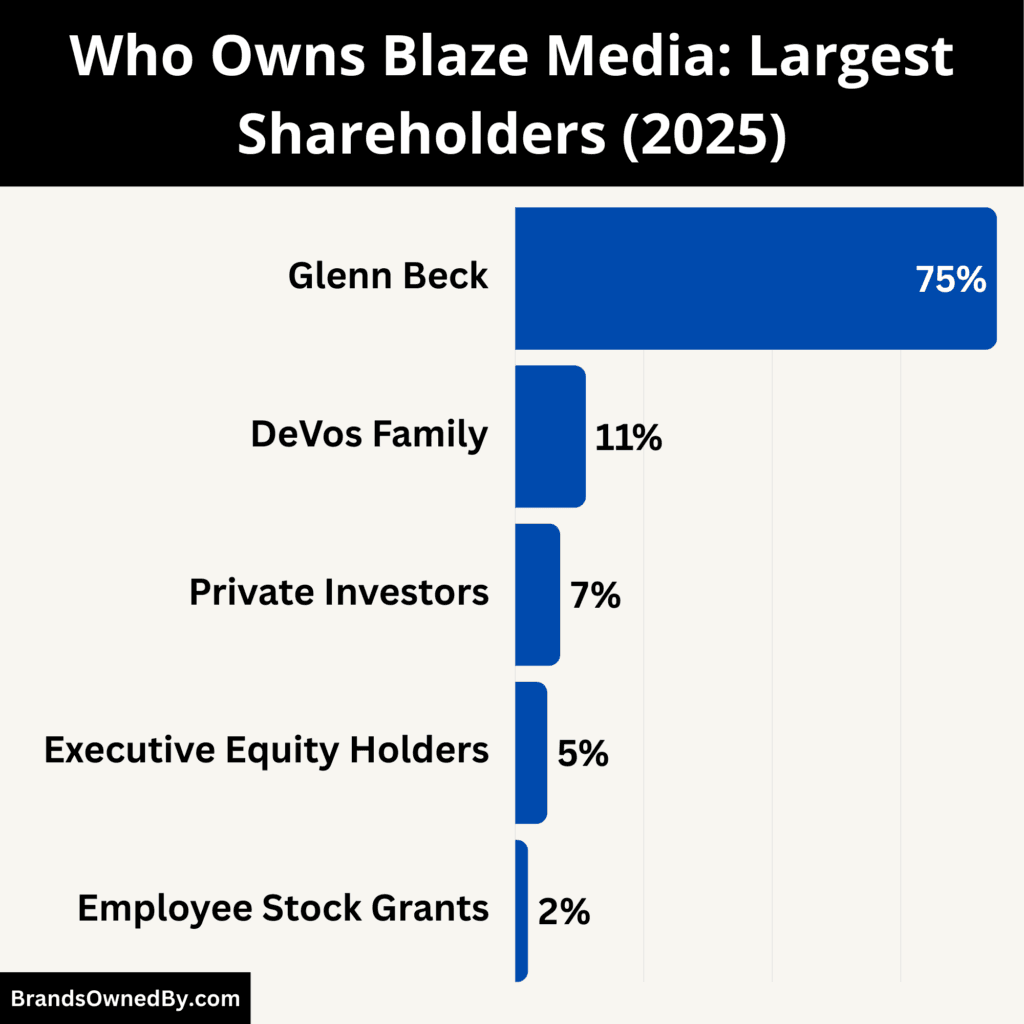
Blaze Media is owned by its founder, Glenn Beck. He is the largest shareholder and the controlling owner of the business. The company is privately held. No public shares exist.
Glenn Beck created Blaze Media as an independently owned company. He has kept decision-making power close. Outside investors have had a limited role over the years. There has never been a full sale to a major media group.
This structure allows Blaze Media to operate without pressure from public shareholders. Editorial independence and strategic control remain internal. Financial backers contribute capital but do not determine content direction or leadership decisions. As of 2025, the company remains firmly controlled by its founding owner.
Here is how practical control looks in 2025:
- Glenn Beck controls more than two-thirds of the company
- External investors collectively hold less than one-fifth
- Executives and internal stakeholders hold a single-digit stake
- No outside group can challenge founder authority
- All voting power effectively flows from the top.
This makes Blaze Media one of the most founder-controlled political media companies operating today.
Glenn Beck – 75%
Glenn Beck is the largest shareholder and controlling owner of Blaze Media. He founded TheBlaze, which later merged with CRTV to create Blaze Media, and he retained majority control following the merger.
Beck’s estimated ownership range places him as the dominant shareholder. This gives him absolute authority over corporate strategy, acquisitions, leadership appointments, and editorial direction.
His stake represents both financial control and brand control. Blaze Media was built around his identity, audience, and ideology. No major decision is taken without his approval. He also retains ownership of key intellectual property created under the brand.
In practice, Beck acts as:
- Majority owner
- Chairman-level authority
- Final executive decision-maker
- Chief brand architect
- Lead ideological voice.
This ownership level prevents any outside party from overruling him. Even combined minority shareholders cannot collectively override the founder.
DeVos Family Investment Group – 11%
In 2023, Blaze Media secured investment from members of the DeVos family through private capital participation. This group holds the largest external stake in the company.
This stake does not translate into editorial control. Instead, the DeVos Group operates as a strategic investor rather than a governing owner. Their role is financial support and long-term backing rather than management involvement.
Their influence is primarily limited to:
- Capital deployment
- Financial performance monitoring
- Business growth input when invited
- Long-term valuation guidance.
They do not influence shows, hiring decisions, or programming policies. Their stake is passive in nature and structured to avoid control dilution of the founder.
Though significant, their equity position does not give them veto authority or executive dominance inside the company.
Other Private Investors – 7%
Beyond the DeVos Group, Blaze Media includes a small number of undisclosed private investors. These individuals or entities entered as funding partners during or after corporate growth phases.
These shareholders:
- Do not participate in operations
- Do not influence editorial direction
- Hold small minority equity positions
- Act as passive financial partners.
Their cumulative stake is modest and fragmented. No single investor in this group holds enough equity to exercise power independently.
These investors typically benefit from:
- Future sale value
- Dividend potential (if distributed)
- Portfolio diversification.
They do not appear in public branding or leadership and hold no operational authority.
Executive Equity Holders – 5%
A portion of Blaze Media equity is believed to be held by senior executives and founding operators following the CRTV merger.
Notable figures associated with executive equity include:
- Gaston Mooney (former co-president)
- Early executive team members
- Leadership involved in post-merger operations
- Platform directors and core management staff.
These shares are typically granted in the form of equity incentives, not founder-level ownership.
Their equity:
- Is tied to employment
- Encourages performance
- Aids long-term retention
- Does not confer control authority.
Executives influence business execution, not ownership direction. Strategy is still dictated by the founder.
Who is the CEO of Blaze Media?
As of 2025, the CEO of Blaze Media is Tyler Cardon. He became the company’s top executive following the merger of TheBlaze and CRTV. His role is focused on business leadership, platform strategy, and long-term operational growth.
Cardon is responsible for overseeing the company’s streaming infrastructure, subscription systems, content distribution, advertising strategy, and internal operations.
While Blaze Media is known for its strong personalities and opinion-driven branding, Cardon works primarily behind the scenes as the business architect. His leadership role centers on stabilizing the organization, expanding distribution channels, and improving viewer conversion into paid subscribers.
The President: Gaston Mooney
Gaston Mooney serves as President of Blaze Media. His role is heavily focused on daily execution. He manages partnerships, creator agreements, promotional strategy, and cross-platform operations. Mooney is also involved in programming expansion and licensing deals.
Mooney’s background helps bridge management and content creation. While Cardon directs corporate strategy, Mooney ensures that operations run smoothly and new content pipelines continue to grow. He is often the executive voice behind creator recruitment and network growth.
Founder Influence: Glenn Beck’s Ongoing Role
Although Glenn Beck is not formally listed as CEO, his influence is stronger than that of most founders who step away from leadership. Beck remains the company’s controlling owner and its primary public figure. He continues to host shows, develop programming, and shape the company’s editorial culture.
Beck retains authority over long-term strategy. Important business decisions, brand positioning, and content philosophy reflect his vision. In practice, Blaze Media operates under a hybrid leadership model. Day-to-day operations are run by professional executives, while the founder continues to steer the ideological and strategic direction from the top.
Leadership Style and Decision-Making Structure
Blaze Media operates with centralized leadership. The structure is founder-led but professionally managed. Strategic decisions are made by Glenn Beck and executed by Cardon and Mooney.
Policy direction, hiring of top talent, and content standards originate from the founder’s vision. Executives then handle implementation, logistics, and expansion. This model keeps Blaze Media agile while maintaining a consistent identity.
Unlike large public media companies, Blaze Media does not face pressure from public shareholders. Leadership decisions are made internally. This allows long-term planning and editorial independence without influence from advertisers or market speculation.
CEO Salary and Compensation
Because Blaze Media is privately owned, executive compensation is not publicly disclosed. However, based on industry standards for private media companies of similar scale, Tyler Cardon is estimated to earn between $600,000 and $1 million annually in total compensation.
This estimate includes:
- Base salary
- Performance bonuses
- Equity incentives or profit participation
- Long-term leadership compensation plans.
These figures are typical for senior leadership running a national digital media company with subscription infrastructure and original content production.
Glenn Beck’s Earnings and Net Worth
Glenn Beck remains one of the highest-earning figures associated with Blaze Media, but much of his income comes from multiple ventures. His total net worth is widely estimated to be around $200 million.
Beck earns income from:
- Blaze Media ownership
- Radio syndication
- Book deals
- Speaking events
- Streaming platforms
- Licensing and merchandise.
His annual earnings across ventures are estimated to exceed $20 million per year. His compensation from Blaze Media itself is not separated publicly from his overall media income.
Because he is the majority owner, Beck’s wealth grows primarily through equity value rather than salary. He does not rely on corporate paychecks. His personal income is tied to the company’s growth and brand power.
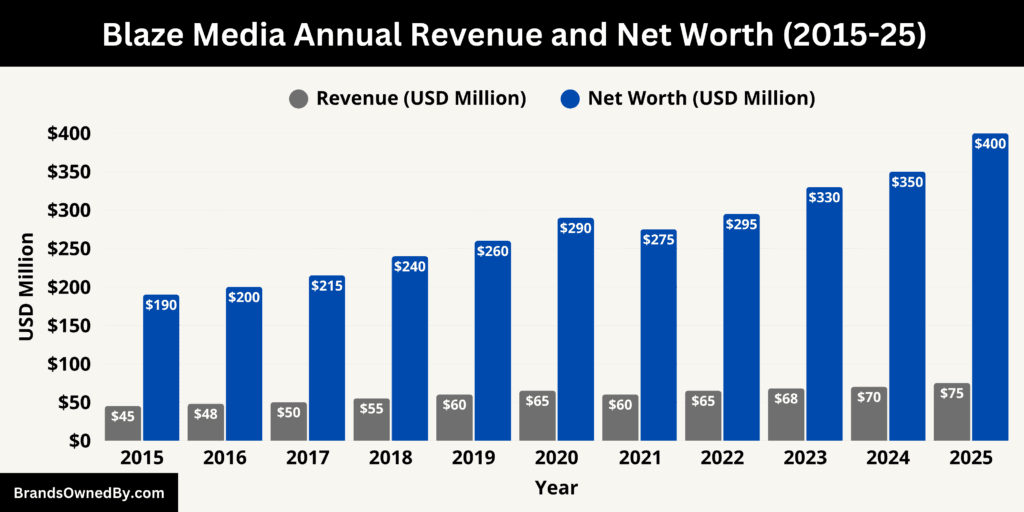
Blaze Media Annual Revenue and Net Worth
As of December 2025, Blaze Media is estimated to generate approximately $75 million in annual revenue, with the company’s net worth estimated at $400 million.
Revenue Model and Income Sources
Blaze Media’s estimated $75 million annual revenue is driven primarily by its subscription platform, BlazeTV. Memberships make up the largest portion of income. Subscribers pay for access to exclusive shows, documentaries, and early releases, allowing consistent monthly revenue flow.
In addition to subscriptions, the company earns revenue from advertising on its public-facing news platform. This includes video ads, sponsored placements, and display advertising. Although advertising is not the company’s core strategy, it remains a meaningful supplemental income stream.
The company also generates revenue through podcast distribution, content licensing, and digital partnerships. Certain exclusive creators operate under profit-sharing agreements. Revenue from merchandise sales and live programming further supports the company’s overall income. While each revenue stream varies in size, together they create a diversified financial structure.
Net Worth and Company Valuation
As of December 2025, Blaze Media’s company valuation is estimated at $400 million. This valuation reflects far more than yearly revenue. It includes the value of intellectual property, media archives, subscription databases, and the long-term strength of its audience base.
Media companies with recurring revenue are valued differently from ad-driven networks. Subscription-driven businesses typically command higher equity value because of predictable cash flow and lower volatility. Blaze Media benefits from audience loyalty and a stable subscriber base, which contributes to its higher valuation range.
The company’s private funding rounds have also increased perceived enterprise value. Outside investment signals market confidence and reduces financial risk. Unlike public firms whose stock prices fluctuate daily, Blaze Media’s private valuation is driven by performance, growth, and investor trust.
Founder Ownership and Wealth Impact
Because Glenn Beck owns the majority of Blaze Media, a substantial portion of the company’s net worth is tied directly to his personal wealth. With Blaze Media valued at $400 million and Beck holding controlling ownership, his equity alone represents a significant share of that figure.
Beck’s personal net worth is further supported by income from book sales, radio distribution, and public appearances. His earnings are not dependent on salary alone. Most of his wealth is derived from ownership and influence rather than corporate compensation.
The company’s continued growth strengthens his financial position. Rising valuation increases equity value, not just operating income.
Financial Stability and Growth Outlook
Blaze Media’s business model in 2025 shows resilience. The company is largely insulated from advertising downturns because subscribers fund the core business. This allows for long-term budget planning and investment in exclusive content.
The $75 million revenue figure reflects a mature subscription engine. It also shows the effectiveness of diversification strategies. Podcasts, partnerships, and licensing have opened additional income streams without diluting brand identity.
With a $400 million estimated valuation, Blaze Media functions more like a mid-size digital media enterprise than a political outlet. Its financial base suggests sustainability rather than trend-driven relevance.
Brands Owned by Blaze Media
As of 2025, Blaze Media controls its own technology, production, publishing, monetization, and branding assets through vertically integrated operations.
Below is a list of the major brands and entities owned by Blaze Media:
| Company / Brand | Type | Role in Blaze Media | Key Functions | Revenue Connection | Strategic Importance |
|---|---|---|---|---|---|
| BlazeTV | Subscription Streaming Platform | Core business unit | Hosts exclusive series, documentaries, commentary shows, and archives | Primary income source | Foundation of revenue and user retention |
| TheBlaze.com | Digital News Website | Public media outlet | Publishes news, opinion, and videos; funnels traffic to BlazeTV | Advertising and conversions | Lead generation and brand visibility |
| Blaze Podcast Network | Audio Network | Content division | Produces and distributes podcasts across platforms | Subscriptions and ad share | Daily engagement and audience growth |
| Blaze Studios | Production Company | Content creator | Produces shows, films, documentaries, and studio programs | Content monetization | Controls production quality and IP |
| Blaze Originals | Content Label | Premium brand | Identifies original long-form and exclusive productions | Subscription value | Builds long-term IP value |
| Blaze Mobile App | Technology Platform | Distribution system | Delivers video, audio, news, and push alerts | Retention engine | Direct audience control |
| CRTV (Archived Unit) | Former platform | Integrated content | Houses legacy library and creator assets | Historical contribution | Strengthened technological and content base |
| Blaze Live Events | Events Division | Audience engagement arm | Produces live shows, tours, and special broadcasts | Ticketing and sales | Brand loyalty and marketing |
| Blaze Store | E-commerce Platform | Merchandise channel | Sells branded apparel and creator products | Product revenue | Brand monetization |
| Creator Partnership Program | Creator Network | Talent development | Onboards independent creators into Blaze ecosystem | Revenue sharing | Expands content supply |
| Licensing & Syndication Unit | Distribution arm | External media sales | Manages content licensing and syndication | Secondary income | Increases reach |
| Subscriber Platform | Internal system | Operations core | Manages billing, renewals, analytics, and CRM | Retention and stability | Operational backbone |
| Digital Marketing Division | Growth team | Engagement engine | Runs promotions, campaigns, and analytics | Conversion optimization | Sustains audience growth |
| Intellectual Property Office | Rights management | Asset control | Manages trademarks, copyrights, and content ownership | Company valuation | Long-term business security |
BlazeTV
BlazeTV is the core subscription platform of Blaze Media. It is the company’s primary paid product and its most valuable asset. BlazeTV operates as a standalone streaming service that distributes content across web, mobile, and connected television platforms.
The platform offers exclusive video series, documentaries, and member-only programs. New episodes are released directly on BlazeTV before appearing anywhere else. Some shows never appear outside the platform at all.
BlazeTV was designed to reduce reliance on social media and cable networks. Subscribers engage through profiles, content recommendations, and digital libraries. The full archive is available on demand.
This platform drives most recurring revenue.
TheBlaze.com
TheBlaze.com is the company’s public news and opinion website. It functions as Blaze Media’s entry point for new audiences. Unlike BlazeTV, the site is free to access.
The website publishes political commentary, cultural reporting, video clips, and select original articles. It is updated daily and optimized for high-traffic distribution.
The site also works as a promotion engine. It introduces readers to BlazeTV by placing premium content behind upgrade prompts. This conversion system is central to user growth.
Blaze Podcast Network
The Blaze Podcast Network controls all audio production. It distributes podcasts through both public streaming platforms and BlazeTV.
Public episodes serve as audience acquisition tools. Premium episodes remain locked behind paid subscriptions. This allows Blaze Media to monetize without sacrificing reach.
Podcasts are produced internally or through creator agreements. Several podcast hosts also appear on BlazeTV programs, creating cross-platform loyalty.
Audio content is a major driver of daily engagement.
CRTV (Integrated Archived Platform)
CRTV merged into Blaze Media in 2018. The brand no longer operates independently. However, its infrastructure, content library, and creator relationships remain in use.
The integrated assets include:
- Streaming architecture
- Content rights
- Creator contracts
- Subscription expertise.
CRTV’s merger gave Blaze Media scale, technology, and talent.
Blaze Studios
Blaze Studios is the company’s internal production unit. All long-form video and documentary content is created here.
The studio oversees scripting, filming, editing, sound mixing, and release scheduling. It controls production standards and allows rapid development of original shows.
Blaze Studios also manages studio-based programs, remote interviews, and event broadcasts.
This eliminates dependence on third-party production houses.
Blaze Originals
Blaze Originals is the premium content label used for long-form productions. It identifies projects created with higher budgets and long-term distribution plans.
Projects under this label include documentaries, investigative series, and historical programming. The Blaze Originals catalog remains owned permanently by the company.
These productions strengthen the company’s intellectual property portfolio.
Blaze Mobile App
The Blaze Media app is the company’s distribution hub. It delivers streaming video, podcasts, and articles in one unified platform.
The app provides:
- Video playback and live streams
- Podcast access
- Downloads
- News alerts
- Account management.
The app gives Blaze Media access to user behavior data and platform control that cannot be achieved through social media networks.
Blaze Live Events
Blaze Media produces live audience events. These include interviews, stage productions, studio tours, and political commentary events.
Programs are recorded and republished digitally. Ticket sales, digital access, and merchandise create additional income.
Live events also strengthen brand loyalty.
Blaze Store
Blaze Store is the branded merchandise platform. It sells apparel, accessories, and exclusive editions.
This platform reinforces identity and monetizes audience loyalty. Branded items are promoted directly through BlazeTV.
Creator Partnership Program
Blaze Media hosts independent creators under non-acquisition agreements. Creators retain identity but distribute through Blaze infrastructure.
The company provides:
- Production support
- Distribution access
- Marketing services
- Monetization tools.
This model allows Blaze Media to scale without purchasing companies.
Licensing & Syndication Operations
Blaze Media operates a dedicated licensing and syndication function to extend the reach of its content beyond its own platforms. Selected programs, interviews, and audio segments are distributed through external platforms under contractual arrangements. These agreements allow Blaze Media to increase visibility while maintaining ownership of intellectual property.
Licensing is also used strategically. Short-form content is redistributed to attract new viewers into the main ecosystem. Longer formats are syndicated under controlled terms that protect exclusive rights. Blaze Media does not license entire libraries. Instead, it selects content tactically based on audience demand, promotional impact, and long-term content value.
This division functions as a growth channel rather than just a revenue stream. It exposes the brand to wider audiences without weakening BlazeTV exclusivity.
Subscriber & Data Infrastructure
Blaze Media operates its own proprietary subscriber-management system rather than outsourcing to third-party platforms. This system controls account creation, renewal cycles, billing systems, access control, and customer engagement.
User behavior is tracked internally to improve retention. Viewing history, subscription activity, and content preferences are analyzed to guide programming decisions and member outreach. This allows Blaze Media to detect churn patterns and proactively intervene through targeted promotions and personalized recommendations.
By owning its customer data directly, Blaze Media avoids dependence on external tech platforms. This creates greater stability and operational autonomy. It also strengthens the company’s direct relationship with its audience.
Digital Marketing Division
The digital marketing division manages Blaze Media’s online visibility, audience growth, and brand targeting strategy. Campaigns are handled internally to protect messaging control and user trust.
Marketing focuses on:
- Content distribution strategy
- Subscription acquisition
- Email campaign automation
- Audience segmentation
- Conversion optimization.
Rather than relying on short-term advertising tactics, Blaze Media focuses on loyalty-building. Messaging emphasizes exclusive access rather than viral engagement.
This division also coordinates promotional launches for major releases. Timed campaigns are used to increase subscriber conversions during content premieres.
Intellectual Property Holdings
Blaze Media retains ownership of all original programming produced under its brand. This includes video productions, podcasts, documentaries, platform-specific series, and creator formats.
Ownership also extends to trademarks, platform designs, streaming architecture, and licensing structures. All content created inside the Blaze ecosystem remains company property unless otherwise agreed.
This approach protects long-term value. Intellectual property can be repurposed, syndicated, or monetized over time. The company is not forced to create constantly to remain relevant. Its content library grows in value each year.
The IP portfolio is a major contributor to enterprise valuation. It also gives Blaze Media leverage in negotiations with platforms and partners.
Final Thoughts
Understanding who owns Blaze Media is simple once you look past rumors. The company is not run by a corporation or a political group. It is controlled by its founder.
Glenn Beck built the company from scratch. He still owns it. He still runs it. That ownership model explains much of its independence and editorial style.
For supporters, it means alignment with a clear vision. For critics, it means the brand reflects one strong point of view. Either way, Blaze Media remains one of the most founder-driven networks in modern media.
FAQs
Who owns Blaze Media?
Blaze Media is privately owned, with Glenn Beck holding the majority stake. He controls an estimated 70%–75% of the company, making him the primary decision-maker and the dominant owner of the entire network.
Is Blaze Media credible?
Blaze Media is considered credible by its audience within the conservative media space. It is known for strong editorial viewpoints rather than neutral reporting. Its credibility depends on the expectations of the viewer—those seeking conservative commentary view it as reliable, while those seeking non-partisan journalism may view it differently.
Who is the founder of Blaze Media?
Glenn Beck is the founder. He launched TheBlaze in 2010, which later merged with CRTV to form Blaze Media. His vision, brand, and leadership shaped the company from the beginning.
Did Glenn Beck sell TheBlaze?
No. Glenn Beck did not sell TheBlaze. Instead, TheBlaze merged with CRTV in 2018 to create Blaze Media. Beck retained majority ownership and remains the controlling figure in the company.
Who is the owner of TheBlaze?
TheBlaze is part of Blaze Media, and its majority owner is Glenn Beck. Since the merger, TheBlaze functions as an integrated brand under the Blaze Media umbrella.
Who produces Blaze Media?
Blaze Media content is produced internally through Blaze Studios, the company’s in-house production division. This includes shows, documentaries, podcasts, and original programming created exclusively for BlazeTV and its platforms.
Where is Blaze Media located?
Blaze Media is headquartered in Irving, Texas. The company operates its studios, corporate offices, and production facilities from this location.