

- Alaska Airlines is owned by Alaska Air Group, a publicly traded airline holding company listed on the New York Stock Exchange, meaning ownership is distributed among institutional investors and public shareholders rather than a single owner.
- The largest shareholder is The Vanguard Group, which holds about 9.7% of Alaska Air Group shares, followed by major investors such as BlackRock, Fidelity (FMR LLC), Dimensional Fund Advisors, PRIMECAP Management, and State Street.
- Institutional investors collectively control around 85–90% of the company’s shares, while the remaining shares are held by retail investors and company insiders.
- Operational control does not lie with shareholders directly. Strategic decisions and daily operations are managed by the company’s executive leadership team and board of directors, led by CEO Ben Minicucci.
Alaska Airlines is a major American airline headquartered in Seattle, Washington. It is one of the largest airlines in the United States and is known for its strong presence on the West Coast. The airline operates an extensive network of routes across the United States, Canada, Mexico, Costa Rica, and Belize.
The airline is the primary subsidiary of Alaska Air Group, a holding company that manages several aviation-related businesses. Alaska Airlines focuses heavily on connecting cities along the West Coast while also linking them to major hubs across North America.
The airline is also a member of the oneworld global airline alliance. This partnership allows passengers to connect with international airlines and travel to hundreds of destinations worldwide through partner networks.
Alaska Airlines is widely recognized for its customer service, operational reliability, and loyalty program. Over the years, it has built a strong reputation among both business and leisure travelers.
The airline operates a modern fleet consisting mainly of Boeing aircraft for mainline routes and Embraer aircraft for regional services through its partner airlines.
Alaska Airlines Founder
Alaska Airlines traces its origins back to 1932 when aviation entrepreneur Linious “Mac” McGee founded a small airline called McGee Airways in Anchorage, Alaska.
McGee started the airline with a single aircraft, a three-passenger Stinson plane. His company primarily transported passengers and cargo within Alaska, serving remote communities that had limited access to transportation.
In the early years, several small aviation companies operated in Alaska. Over time, many of these companies merged to form a larger airline network.
In 1944, the merged airline adopted the name Alaska Airlines. This marked the official beginning of the modern airline that exists today.
Although McGee Airways laid the foundation, Alaska Airlines grew through the consolidation of multiple regional carriers. These mergers helped the airline expand routes and build a stronger operational base.
The early founders and aviation pioneers behind these companies played an important role in establishing reliable air transportation in Alaska. Their efforts helped transform the airline from a small regional carrier into one of the leading airlines in North America.
Ownership History
The ownership history of Alaska Airlines reflects how the company evolved from a small, privately owned aviation business into a large airline operating under a publicly traded parent company. Over several decades, mergers, acquisitions, and corporate restructuring shaped the modern ownership structure of the airline.
Early Private Ownership and Airline Consolidation (1930s–1970s)
Alaska Airlines started as a privately owned aviation company in the early 1930s. The airline traces its roots to McGee Airways, which was founded in Anchorage, Alaska. During the early years of aviation in Alaska, many small airlines operated short routes connecting remote communities.
These early carriers often merged to survive the harsh operating environment and limited infrastructure. Several small airlines gradually combined their operations to form the company that later became Alaska Airlines.
During the mid-20th century, the airline remained privately owned and was controlled by aviation entrepreneurs and investors. The company slowly expanded beyond Alaska and began serving cities in the Pacific Northwest and the western United States.
This period laid the foundation for Alaska Airlines to become a national carrier. The airline expanded its fleet, increased routes, and strengthened its operational structure.
Creation of Alaska Air Group Holding Company (1985)
A major turning point in the airline’s ownership structure came in 1985 when Alaska Air Group was created as a holding company. This new corporate structure allowed the organization to manage multiple aviation businesses under a single parent company.
Alaska Airlines became the main operating airline within the group. Shortly after forming the holding company, Alaska Air Group expanded by acquiring other aviation companies.
In 1986, the company acquired Horizon Air and Jet America Airlines. Jet America was later integrated into Alaska Airlines in 1987, while Horizon Air continued operating as a regional airline serving smaller markets.
This holding company structure made it easier for Alaska Air Group to expand its network and diversify its aviation services.
Expansion Through Strategic Acquisitions
Over the following decades, Alaska Air Group used acquisitions to strengthen its position in the airline industry. The most significant acquisition came in 2016 when the company announced it would purchase Virgin America.
The deal valued Virgin America at approximately $2.6 billion in equity and about $4 billion including debt and leases.
The acquisition was completed on December 14, 2016. This merger significantly expanded Alaska Airlines’ presence in California and strengthened its position as a major West Coast airline.
Initially, Alaska Airlines and Virgin America continued operating as separate airlines. Over time, the two brands were integrated into a single operation under the Alaska Airlines brand.
The integration process was completed between 2018 and 2019, when the Virgin America brand was officially retired.
This acquisition transformed Alaska Airlines into one of the largest airlines in the United States and significantly expanded its route network.
Hawaiian Airlines Acquisition (2024)
Another major development in the company’s ownership history occurred in 2023 when Alaska Air Group announced plans to acquire Hawaiian Airlines. The transaction was valued at approximately $1.9 billion.
After receiving regulatory approval, the acquisition was completed on September 18, 2024. The deal expanded Alaska Air Group’s reach into long-haul international markets and strengthened its presence across the Pacific.
Unlike previous mergers, both Alaska Airlines and Hawaiian Airlines were expected to continue operating as separate airline brands within the same corporate group.
This acquisition significantly increased the scale of Alaska Air Group and positioned it as a stronger competitor in the U.S. airline industry.
Modern Public Shareholder Structure
Today, Alaska Airlines operates as the largest airline subsidiary of Alaska Air Group, which is a publicly traded company listed on the New York Stock Exchange.
Ownership of the company is divided among institutional investors, mutual funds, pension funds, and individual shareholders. Major global asset management firms hold significant stakes in the company.
Although investors own the shares, the airline’s operations are managed by its executive leadership team and board of directors.
The modern ownership structure reflects the airline’s transition from a small regional carrier to a large publicly owned aviation company with global investors.
Over more than nine decades, Alaska Airlines has evolved through mergers, acquisitions, and corporate restructuring. These developments have shaped the airline into one of the most influential carriers in the North American aviation market.
Who Owns Alaska Airlines: Major Shareholders
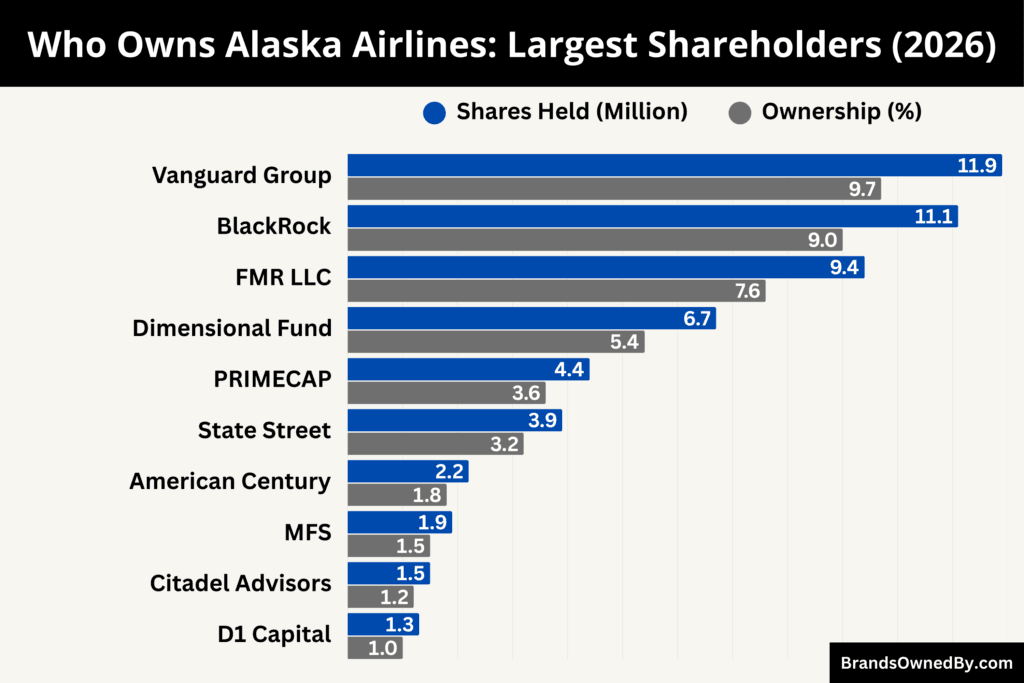
Alaska Airlines is owned by Alaska Air Group, Inc., a publicly traded airline holding company listed on the New York Stock Exchange under the ticker ALK. Because the company is publicly traded, its ownership is distributed among institutional investors, mutual funds, investment firms, company insiders, and retail investors.
Institutional investors hold the majority of Alaska Air Group shares. As of March 2026, institutions collectively control around 85–90% of the company’s outstanding stock, while retail investors and company insiders own the remaining portion.
The largest shareholder of Alaska Air Group is The Vanguard Group, which holds roughly about 9.5%–9.7% of the company’s shares. Other major shareholders include BlackRock, FMR LLC (Fidelity Investments), Dimensional Fund Advisors, PRIMECAP Management, and State Street Corporation.
The Vanguard Group
The Vanguard Group is the largest shareholder of Alaska Air Group. The investment firm holds roughly 9.5% to 9.7% of the company’s outstanding shares, representing more than 11 million shares.
Vanguard is one of the world’s largest asset management companies. It manages trillions of dollars in global investments through index funds, exchange-traded funds (ETFs), and retirement portfolios.
Most of Vanguard’s ownership in Alaska Air Group comes from index funds such as the Vanguard Total Stock Market Index Fund and other institutional portfolios. These funds invest in large publicly traded companies across the United States.
Although Vanguard holds the largest stake, it does not directly control the airline. Its role is that of a financial investor representing millions of fund investors.
BlackRock
BlackRock is another major shareholder of Alaska Air Group. The firm owns roughly about 8.8% to 9.1% of the company’s shares, making it one of the largest institutional investors in the airline.
BlackRock is the largest asset manager in the world and manages a wide range of investment products including ETFs, through its iShares platform. Many of these funds track major U.S. stock indexes.
Because Alaska Air Group is part of several mid-cap stock indexes, BlackRock funds hold shares as part of diversified portfolios. The company’s investment is spread across multiple funds rather than a single entity.
Like Vanguard, BlackRock acts primarily as a financial investor and does not participate in daily airline management.
FMR LLC (Fidelity Investments)
FMR LLC, the parent company of Fidelity Investments, is another major shareholder of Alaska Air Group. The firm holds roughly around 7% to 8% of the company’s shares.
Fidelity is a global investment management firm known for managing mutual funds, retirement accounts, and brokerage services.
Its ownership in Alaska Air Group comes mainly from Fidelity mutual funds and institutional portfolios. These funds invest in transportation and mid-cap companies across the United States.
Fidelity’s investment reflects confidence in the airline’s long-term growth potential and financial stability.
Dimensional Fund Advisors
Dimensional Fund Advisors is another significant institutional shareholder. The firm owns approximately about 5% to 6% of Alaska Air Group shares, representing several million shares.
Dimensional Fund Advisors is known for its research-driven investment strategies. The company manages a large number of institutional portfolios and retirement funds.
Its investment approach focuses on long-term market performance. Because Alaska Air Group is part of several market indexes and investment portfolios, Dimensional holds shares as part of diversified global funds.
PRIMECAP Management Company
PRIMECAP Management Company holds roughly around 3% to 4% of Alaska Air Group’s outstanding shares.
PRIMECAP is an investment firm that focuses on long-term equity investments in companies with strong growth potential. The firm manages several mutual funds and institutional portfolios.
Its stake in Alaska Air Group reflects long-term investment confidence in the airline industry and the company’s operational performance.
State Street Corporation
State Street Corporation is another major institutional investor in Alaska Air Group. The company owns roughly about 3% of the airline’s shares.
State Street manages investment funds and ETFs used by institutional investors worldwide. Many of its holdings are linked to index-tracking funds that replicate the performance of major stock market indexes.
Because Alaska Air Group is part of several market indexes, State Street funds hold shares as part of diversified portfolios.
Other Institutional Investors
In addition to the major shareholders above, several other investment firms hold smaller stakes in Alaska Air Group. These include firms such as American Century Investments, Massachusetts Financial Services, Citadel Advisors, and D1 Capital Partners.
Each of these investors generally holds between 1% and 3% of the company’s shares through institutional funds and investment portfolios.
Together, these institutional investors represent the majority of Alaska Air Group’s shareholder base.
Retail Investors and Insider Ownership
Alongside institutional investors, a portion of Alaska Air Group shares are held by individual retail investors. These are private investors who purchase shares through brokerage accounts.
Company executives and board members also hold a small percentage of shares as part of compensation packages and long-term incentive plans.
Insider ownership is relatively small compared with institutional ownership. However, executive share ownership aligns leadership incentives with shareholder interests.
Competitor Ownership Comparison
The ownership structure of Alaska Airlines is very similar to other major airlines in the United States. Most large airlines operate as publicly traded corporations. Their shares are distributed among institutional investors, mutual funds, hedge funds, pension funds, and retail investors.
Alaska Airlines operates under Alaska Air Group, which follows this same shareholder-based ownership model. Large investment firms hold significant stakes in the company, but no single investor has majority control.
To better understand this structure, it helps to compare Alaska Airlines with several of its major competitors in the U.S. airline industry. These include American Airlines, Delta Air Lines, United Airlines, Southwest Airlines, and JetBlue Airways.
| Airline | Parent Company | Ownership Type | Largest Shareholders | Ownership Structure |
|---|---|---|---|---|
| Alaska Airlines | Alaska Air Group, Inc. | Publicly traded (NYSE: ALK) | The Vanguard Group, BlackRock, FMR LLC (Fidelity), Dimensional Fund Advisors, State Street | Majority owned by institutional investors. No controlling shareholder. |
| American Airlines | American Airlines Group Inc. | Publicly traded (NASDAQ: AAL) | The Vanguard Group, BlackRock, State Street, Fidelity | Institutional investors hold the majority of shares. Ownership widely distributed. |
| Delta Air Lines | Delta Air Lines, Inc. | Publicly traded (NYSE: DAL) | The Vanguard Group, BlackRock, Fidelity, State Street | Institutional investors dominate ownership with dispersed shareholder base. |
| United Airlines | United Airlines Holdings, Inc. | Publicly traded (NASDAQ: UAL) | The Vanguard Group, BlackRock, State Street, Fidelity | Large institutional ownership with diversified global investors. |
| Southwest Airlines | Southwest Airlines Co. | Publicly traded (NYSE: LUV) | The Vanguard Group, BlackRock, State Street, Fidelity | Widely distributed shareholder base dominated by investment funds. |
| JetBlue Airways | JetBlue Airways Corporation | Publicly traded (NASDAQ: JBLU) | The Vanguard Group, BlackRock, Fidelity, institutional hedge funds | Institutional investors hold significant stakes with no majority owner. |
American Airlines Ownership
American Airlines operates under its parent company, American Airlines Group Inc., which is listed on the NASDAQ stock exchange. The company is one of the largest airlines in the world by passenger traffic and fleet size.
Ownership of American Airlines Group is dominated by institutional investors. As of 2026, a large majority of its shares are held by major asset management firms and investment funds.
The largest shareholders include firms such as The Vanguard Group, BlackRock, and State Street Corporation. These investors hold shares through diversified index funds and retirement portfolios.
Because ownership is widely distributed across institutional investors, no single shareholder controls the airline. Corporate decisions are made by the executive leadership team and overseen by the board of directors.
This ownership model is very similar to the structure used by Alaska Air Group.
Delta Air Lines Ownership
Delta Air Lines is another major publicly traded airline in the United States. The company is listed on the New York Stock Exchange and operates one of the largest airline networks globally.
Delta’s shareholder base is heavily dominated by institutional investors. Investment firms such as Vanguard, BlackRock, and Fidelity are among the largest shareholders.
Institutional investors collectively hold a significant majority of Delta’s outstanding shares. Retail investors and company insiders own a smaller portion of the company.
Delta Air Lines operates under a corporate governance structure in which shareholders elect a board of directors, while the CEO and executive leadership team manage day-to-day operations.
The airline’s ownership structure closely mirrors that of Alaska Airlines.
United Airlines Ownership
United Airlines operates under the parent company United Airlines Holdings Inc., which is publicly traded on the NASDAQ stock exchange.
The company’s ownership is also dominated by institutional investors. Major shareholders include Vanguard Group, BlackRock, State Street Corporation, and Fidelity-managed investment funds.
These firms hold shares through large investment portfolios that track stock market indexes or invest in transportation and travel companies.
Because United Airlines Holdings has a dispersed shareholder base, there is no single controlling owner. Strategic decisions are made by the company’s management team and board of directors.
This structure reflects the standard governance model used across the airline industry.
Southwest Airlines Ownership
Southwest Airlines is one of the largest low-cost carriers in the world and is listed on the New York Stock Exchange.
The airline’s ownership is widely distributed among institutional investors. The largest shareholders typically include Vanguard Group, BlackRock, and State Street Corporation.
These firms hold shares through large index funds and institutional portfolios. Southwest Airlines also has significant participation from retail investors.
Like Alaska Airlines, Southwest operates under a public company governance structure. The executive leadership team manages operations, while the board of directors oversees corporate strategy and represents shareholder interests.
JetBlue Airways Ownership
JetBlue Airways is another major competitor of Alaska Airlines, particularly on routes across the United States and the Caribbean. The airline is publicly traded and listed on the NASDAQ stock exchange.
JetBlue’s ownership structure is also dominated by institutional investors. The largest shareholders include major asset management firms such as Vanguard Group, BlackRock, and Fidelity.
These investors hold shares through diversified investment funds and retirement portfolios. Hedge funds and activist investors have also occasionally taken positions in JetBlue to influence corporate strategy.
As with Alaska Airlines, ownership of JetBlue is widely distributed and no single investor has majority control.
What the Comparison Shows
The comparison shows that Alaska Airlines follows the same ownership structure as most major U.S. airlines.
Public airline companies require large amounts of capital to purchase aircraft, maintain fleets, develop infrastructure, and expand route networks. Listing shares on public stock markets allows these companies to raise funding from global investors.
Institutional investors, therefore, hold large stakes in most airlines, including Alaska Airlines and its competitors. These investors provide capital but do not manage airline operations directly.
Instead, professional management teams run the airlines while boards of directors represent shareholder interests.
This governance structure is standard across the airline industry and ensures that airlines can access investment capital while maintaining operational independence.
Who Controls Alaska Airlines?
Although Alaska Airlines is owned by public shareholders through Alaska Air Group, control of the company lies with its executive leadership team and board of directors. These leaders make strategic, operational, and financial decisions that determine the airline’s direction.
The governance structure follows a typical public company model. Shareholders elect the board of directors. The board appoints senior executives who manage the airline and its subsidiaries.
Chief Executive Officer
The most important decision-maker at Alaska Airlines is Ben Minicucci, the Chief Executive Officer of Alaska Air Group.
Minicucci became CEO in March 2021 after previously serving as President of Alaska Airlines. He joined the company in 2004 and has held multiple operational leadership roles.
As CEO, Minicucci oversees:
- Corporate strategy and long-term growth
- Airline network expansion and partnerships
- Fleet strategy and aircraft investments
- Financial performance and shareholder value
- Integration of major acquisitions such as Hawaiian Airlines.
Under his leadership, Alaska Air Group has focused on expanding its global partnerships through the oneworld alliance and strengthening its West Coast network.
Executive Leadership Team
The CEO is supported by a senior leadership team responsible for running key parts of the airline’s operations.
Major executives at Alaska Air Group and Alaska Airlines as of 2026 include:
- Shane Tackett (Chief Financial Officer)
Oversees financial strategy, capital allocation, investor relations, and corporate financial planning for Alaska Air Group. - Constance von Muehlen (Chief Operating Officer)
Responsible for airline operations including flight operations, maintenance, safety, and operational performance across the network. - Andrew Harrison (Chief Commercial Officer)
Leads commercial strategy including route planning, pricing strategy, revenue management, partnerships, and loyalty programs. - Charu Jain (Senior Vice President, Innovation and Merchandising)
Oversees digital commerce, customer experience innovation, and merchandising strategy across Alaska Airlines platforms. - Andrea Schneider (Senior Vice President, People)
Leads workforce strategy, employee engagement, and organizational development across the company.
These executives manage daily airline operations while executing the long-term strategy defined by the CEO and board.
Board of Directors
The Alaska Air Group Board of Directors provides oversight and governance for the company. The board represents shareholder interests and supervises executive leadership.
As of 2026, the board includes experienced leaders from industries such as aviation, technology, finance, and global business.
Key members include:
- Patty Bedient — Board Chair
- Ben Minicucci — CEO and Board Member
- Brad Tilden — Former CEO of Alaska Air Group
- J. Kenneth Thompson — Former CEO of Pacific Life
- Douglas Steenland — Former CEO of Northwest Airlines
- Kristin R. Peck — CEO of Zoetis.
The board is responsible for:
- Appointing and evaluating the CEO
- Approving major acquisitions and strategic investments
- Overseeing financial performance and risk management
- Representing shareholder interests in corporate governance.
Decision-Making Structure
Control of Alaska Airlines operates through a structured hierarchy.
- Shareholders own the company through publicly traded stock.
- The board of directors represents shareholders and oversees governance.
- The CEO sets the company’s strategic direction.
- Senior executives manage daily airline operations.
This governance structure allows Alaska Airlines to balance investor accountability with professional operational management.
Alaska Airlines Annual Revenue and Net Worth

As of March 2026, the company generates about $12.3 billion in annual revenue and has an estimated net worth of approximately $8.5 billion. These figures reflect steady post-pandemic recovery, expanded passenger demand, and network growth across North America.
Revenue is primarily generated from passenger transportation, loyalty program partnerships, cargo services, and ancillary airline products. Passenger travel remains the dominant revenue source, but additional income streams such as Mileage Plan partnerships and cargo operations provide financial diversification.
Revenue Breakdown in 2026
In 2026, Alaska Air Group’s estimated $12.3 billion revenue comes from several major business segments within the airline ecosystem.
The largest portion of revenue comes from passenger transportation, which accounts for roughly $10.2 billion of the company’s total annual revenue. This segment includes ticket sales from domestic routes across the United States as well as international routes to Canada, Mexico, and Central America. Alaska Airlines operates a strong network of routes connecting West Coast hubs such as Seattle, Portland, San Francisco, and Los Angeles to more than 120 destinations.
The Mileage Plan loyalty program represents the second major revenue stream. Loyalty partnerships generate approximately $1.1 billion in annual revenue. Airlines sell miles to banks and financial institutions that offer airline credit cards and reward programs. These agreements create a stable, recurring revenue stream and are among the most profitable parts of the airline business.
Cargo operations are another important contributor. Alaska Air Cargo generates about $550 million annually by transporting freight, e-commerce shipments, and mail across the airline’s route network. Cargo services are particularly important for shipments between Alaska and the continental United States.
Ancillary services generate the remaining revenue. These services contribute around $450 million annually and include baggage fees, seat upgrades, onboard purchases, and premium seating options.
Together, these revenue streams combine to generate the airline’s estimated $12.3 billion annual revenue in 2026.
Net Worth and Market Valuation in 2026
The net worth of Alaska Airlines is typically measured through the market capitalization of Alaska Air Group. Market capitalization represents the total value of the company’s publicly traded shares.
As of 2026, Alaska Air Group’s estimated market capitalization is approximately $8.5 billion. This value is calculated based on the company’s stock price and the number of outstanding shares.
Several factors influence the airline’s valuation. These include passenger demand, operating costs such as fuel prices, airline competition, and investor expectations about future growth.
Compared with larger global airlines, Alaska Air Group operates as a mid-size airline company. However, it maintains strong financial stability due to efficient operations, strong customer loyalty, and a profitable route network concentrated on the U.S. West Coast.
Financial Growth Since Major Acquisitions
Alaska Air Group’s financial growth over the past decade has been shaped by strategic acquisitions and network expansion.
The 2016 acquisition of Virgin America significantly increased the airline’s presence in California and major U.S. travel markets. This acquisition expanded the airline’s passenger base and increased total revenue in subsequent years.
Another major development occurred in 2024 when Alaska Air Group acquired Hawaiian Airlines. The acquisition expanded the company’s network into the Pacific region and added long-haul routes between Hawaii, the mainland United States, and international destinations.
These strategic moves strengthened the airline’s competitive position and contributed to revenue growth in the years following the pandemic recovery.
Revenue Forecast Through 2030
Industry analysts expect Alaska Air Group’s revenue to continue growing as travel demand increases and the integration of Hawaiian Airlines expands the company’s network.
Projected revenue growth for the airline is estimated as follows:
- 2027: approximately $13.1 billion
- 2028: approximately $14.0 billion
- 2029: approximately $15.0 billion
- 2030: approximately $16.2 billion.
Future revenue growth is expected to be driven by expanding international routes, increased passenger traffic across the Pacific, continued growth in loyalty program partnerships, and improvements in fleet efficiency through newer aircraft.
If these strategic initiatives continue to perform well, Alaska Air Group could strengthen its financial position and remain one of the most competitive mid-size airlines in North America through the end of the decade.
Companies Owned by Alaska Airlines
Alaska Airlines operates several companies, service divisions, and internal brands that support its airline ecosystem. These include operational subsidiaries, travel service brands, cargo operations, loyalty programs, and commercial travel platforms.
The following are the key companies, brands, and operational entities associated directly with Alaska Airlines as of March 2026:
| Company / Brand | Type | Year Launched / Acquired | Status | Key Details |
|---|---|---|---|---|
| Alaska Airlines | Main Airline Brand | 1932 | Active | Core airline operating passenger flights across more than 120 destinations in North America, Central America, and the Pacific region. Main hub in Seattle. |
| Virgin America | Airline Acquisition | 2016 | Integrated (2018) | Acquired for about $4 billion. Expanded Alaska Airlines’ presence in California markets including San Francisco and Los Angeles before being fully merged into Alaska Airlines. |
| Jet America Airlines | Airline Acquisition | 1986 | Integrated | Regional airline acquired to expand Alaska Airlines’ network in the western United States. Operations later merged into Alaska Airlines. |
| Alaska Air Cargo | Cargo Division | 1940s | Active | Freight and logistics division transporting cargo, mail, and commercial shipments across the airline’s network, especially between Alaska and the mainland United States. |
| Mileage Plan | Loyalty Program | 1980s | Active | Alaska Airlines’ frequent flyer program with millions of members. Generates revenue through airline partnerships and co-branded credit card agreements. |
| Alaska Airlines Vacations | Travel Package Brand | 2000s | Active | Travel booking platform offering bundled vacation packages including flights, hotels, rental cars, and experiences. |
| Alaska Lounge | Airport Lounge Brand | 1980s | Active | Premium airport lounge network located in major airports such as Seattle, Portland, San Francisco, Los Angeles, and Anchorage. |
| Alaska Airlines Corporate Travel Program | Corporate Services | 2000s | Active | Business travel platform offering negotiated fares, reporting tools, and travel management services for corporate customers. |
| Alaska Airlines Digital Platforms | Technology Platform | 2000s | Active | Includes mobile apps, online booking systems, and digital customer service platforms used for reservations, check-in, and loyalty management. |
Alaska Airlines
Alaska Airlines is the primary airline brand and the core operating entity within Alaska Air Group. The airline traces its origins to 1932 and has grown into one of the largest airlines in the United States.
The airline operates hundreds of daily flights across more than 120 destinations throughout the United States, Canada, Mexico, Costa Rica, and Belize. Its largest hub is Seattle–Tacoma International Airport, which serves as the airline’s main gateway for domestic and international connections.
Alaska Airlines operates a fleet primarily consisting of Boeing 737 aircraft along with Embraer regional jets operated by partner carriers. The airline focuses strongly on West Coast routes and maintains one of the most extensive route networks connecting the Pacific Northwest to the rest of North America.
The airline joined the oneworld global airline alliance in 2021, which expanded its international connectivity through partnerships with major global carriers.
Virgin America
Virgin America was one of the most important acquisitions in Alaska Airlines’ history. Alaska Air Group announced the acquisition of Virgin America in 2016 in a deal valued at approximately $4 billion including debt and leases.
Virgin America was known for its premium in-flight experience and strong presence in California markets such as San Francisco and Los Angeles.
After the acquisition, Alaska Airlines integrated Virgin America’s aircraft, routes, and operations into its network. The Virgin America brand was officially retired in 2018 as part of the integration process.
The acquisition significantly expanded Alaska Airlines’ footprint in California and strengthened its competitive position against larger U.S. carriers.
Jet America Airlines
Jet America Airlines was another airline acquired by Alaska Air Group during its expansion period in the 1980s. The airline primarily operated routes across the western United States.
Alaska Air Group acquired Jet America in 1986. Shortly after the acquisition, the airline’s operations were merged into Alaska Airlines. The Jet America brand was eventually discontinued as the routes and aircraft were absorbed into Alaska Airlines’ network.
This acquisition helped Alaska Airlines expand its presence in several U.S. markets and increase its passenger capacity.
Alaska Air Cargo
Alaska Air Cargo is the dedicated cargo division of Alaska Airlines. The service transports freight, mail, and commercial shipments across the airline’s network.
Cargo operations are particularly important for shipments between Alaska and the mainland United States. Many remote communities rely on Alaska Air Cargo for essential goods and supplies.
The cargo division also supports e-commerce shipments, seafood transport, and specialized freight services. Cargo operations generate hundreds of millions of dollars in annual revenue and remain an important component of Alaska Airlines’ diversified business model.
Mileage Plan Loyalty Program
Mileage Plan is the frequent flyer program operated by Alaska Airlines. It is one of the airline’s most valuable customer loyalty assets and serves millions of members worldwide.
Members earn miles when flying with Alaska Airlines or partner airlines within the oneworld alliance. Miles can also be earned through credit card purchases, hotel bookings, car rentals, and other travel partnerships.
The program generates significant revenue through agreements with financial institutions that purchase miles to offer airline credit card rewards.
Mileage Plan also includes elite status tiers that provide benefits such as priority boarding, complimentary upgrades, and free checked baggage.
Alaska Airlines Vacations
Alaska Airlines Vacations is the airline’s travel package platform. It allows travelers to book bundled vacation packages that combine flights, hotels, rental cars, and local experiences.
The service focuses primarily on vacation destinations such as Hawaii, Mexico, California, and the Caribbean.
Customers who book through Alaska Airlines Vacations can earn or redeem Mileage Plan miles, creating integration between the airline’s travel services and loyalty program.
This division generates additional revenue by partnering with hotels, resorts, and tourism providers.
Alaska Lounge
Alaska Lounge is the airline’s airport lounge brand designed for premium travelers and frequent flyers.
The lounges provide amenities such as comfortable seating areas, complimentary food and beverages, high-speed internet, and workspaces for business travelers.
Alaska Airlines operates several Alaska Lounge locations across major airports including Seattle, Portland, San Francisco, Los Angeles, Anchorage, and New York.
Access is available to lounge members, elite Mileage Plan members, premium cabin passengers, and certain partner airline travelers.
Alaska Airlines Corporate Travel Program
Alaska Airlines also operates a corporate travel program that provides services to business customers and large corporate accounts.
The program offers companies negotiated travel rates, travel management tools, and loyalty benefits tied to corporate travel spending.
Businesses that frequently book flights with Alaska Airlines can receive special travel incentives and customized travel reporting tools.
This program helps the airline secure long-term contracts with companies and strengthens its position in the corporate travel segment.
Alaska Airlines Digital Platforms
Alaska Airlines operates a large digital ecosystem that includes its official website, mobile applications, and booking platforms.
These digital platforms allow customers to search for flights, manage reservations, check in for flights, track loyalty miles, and receive real-time travel updates.
The airline’s digital platforms also generate ancillary revenue through seat upgrades, baggage purchases, and onboard service purchases.
These systems are central to Alaska Airlines’ customer experience strategy and operational efficiency.
Strategic Airline Partnerships
Although not owned companies, Alaska Airlines also maintains several strategic airline partnerships that expand its global network.
As a member of the oneworld alliance, Alaska Airlines works with global carriers such as American Airlines, British Airways, Qatar Airways, Japan Airlines, and Qantas.
These partnerships allow passengers to travel to hundreds of international destinations while earning and redeeming Mileage Plan miles.
Through these alliances, Alaska Airlines extends its global reach without directly operating long-haul international airlines.
Final Words
The question of who owns Alaska Airlines reflects how most major airlines operate today. The airline is owned by Alaska Air Group and its shares are held by a wide range of institutional investors and public shareholders. No single entity controls the company, which allows ownership to remain widely distributed.
Operational control rests with the company’s leadership and board, who guide strategy, expansion, and long-term growth. Supported by strong brand recognition, a loyal customer base, and an extensive route network, Alaska Airlines continues to remain an important player in the North American aviation market.
FAQs
What company owns Alaska Airlines?
Alaska Airlines is owned by Alaska Air Group, Inc., a publicly traded airline holding company headquartered in Seattle. Alaska Air Group operates Alaska Airlines as its main airline brand along with several aviation-related services.
The company is listed on the New York Stock Exchange, and its shares are owned by institutional investors, mutual funds, and individual shareholders.
Who are Alaska Airlines partners?
Alaska Airlines partners with several international and regional airlines through alliances and codeshare agreements. The airline is a member of the oneworld global airline alliance, which connects its network with major global carriers.
Major partners include American Airlines, British Airways, Japan Airlines, Qatar Airways, Qantas, Cathay Pacific, Finnair, and Iberia. Through these partnerships, Alaska Airlines passengers can travel to hundreds of global destinations while earning or redeeming Mileage Plan miles.
Does American own Alaska Airlines?
No, American Airlines does not own Alaska Airlines. Both airlines are separate companies with different parent organizations.
Alaska Airlines is owned by Alaska Air Group, while American Airlines operates under American Airlines Group. However, the two airlines cooperate through the oneworld alliance and codeshare partnerships.
Are Delta and Alaska Airlines partners?
Delta Air Lines and Alaska Airlines previously had a codeshare partnership that allowed passengers to connect flights and earn loyalty points across both airlines.
The partnership ended in 2017 after Delta significantly expanded its operations in Seattle, making the two airlines direct competitors on many routes.
Who is the largest shareholder of Alaska Airlines?
The largest shareholder of Alaska Air Group is The Vanguard Group, which owns roughly 9.7% of the company’s shares.
Other major institutional shareholders include BlackRock, Fidelity Investments (FMR LLC), Dimensional Fund Advisors, PRIMECAP Management, and State Street Corporation.
Is Alaska Airlines owned by Delta?
No, Alaska Airlines is not owned by Delta Air Lines. Both airlines operate independently and are publicly traded companies with separate ownership structures.
Alaska Airlines is owned by Alaska Air Group, while Delta Air Lines is its own airline corporation.
Does Alaska own Hawaiian Airlines?
Yes, Alaska Air Group agreed to acquire Hawaiian Airlines in a deal valued at approximately $1.9 billion, which was completed in 2024.
Hawaiian Airlines continues to operate as a separate airline brand within Alaska Air Group, allowing the company to expand its network across Hawaii and the Pacific region.