
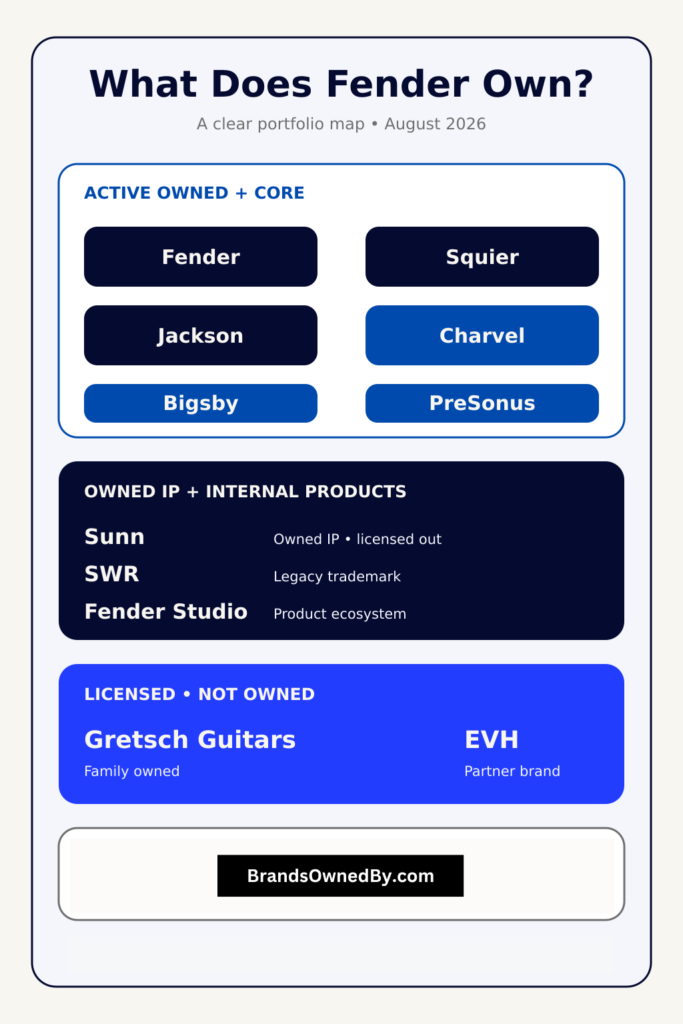
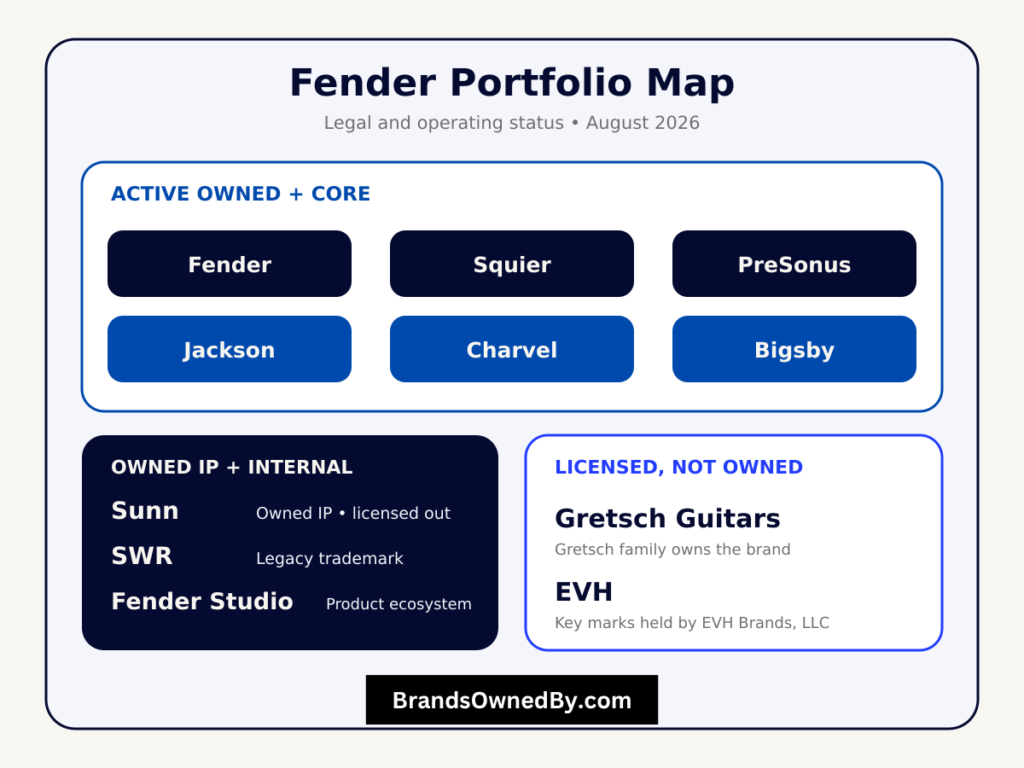
- Fender’s active owned portfolio centers on Fender, Squier, Jackson, Charvel, Bigsby, and PreSonus.
- PreSonus is the clearest full-company acquisition. Most other names are brands or business lines inside FMIC.
- Fender owns Sunn’s intellectual property and licenses it to an independent operator. SWR remains a legacy Fender trademark.
- Gretsch Guitars and EVH are licensed relationships. They should not be described as wholly owned Fender brands.
Fender Musical Instruments Corporation, or FMIC, owns Squier, Jackson, Charvel, Bigsby, and PreSonus. Fender is its flagship brand. The group also owns the Sunn intellectual property and the legacy SWR trademark. Gretsch Guitars and EVH are licensed relationships, not wholly owned Fender businesses.
That distinction matters. A name can appear in Fender’s commercial portfolio without being legally owned by Fender. This guide separates operating companies, active brands, internal products, licenses, and dormant intellectual property using information reviewed through August 25, 2026.
Fender Ownership Status at a Glance
The table gives the fastest, most accurate answer to what companies does Fender own as of August 2026:
| Name | Current status | Relationship to Fender |
|---|---|---|
| Fender | Core corporate brand | Flagship brand of FMIC |
| Squier | Owned and active | Entry-level and value instruments |
| Jackson | Owned and active | Performance guitars and basses |
| Charvel | Owned and active | Hot-rodded performance guitars |
| Bigsby | Owned and active | Vibrato systems and guitar hardware |
| PreSonus | Owned operating company | Recording hardware, live sound, and software |
| Fender Studio | Internal product ecosystem | Software and creator tools built within Fender |
| Sunn | Fender-owned intellectual property | Operated by an independent company under an exclusive license |
| SWR | Legacy Fender trademark | Bass amplification brand with no broad current product line |
| Gretsch Guitars | Licensed relationship | Gretsch family owns the brand; Fender supports the guitar business |
| EVH | Licensed relationship | Key marks belong to EVH Brands, LLC |
Fender Founder and Origin
Fender’s origin explains why the group still competes through practical engineering rather than ornamental design alone. The business began with repair work. It then moved into amplifiers, steel guitars, solid-body electric guitars, and basses that could be manufactured and serviced efficiently.
Clarence “Leo” Fender
Clarence Leonidas “Leo” Fender founded the company that became Fender Electric Instrument Company in Fullerton, California, in 1946. He had opened Fender’s Radio Service in 1938. That repair business exposed him to recurring problems in amplifiers and public-address equipment.
Leo Fender was not known as a performing guitarist. His strength was product engineering. He designed instruments around the needs of working musicians. Bolt-on necks simplified production and repair. Solid bodies reduced feedback. Replaceable components made maintenance easier.
The Broadcaster, later renamed the Telecaster, put this approach into a commercially successful electric guitar. Fender followed it with the Precision Bass in 1951 and the Stratocaster in 1954. These were not minor variations on existing instruments. They helped establish new product categories and production standards.
Doc Kauffman and the K&F Predecessor
Before the Fender company was formed, Leo Fender worked with Clayton Orr “Doc” Kauffman. The pair created K&F Manufacturing Corporation in the mid-1940s. K&F produced lap-steel guitars and amplifiers.
Kauffman left the partnership before Leo established Fender Electric Instrument Company in 1946. It is therefore most accurate to call Leo Fender the founder of Fender. Kauffman was the co-founder of its immediate predecessor.
From CBS to Fender Musical Instruments Corporation
Leo Fender sold the business to CBS in 1965. CBS owned Fender for two decades. In 1985, a management-led investor group headed by William “Bill” Schultz bought the business from CBS and formed Fender Musical Instruments Corporation, usually shortened to FMIC.
The 1985 transaction matters because the current Fender corporation is the successor created by that buyout. Servco participated in the investor group and remained connected to Fender for decades. It eventually became the controlling owner.
List of Companies and Brands Owned by Fender
Fender’s owned portfolio covers instruments, components, amplification, recording hardware, and music software. The corporate form differs by name. PreSonus arrived as an operating company. Squier, Jackson, Charvel, and Bigsby function mainly as brands within the group.
Fender
Fender is FMIC’s core brand. It is not a separate acquisition that the corporation happens to own. The name anchors the group’s identity and its largest product platform.
Fender sells electric guitars, acoustic guitars, basses, amplifiers, effects, accessories, apparel, and digital services. Stratocaster, Telecaster, Jazzmaster, Jaguar, Precision Bass, and Jazz Bass are product families. They are not separate companies.
The Fender Custom Shop is also a division. It serves professional musicians and collectors through limited, team-built, and master-built instruments. Fender Play sits at the other end of the customer journey. It helps new players learn and remain engaged.
The practical strategy is lifecycle ownership. A customer can learn through Fender Play, begin on a Squier, upgrade to Fender, and record with PreSonus or Fender Studio products.
Squier
Squier is an active Fender-owned brand. Fender acquired the V.C. Squier Company in 1965. The business had deep roots in string manufacturing. Fender later revived the Squier name for instruments in 1982.
Squier gives Fender a credible entry-level range without forcing the main Fender name to cover every price point. Its catalog includes accessible versions of familiar Fender designs. It also supports original series and artist models.
Consider a first-time buyer who wants a Stratocaster-style guitar and a modest amplifier. Squier lets Fender serve that customer. If the player later upgrades to a Player II or American Professional instrument, Fender keeps the relationship inside the same group.
Squier is a brand, not a separately traded subsidiary. Its financial performance is consolidated into Fender’s private accounts.
Jackson
Jackson is an active Fender-owned brand. Fender acquired Jackson and Charvel assets in October 2002. The deal included trademarks, inventory, and related operating assets.
Jackson focuses on high-performance guitars and basses. The range is closely associated with hard rock and metal. Typical features include fast necks, high-output pickups, extended ranges, locking tremolos, and aggressive body shapes.
This positioning protects brand clarity. Fender can continue to lead with classic and alternative designs. Jackson can compete directly for metal players without forcing the Fender name into a category where another identity has greater credibility.
Charvel
Charvel entered Fender with Jackson in the 2002 asset purchase. It remains an active owned brand.
The company is known for hot-rodded electric guitars. Many models pair familiar body shapes with high-output electronics, fast necks, and performance-focused hardware. The result is more restrained visually than many Jackson instruments, but no less purpose-built.
Jackson and Charvel therefore complement each other. A retailer can offer Jackson to a player seeking an overt metal design. The same retailer can position Charvel for a player who wants similar speed and flexibility in a more traditional silhouette.
Bigsby
Fender acquired Bigsby and its assets from Fred Gretsch Enterprises in January 2019. Bigsby is best known for vibrato tailpieces used across several guitar brands.
The acquisition differs from buying another guitar label. Bigsby is a component platform. Its products can appear on Fender, Gretsch, and third-party instruments. It also serves repair, customization, and aftermarket demand.
Bigsby has strategic heritage value as well. Paul Bigsby was an influential early electric-guitar designer. Fender gained a recognizable hardware name with relevance beyond its own instrument catalog.
PreSonus Audio Electronics
Fender completed its acquisition of PreSonus in 2021. This is the strongest answer when someone asks what actual company Fender bought. PreSonus arrived with teams, hardware, software, customers, and a position in professional and home recording.
Its range has included audio interfaces, studio monitors, mixers, controllers, microphones, live-sound tools, and production software. Those categories extend Fender beyond the replacement cycle for guitars and amplifiers.
The commercial logic is straightforward. A musician can play a Fender or Squier instrument, connect through a PreSonus interface, monitor through PreSonus speakers, and finish a track in Fender’s software environment. Fender participates in more of the creative workflow.
Fender Studio
Fender Studio is an internal software and creator-products ecosystem. It should not be treated as a separate acquired company.
The brand builds on technology and expertise connected to the PreSonus acquisition. Fender Studio Pro succeeds the Studio One recording platform. The wider identity brings production software, mobile tools, Fender amplifier technology, and compatible hardware into a more unified offering.
This matters because software changes Fender’s economics. Instruments are occasional purchases. Software can generate upgrades, subscriptions, add-ons, and frequent customer contact. Fender Studio also gives the company a place in the workflow after the instrument has been sold.
Fender-Owned Intellectual Property and Legacy Brands
Some Fender-owned names do not operate like the active brands above. They still matter legally and strategically. Their status needs a separate category.
Sunn
Fender owns the Sunn name, logo, and associated intellectual property. That makes Sunn part of Fender’s owned asset base.
The current Sunn Musical Equipment Corporation is independently operated. It uses the Sunn intellectual property under an exclusive license from Fender. Fender does not run its daily business or manufacture its current products.
This is a subtle but important correction. Calling Sunn “formerly owned by Fender” is inaccurate. Calling the new Sunn company a normal Fender subsidiary is also inaccurate. The defensible description is Fender-owned IP operated by an independent licensee.
SWR
SWR is a Fender-owned legacy trademark associated with bass amplification. Fender acquired the brand in 2003. It later discontinued the broad SWR product line.
The trademark has not simply vanished. Current Fender corporate materials continue to identify SWR as an FMIC mark. It belongs in a complete ownership map, but not beside Squier or Jackson as an equally active consumer brand.
Brands Licensed to Fender but Not Owned by It
Fender sometimes describes its portfolio as containing owned and licensed brands. The two licensed relationships below are commercially important. Neither transfers full legal ownership to Fender.
Gretsch Guitars
Fender does not own Gretsch. The Gretsch family, through Fred W. Gretsch Enterprises, retains ownership of the Gretsch business and trademarks.
An agreement reached in 2002 gave Fender responsibility for major parts of the Gretsch guitar operation. These include product development, manufacturing coordination, marketing, and distribution. Fender therefore has meaningful operating influence without owning the brand.
The arrangement concerns Gretsch guitars. It does not make Gretsch Drums a Fender-owned business. A useful retail example is warranty and distribution support. A customer may interact with Fender systems, even though the product name remains family owned.
EVH
EVH is a licensed partner brand in Fender’s commercial system. The key EVH, 5150, and Wolfgang marks belong to EVH Brands, LLC rather than FMIC.
Fender supports product development, manufacturing, marketing, distribution, service, and warranties under the relationship. That operating role explains why EVH often appears alongside Fender’s owned brands.
The legal conclusion remains different. Fender participates deeply in the EVH business, but “Fender wholly owns EVH” is not a reliable description.
Former Fender Brands and Companies Fender Does Not Own
Several names appear in outdated ownership lists because Fender once owned them or worked with them. Others are simply confused with Fender because they compete in the same market.
Guild
Fender acquired Guild in 1995 and sold it to Cordoba Music Group in 2014. Guild is therefore a former Fender brand, not a current holding.
KMC Music and Related Brands
Fender sold the KMC Music wholesale distribution business in 2015. The transaction moved several product lines and brands out of Fender’s portfolio, including Ovation, Hamer, Latin Percussion, Toca, and Genz Benz.
Historical association does not establish current ownership. Any article that includes these names in Fender’s active 2026 portfolio is mixing time periods.
Acquisition and Relationship Timeline
This timeline shows how the current Fender brand portfolio took shape. It also identifies whether each event involved ownership or a commercial agreement.
| Year | Brand or company | Transaction or relationship | Current classification |
| 1965 | Squier | Fender acquired V.C. Squier Company | Owned, active brand |
| 2002 | Jackson and Charvel | Fender acquired operating assets and trademarks | Owned, active brands |
| 2002 | Gretsch Guitars | Commercial agreement with the Gretsch family | Licensed relationship |
| 2003 | SWR | Fender acquired the bass-amplification brand | Owned, legacy trademark |
| 2019 | Bigsby | Fender acquired the brand and assets | Owned, active brand |
| 2021 | PreSonus | Fender completed a merger acquisition | Owned operating company |
| 2023 | Sunn | Independent operator received an exclusive license | Fender-owned IP, licensed out |
Who Owns Fender?
Fender is privately held. It has no publicly traded stock and does not file a public proxy statement listing every shareholder. Credit-rating information nevertheless provides a credible view of the controlling stake.
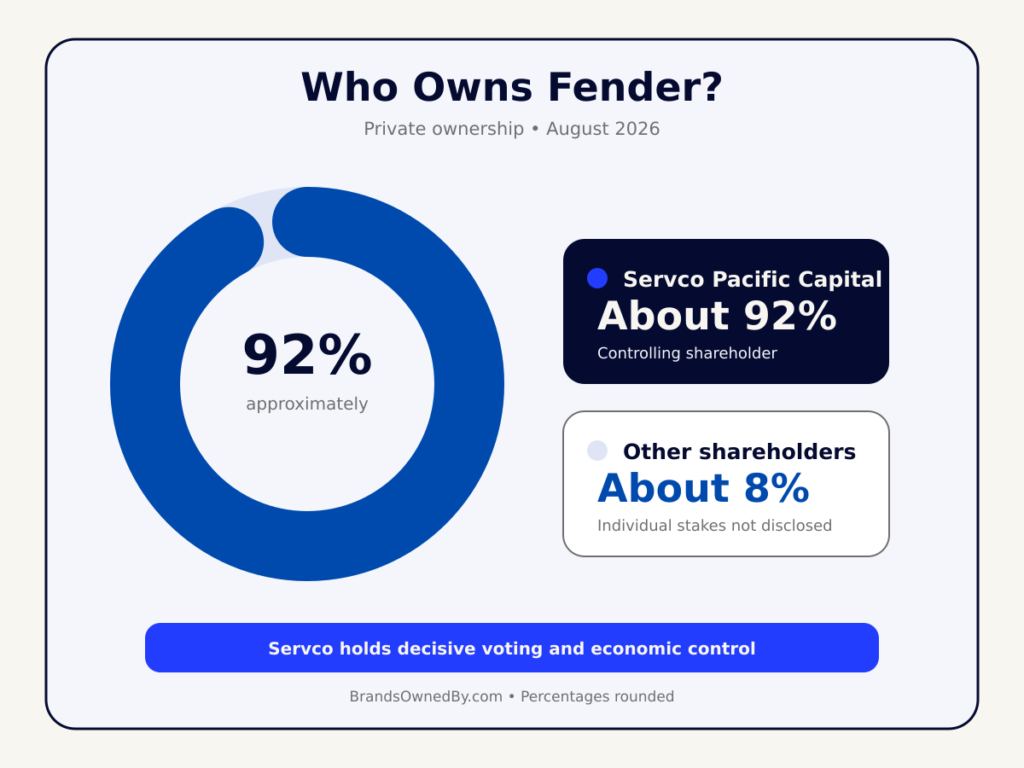
Servco Pacific Capital (92%)
Servco Pacific Capital, part of Hawaii-based Servco Pacific, owns about 92% of Fender as of August 2026. This is both an economic majority and a decisive voting position.
Servco’s relationship with Fender is unusually long for a financial owner. It sold Fender products in Hawaii in the 1950s. It joined the investor group that bought Fender from CBS in 1985. Servco later increased its investment and became an equal partner with TPG Growth in 2012.
In 2020, Servco agreed to acquire TPG Growth’s Fender shares. That transaction gave Servco the majority position. Subsequent credit analysis places its holding at about 92%.
Other Minority Shareholders
The remaining approximately 8% is held by other minority investors. Fender does not publicly identify a current holder-by-holder breakdown.
It would be misleading to assign individual percentages to executives, employees, or historical investors without a current capitalization table. TPG Growth is not a current major shareholder. Servco bought its position in 2020.
Competitor Ownership Comparison
Fender’s concentrated strategic ownership differs from the structures behind other major guitar groups. Those differences affect disclosure, investment horizons, and management accountability.
| Company | Ownership model | Key contrast with Fender |
| Gibson Brands | Private, investor controlled | Ownership followed a 2018 restructuring |
| Yamaha Corporation | Public company | Broad shareholders and extensive reporting |
| Taylor Guitars | Employee owned | ESOP owns the company for eligible employees |
| PRS Guitars | Private and founder led | Founder remains central to product identity |
| Ibanez | Brand of private Hoshino Gakki | Ibanez is a brand within a parent group |
Gibson Brands
Gibson is privately held. Investors led by KKR took control when Gibson emerged from Chapter 11 restructuring in 2018.
Both Fender and Gibson operate without the quarterly reporting expected from public companies. Their controlling-owner histories differ. Servco has participated in Fender since the 1985 buyout. Gibson’s current ownership emerged from a creditor-led restructuring.
Gibson also owns Epiphone and Kramer.
Yamaha Corporation
Yamaha is a publicly traded Japanese corporation. Its shares are dispersed among institutional and other investors. It has no single owner comparable to Servco’s 92% Fender stake.
Yamaha publishes audited consolidated and segment results. Fender provides far less financial detail because it is private.
Yamaha is also more diversified. It competes in guitars and amplifiers, but it has major positions in pianos, keyboards, wind instruments, drums, and professional audio.
Taylor Guitars
Taylor Guitars became fully employee-owned through an employee stock ownership plan in 2021. An ESOP trust holds the business for eligible employees.
That model differs sharply from Fender’s concentrated outside ownership. Both structures can support long investment horizons. Their incentives are not identical. Taylor’s employee beneficiaries participate through the plan. Fender’s ultimate voting power rests with Servco.
PRS Guitars
PRS Guitars is privately held and founder-led. Paul Reed Smith remains central to product development and the company’s identity.
Fender retains Leo Fender’s design legacy, but Leo stopped owning the company in 1965. Modern Fender governance sits with Servco and the board. PRS therefore offers a stronger example of continuing founder influence.
Ibanez
Ibanez is owned by privately held Hoshino Gakki of Japan. Hoshino also owns Tama, which extends the parent group into drums.
The model resembles Fender’s use of distinct brands to reach different players. The corporate architecture differs. Fender is both the flagship name and the operating group. Ibanez is a brand within Hoshino Gakki.
Who Controls Fender?
Control has three layers at Fender. Servco controls shareholder voting. The board oversees strategy and senior management. Fender’s executives run daily operations.
Servco’s Voting Control
An ownership stake of about 92% gives Servco the practical ability to approve director elections and other shareholder-level decisions. Minority investors cannot outvote it as a group.
That does not mean Servco selects individual guitar specifications. It means Servco can shape governance, capital allocation, major financing, acquisitions, and leadership through the board.
Mark Fukunaga and the Board
Mark Fukunaga is the chairman and chief executive officer of Servco and serves as executive chairman of FMIC. This role places Servco’s senior leadership directly at the board level.
The board appointed Edward “Bud” Cole as Fender’s chief executive officer and as a director. Board control is especially relevant because Fender carries substantial debt and must balance growth investment with liquidity and lender requirements.
Edward “Bud” Cole and Executive Management
Edward “Bud” Cole officially became Fender’s CEO on February 16, 2026. He succeeded Andy Mooney, who led the company for about a decade.
Cole previously ran Fender’s Asia-Pacific business. His operating responsibilities include global strategy, brand development, distribution, manufacturing priorities, digital products, and financial execution. Matt Janopaul serves as chief financial officer. Justin Norvell leads the Americas business.
In practical terms, Servco controls Fender as owner. The board controls governance. Cole and the executive team control day-to-day execution.
Final Words
Fender owns a compact but strategically broad portfolio. Squier covers accessible instruments. Jackson and Charvel address performance players. Bigsby adds hardware. PreSonus and Fender Studio extend the group into recording and software.
The legal boundaries are just as important as the brand names. Fender owns Sunn’s intellectual property but licenses it to an independent operator. It retains SWR as a legacy mark. Gretsch Guitars and EVH are commercial partners rather than wholly owned subsidiaries.
For ownership research, use the category before the logo. Ask whether the name is an operating company, an owned brand, a licensed relationship, a legacy trademark, or a former asset. That method produces a far more accurate answer to what companies Fender owns.
FAQs
What companies does Fender own?
Fender owns PreSonus as an operating company. Its active owned brands include Squier, Jackson, Charvel, and Bigsby. Fender is the flagship brand of FMIC. Fender also owns Sunn intellectual property and the legacy SWR trademark.
Does Fender own Squier?
Yes. Squier is wholly within Fender’s portfolio. It serves entry-level and value-oriented players with instruments that often use familiar Fender designs.
Does Fender own Jackson and Charvel?
Yes. Fender acquired Jackson and Charvel assets and trademarks in 2002. Both remain active Fender-owned brands.
Does Fender own PreSonus?
Yes. Fender completed its acquisition of PreSonus in 2021. PreSonus brought recording hardware, live-sound products, and software capabilities into the group.
Does Fender own Gretsch?
No. The Gretsch family retains ownership. Fender supports major parts of the Gretsch guitar business under a long-term agreement. Gretsch Guitars is a licensed relationship, not a wholly owned Fender brand.
Does Fender own EVH?
Not outright. Fender manufactures, distributes, supports, and markets EVH products through a licensing relationship. The key EVH trademarks belong to EVH Brands, LLC.
Does Fender own Sunn amps?
Fender owns the Sunn name, logo, and intellectual property. The current Sunn Musical Equipment Corporation operates independently under an exclusive license from Fender.
Does Fender still own SWR?
Fender retains the SWR trademark. The brand is best classified as legacy or dormant because it does not have a broad active product line comparable to Squier, Jackson, or PreSonus.
Is Fender owned by CBS?
No. CBS sold the Fender business to a management-led investor group in 1985. That buyout created the modern Fender Musical Instruments Corporation.
Who owns Fender now?
Servco Pacific Capital owns about 92% of Fender and controls the company. Other minority shareholders collectively hold about 8%, but Fender does not disclose a current individual breakdown.