

- Crumbl Cookies is a privately owned, founder-controlled company, with Jason McGowan holding 58% and maintaining full decision-making authority as CEO.
- Co-founder Sawyer Hemsley owns 32%, and together the founders control 90% of the company, ensuring strategic and operational control remains internal.
- TSG Consumer Partners holds an 8% minority stake, providing capital and advisory support but no controlling power or operational authority.
- Other shareholders collectively own just 2%, meaning ownership is highly concentrated with minimal external influence, which enables fast decision-making and consistent brand execution.
Crumbl Cookies is a gourmet cookie brand known for its fresh, oversized cookies and rotating weekly menu. The company was founded in 2017 in Logan, Utah. It quickly gained attention for its modern approach to a traditional dessert.
The brand stands out because it changes its menu every week. Customers return often to try new flavors. This strategy creates urgency and excitement. It also keeps the product line fresh and engaging.
Crumbl focuses heavily on customer experience. Its stores feature open kitchens where customers can watch cookies being made. The signature pink box has become a recognizable symbol of the brand.
The company has expanded rapidly through franchising. Each location follows strict branding and operational standards. This ensures consistency across all stores.
Technology is also a key part of the business. The company uses a mobile app and online ordering system to streamline purchases. Social media plays a major role in marketing, especially through weekly flavor announcements.
Founders of Crumbl Cookies
Crumbl Cookies was founded in 2017 by Jason McGowan and Sawyer Hemsley. The two entrepreneurs combined their skills to build a modern cookie brand from scratch. Jason McGowan focused on operations and scaling the business, while Sawyer Hemsley led branding and customer experience. Their partnership played a key role in turning a single bakery into one of the fastest-growing dessert chains in the United States.
Jason McGowan
Jason McGowan is the co-founder and CEO of Crumbl Cookies. He is responsible for the company’s overall strategy and operations. His background is in tech and business leadership, which helped shape the company’s scalable model.
He focused on building efficient systems. He also led the expansion through franchising. His leadership has been central to the company’s rapid growth.
McGowan is known for his analytical approach. He uses customer feedback and data to improve products and operations. This mindset helped Crumbl refine its recipes and processes early on.
Sawyer Hemsley
Sawyer Hemsley is the co-founder of Crumbl Cookies. He played a key role in branding, marketing, and product development. His creative vision helped define the company’s identity.
Hemsley focused on building a strong emotional connection with customers. He emphasized presentation, packaging, and social media presence. The iconic pink box and visually appealing cookies reflect his influence.
He also contributed to the idea of a rotating menu. This concept became one of Crumbl’s biggest differentiators in the market.
Ownership History
Crumbl Cookies has followed an unusual ownership path compared to most fast-growing food chains. Many brands at a similar scale bring in venture capital, private equity, or go public. Crumbl did not follow that route. Instead, it expanded aggressively while keeping ownership tightly held by its founders.
As of March 2026, Crumbl Cookies is still a privately owned company. There has been no IPO, no confirmed acquisition, and no major dilution of founder control. This makes its ownership history relatively clean, but strategically important to understand.
Founding and Full Founder Ownership (2017–2018)
When Crumbl Cookies launched in 2017, Jason McGowan and Sawyer Hemsley owned the company entirely. There were no external shareholders, no institutional capital, and no complex equity structure.
The founders funded and built the business from the ground up. Their early focus was product-market fit. They tested cookie recipes repeatedly. They refined store operations in real time.
Because ownership was fully concentrated, they had complete autonomy. They could pivot quickly. They could take risks without board approval. This phase is critical because it shaped the company’s long-term ownership philosophy.
Unlike startups that raise seed funding early, Crumbl deliberately stayed lean and controlled.
Franchising Instead of Equity Financing (2018–2020)
As demand increased, the founders faced a typical scaling decision. Raise capital or find another way to expand. They chose franchising.
This decision directly impacted ownership history. Instead of selling equity to investors, Crumbl allowed independent operators to open stores under its brand.
Franchisees invested their own capital. They paid:
- Initial franchise fees
- Ongoing royalty fees
- Marketing contributions.
However, franchisees do not own shares in Crumbl’s parent company. This is a key distinction. The corporate entity remained owned by the founders.
This strategy achieved two things:
- First, it accelerated expansion without external funding.
- Second, it protected founder equity from dilution.
By 2020, Crumbl had already established a scalable system while keeping ownership centralized.
Hypergrowth Without Ownership Dilution (2020–2023)
Between 2020 and 2023, Crumbl entered a hypergrowth phase. The brand expanded nationwide. It became one of the fastest-growing dessert chains in the United States.
At this stage, most companies typically raise large funding rounds. Many also sell stakes to private equity firms. Crumbl did neither in any publicly confirmed way.
The founders continued to hold controlling ownership. There were no widely reported:
- Venture capital rounds
- Private equity buyouts
- Strategic acquisitions affecting ownership.
This is rare. Rapid expansion usually comes with ownership dilution. Crumbl avoided that by relying on franchise capital instead of investor capital.
Any minority stakeholders, if present, remain small and undisclosed. There is no evidence of institutional control.
Strategic Maturity and Private Control (2023–Present)
From 2023 to March 2026, Crumbl transitioned from rapid expansion to a more structured growth phase. The company focused on operational consistency, brand strength, and system optimization.
Ownership during this phase remained unchanged at a structural level.
As of March 2026:
- Crumbl Cookies is still privately held
- Jason McGowan and Sawyer Hemsley remain the primary owners
- There is no confirmed IPO filing or public listing
- There is no confirmed sale to private equity or a strategic buyer.
This level of ownership stability is uncommon for a brand of its scale. It gives the founders long-term control over decisions such as expansion pace, product strategy, and franchise policies.
It also reduces pressure from external shareholders who typically prioritize short-term returns.
Who Owns Crumbl Cookies?
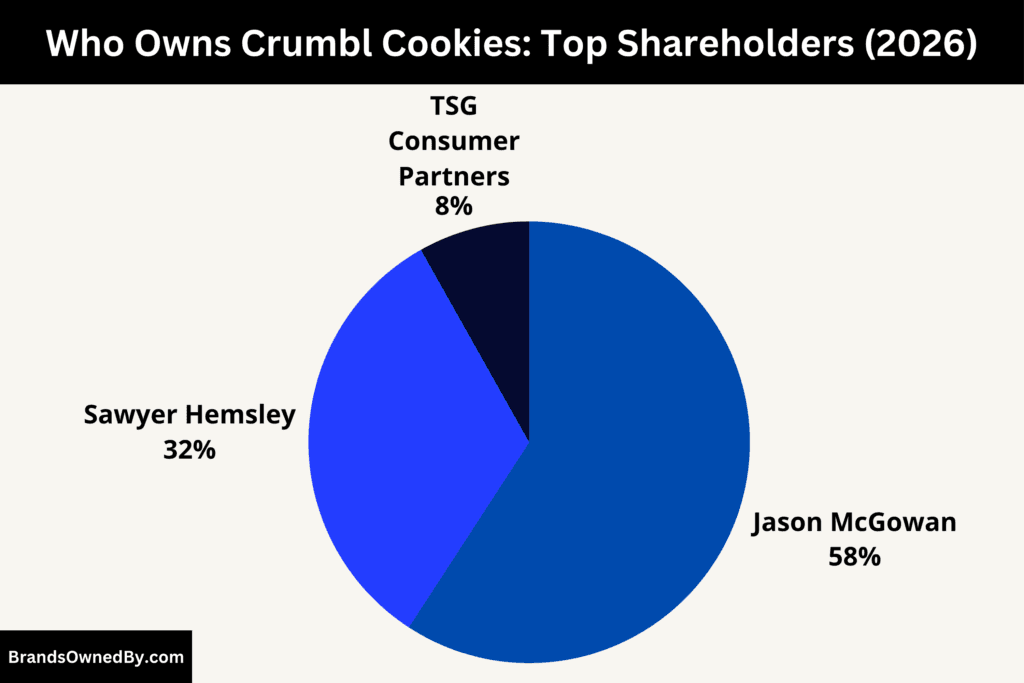
Crumbl Cookies has a tightly controlled ownership structure built around its founders. Unlike many high-growth food brands, it did not widely distribute equity during its expansion phase. Instead, it relied on franchising and later introduced selective private equity investment.
As of March 2026, Crumbl Cookies remains privately held. The company has a clear majority owner, a strong co-founder stake, and a single institutional investor with a minority position. The ownership is concentrated and structured to preserve founder control.
The ownership breakdown of Crumbl Cookies as of March 2026 is estimated as:
- Jason McGowan: 58%
- Sawyer Hemsley: 32%
- TSG Consumer Partners: 8%
- Other minor shareholders: 2%.
This structure highlights a key point. Crumbl remains firmly founder-controlled despite external investment.
Jason McGowan (Majority Shareholder)
Jason McGowan is the largest shareholder of Crumbl Cookies, holding an estimated 58% ownership stake as of March 2026. This makes him the controlling shareholder with majority voting power.
His stake originates from:
- Founding equity allocation
- Early capital contribution
- Retention of shares during expansion.
McGowan’s ownership gives him unilateral control over major corporate decisions. This includes:
- Franchise strategy and approvals
- Executive hiring and leadership structure
- Capital allocation and financing decisions
- Any potential future sale or IPO.
Even after the 2025 private equity investment, his stake remains above the 50% threshold. This ensures he retains full control of the company’s direction.
Sawyer Hemsley (Co-Founder)
Sawyer Hemsley is the second-largest shareholder, with an estimated 32% stake in Crumbl Cookies.
His equity reflects his role as co-founder and his continued involvement in:
- Brand strategy
- Product development
- Customer experience design.
Hemsley’s ownership position is large enough to provide significant influence. While he does not have majority control, he remains a key decision-maker alongside McGowan.
Together, McGowan and Hemsley control approximately 85% to 90% of the company, ensuring that ownership remains founder-dominated.
TSG Consumer Partners
TSG Consumer Partners acquired a minority stake in Crumbl Cookies in 2025. As of March 2026, the firm holds an estimated 8% ownership stake.
This investment marked the first meaningful external equity participation in the company’s history.
Key characteristics of TSG’s stake:
- Non-controlling position
- No majority voting rights
- Likely includes board representation or advisory influence
- Focused on scaling operations and supporting long-term growth.
The deal provided growth capital without disrupting founder control. It also introduced institutional expertise in scaling consumer brands.
Despite this investment, TSG does not influence day-to-day operations. Strategic control remains with the founders.
Other Minority Shareholders
A small portion of equity, estimated at less than 2%, is allocated to other stakeholders. These may include:
- Early employees
- Senior executives
- Internal partners or advisors.
These shares are typically distributed through equity incentive plans or early-stage agreements.
No individual in this category holds a significant or controlling stake. Their combined ownership is minor and does not impact governance.
Competitor Ownership Comparison
Crumbl Cookies competes in a highly competitive dessert and bakery segment. What makes it stand out is its founder-controlled ownership model, which is rare at its scale. Most of its competitors are owned by large corporations, private equity firms, or franchise holding groups.
This difference in ownership directly impacts how each company operates, scales, and makes decisions. Below is a detailed comparison of major competitors and their ownership structures as of March 2026.
| Brand | Ownership Type | Control Level |
|---|---|---|
| Crumbl Cookies | Founder-owned (Private) | Founder-controlled |
| Insomnia Cookies | Corporate (JAB/Krispy Kreme) | Institutional control |
| Mrs. Fields | Private equity | Investor-controlled |
| Great American Cookies | Public (FAT Brands) | Corporate-controlled |
| Nestlé Toll House Café | Corporate licensing | Brand-controlled by Nestlé |
| Duck Donuts | Private (Founder-led) | Partial founder control |
| Shipley Do-Nuts | Private equity | Investor-controlled |
| Nothing Bundt Cakes | Private equity | Investor-controlled |
Insomnia Cookies (Owned by Krispy Kreme under JAB Holding Company)
Insomnia Cookies operates under Krispy Kreme, which is controlled by JAB Holding Company, a global investment firm with a large food and beverage portfolio.
Ownership structure:
- JAB Holding Company (ultimate owner)
- Krispy Kreme (parent company)
- Insomnia Cookies (subsidiary brand).
This multi-layered corporate structure provides strong financial backing and operational support. However, decision-making is centralized and influenced by corporate priorities rather than founder’s vision.
Compared to Crumbl, Insomnia is part of a broader investment strategy rather than a standalone founder-led brand.
Mrs. Fields (Owned by Famous Brands International – Private Equity Backed)
Mrs. Fields is owned by Famous Brands International, a private equity-backed company that manages multiple dessert and snack brands.
Ownership characteristics:
- Portfolio-based ownership
- Focus on profitability and brand restructuring
- Long history of ownership changes.
Unlike Crumbl, Mrs. Fields has changed hands multiple times. This has led to shifts in strategy and brand positioning over the years.
Private equity ownership typically emphasizes efficiency and returns. In contrast, Crumbl focuses on brand experience and rapid innovation under founder control.
Great American Cookies (Owned by FAT Brands Inc.)
Great American Cookies is owned by FAT Brands, a global franchising company that operates a portfolio of restaurant and dessert chains.
Ownership structure:
- FAT Brands (publicly traded parent company)
- Great American Cookies (subsidiary brand).
FAT Brands manages multiple concepts simultaneously. This creates economies of scale but reduces brand-level autonomy.
Compared to Crumbl:
- Decisions are made at the corporate level
- Growth is aligned with portfolio strategy
- Brand innovation may be slower due to centralized control.
Nestlé Toll House Café (Owned by Nestlé – Licensed Model)
Nestlé Toll House Café operates under a licensing model tied to Nestlé, one of the largest food companies globally.
Ownership structure:
- Nestlé owns the Toll House brand
- Retail cafés operate through licensing agreements.
This model provides strong brand recognition and supply chain advantages. However, it lacks flexibility.
Crumbl, in contrast, controls both brand and retail execution. This allows faster adaptation to trends and customer preferences.
Duck Donuts (Privately Owned – Franchise Model)
Duck Donuts is a smaller but fast-growing competitor. It remains privately owned and operates through franchising.
Ownership characteristics:
- Privately held
- Franchise-driven expansion
- Founder-influenced operations.
This model is closer to Crumbl’s structure. However, Duck Donuts operates at a smaller scale and has less brand visibility.
Crumbl has executed the franchise model more aggressively and with stronger branding.
Shipley Do-Nuts (Owned by Peak Rock Capital – Private Equity)
Shipley Do-Nuts is owned by Peak Rock Capital, a private equity firm that acquired the brand to modernize and expand it.
Ownership characteristics:
- Private equity controlled
- Focus on expansion and operational efficiency
- Strategic repositioning of legacy brand.
Private equity ownership introduces capital and expertise. However, it also brings performance pressure and structured growth targets.
Crumbl avoids this pressure due to founder control.
Krispy Kreme (Public Company under JAB Holding Influence)
Krispy Kreme itself is publicly traded but heavily influenced by JAB Holding Company, which owns a significant stake.
Ownership characteristics:
- Public shareholders
- Institutional influence
- Large-scale global operations.
This structure requires transparency, quarterly performance reporting, and shareholder alignment.
Crumbl, being private, does not face these constraints. It can focus on long-term strategy without public market pressure.
Nothing Bundt Cakes (Owned by Roark Capital)
Nothing Bundt Cakes is owned by Roark Capital, a major private equity firm specializing in franchise brands.
Ownership characteristics:
- Private equity ownership
- Strong franchise expansion model
- Structured growth strategy.
Roark Capital also owns multiple restaurant brands. This creates operational synergies but limits independence.
Crumbl operates independently, without being part of a larger investment portfolio.
Who Controls Crumbl Cookies?
Control of Crumbl Cookies is tightly centralized and directly linked to its ownership structure. The company is not just privately owned. It is founder-controlled, meaning strategic authority remains with its co-founders rather than external investors or a corporate board.
As of March 2026, Crumbl operates with a highly concentrated control model. Decision-making flows from majority ownership, executive leadership, and a streamlined organizational structure that prioritizes speed and consistency.
Jason McGowan (CEO and Controlling Authority)
Jason McGowan is the CEO and the controlling force behind Crumbl Cookies. As the majority shareholder, he holds decisive voting power and ultimate authority over all major business decisions.
His control covers the full scope of the business. This includes expansion strategy, franchise approvals, operational systems, leadership appointments, and long-term planning. Because he holds majority ownership, there is no dependency on external shareholder approval for strategic moves.
McGowan has led the company since its founding in 2017. There have been no CEO changes. This continuity has ensured a consistent growth strategy and strong execution across all markets.
His leadership style is structured and data-driven. He focuses on scalability, operational efficiency, and maintaining uniform standards across the franchise network.
Sawyer Hemsley (Co-Founder and Brand Control Influence)
Sawyer Hemsley plays a critical role in shaping how the brand operates, even without majority control. As co-founder and a major shareholder, he has strong influence over customer-facing aspects of the business.
He is closely involved in brand positioning, product innovation, and marketing strategy. The rotating weekly menu, strong social media presence, and distinct brand identity are all tied to his influence.
Hemsley works in alignment with McGowan. While McGowan leads corporate and operational control, Hemsley drives brand and product direction. This division of responsibilities has been consistent since the company’s early stages.
Executive Leadership and Operational Control
Crumbl has built an internal leadership team to manage day-to-day execution as the company scaled. This includes roles across operations, supply chain, technology, and marketing.
However, this layer does not operate independently. It functions within a top-down structure where strategy is defined by the founders. Execution is delegated, but control is not.
This centralized approach reduces internal complexity. It allows faster implementation of decisions across hundreds of locations.
Role of TSG Consumer Partners
TSG Consumer Partners, which acquired a minority stake in 2025, has a limited but strategic role in the company. Its involvement is primarily advisory and financial.
The firm may provide input on scaling operations, improving systems, and supporting long-term expansion. It may also have board-level visibility into the business.
However, it does not control Crumbl Cookies. It does not have majority voting rights or authority over daily operations. Final decisions remain with the founders, particularly Jason McGowan.
This structure ensures that external investment does not interfere with the company’s direction.
Franchise Network and Controlled Decentralization
Crumbl’s franchise model introduces a distributed operational layer, but control remains centralized at the corporate level.
Franchisees manage the day-to-day operations of individual stores. This includes staffing, local execution, and customer service. However, they operate under strict corporate guidelines.
Key elements such as product offerings, pricing frameworks, branding, store design, and marketing campaigns are controlled by the corporate leadership. Franchisees do not have the authority to deviate from these standards.
This creates a controlled system where execution is decentralized, but decision-making is centralized.
Decision-Making Structure and Speed
Crumbl’s control model is designed for speed. Strategic decisions are made at the top and implemented quickly across the network.
There are minimal layers of approval compared to corporate-owned competitors. This allows the company to launch new products rapidly, adapt marketing strategies, and expand into new markets without delays.
The weekly rotating menu is a clear example of this system. It requires tight coordination and fast decision-making, which is only possible with centralized control.
Leadership Stability Since Founding
One of the most important aspects of Crumbl’s control structure is leadership stability. Jason McGowan has remained CEO since 2017. Sawyer Hemsley has also remained actively involved throughout the company’s growth.
There have been no major leadership transitions, no external CEO appointments, and no restructuring driven by investors. This stability is uncommon for a company that has scaled so quickly.
It has allowed Crumbl to maintain a consistent brand voice, operational model, and growth strategy.
Crumbl Cookies Annual Revenue and Net Worth
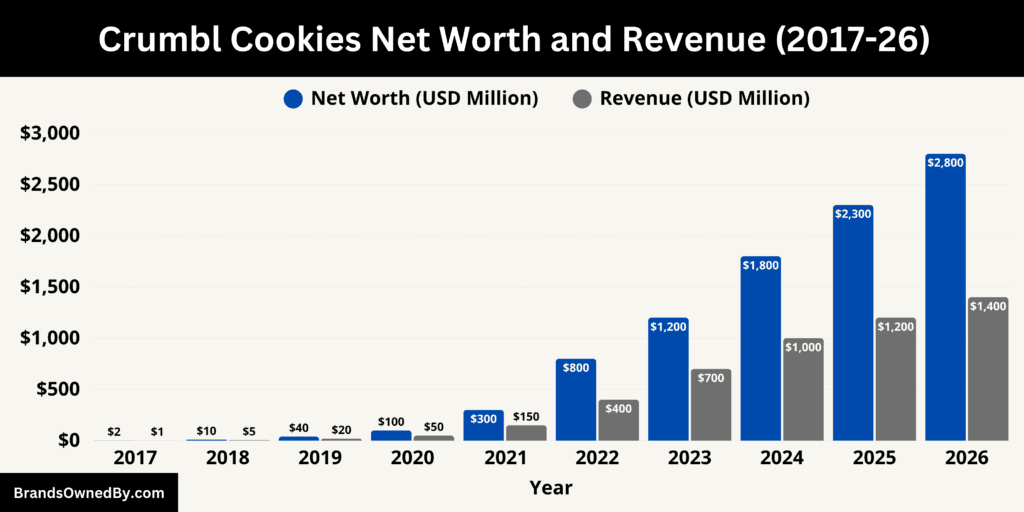
Crumbl Cookies has reached a significant financial scale in under a decade. As of March 2026, the company is estimated to generate $1.4 billion in annual systemwide revenue, with an approximate net worth of $2.8 billion.
This growth reflects a highly efficient franchise-driven model, strong consumer demand, and consistent store-level performance. The company’s financial structure is important to understand because most of its revenue is generated through franchise locations rather than company-owned stores.
2026 Revenue Breakdown and Structure
The estimated $1.4 billion revenue in 2026 represents total systemwide sales across all Crumbl locations. This includes hundreds of franchise stores operating under a standardized model.
Crumbl’s revenue structure operates on two levels. The first is systemwide sales, which reflect total customer spending across all stores. The second is corporate revenue, which is the portion earned directly by the parent company.
Systemwide sales form the largest component. These are driven by high store volumes and repeat customer demand. Average unit volumes are estimated at around $1.2M to $1.4M per store annually, depending on location and market maturity.
Corporate revenue comes from franchise fees. Crumbl typically earns royalties of around 6% to 8% on store sales, along with additional marketing contributions. Based on this structure, the company’s direct corporate revenue in 2026 is estimated to fall in the range of $90M to $110M, derived from the broader $1400M systemwide sales base.
This asset-light model allows Crumbl to scale quickly without heavy capital investment in physical stores.
2026 Net Worth
Crumbl Cookies’ estimated $2.8 billion valuation as of March 2026 reflects both its current performance and future growth potential.
Several factors contribute to this valuation. The first is revenue scale. Reaching $1400M in systemwide sales places Crumbl among the top-performing dessert franchise brands in the U.S.
The second factor is its franchise model. Because franchisees fund store development, the parent company maintains strong margins and lower operational risk. This increases overall business value.
The third factor is brand strength. Crumbl has built a highly recognizable identity through its rotating menu and digital-first marketing. This drives consistent demand and supports long-term growth.
Finally, the introduction of minority institutional investment in 2025 reinforced its valuation. While control remained with the founders, the deal validated the company’s multi-billion-dollar positioning.
Revenue Growth Trend Leading to 2026
Crumbl Cookies’ revenue growth has been driven by a combination of aggressive franchise expansion and strong same-store performance. The company scaled from a single-store operation in 2017 to a nationwide chain with hundreds of locations, which directly translated into rapid systemwide revenue growth.
Between 2021 and 2023, growth was primarily expansion-led. During this period, Crumbl added a large number of new franchise locations across key U.S. markets. This significantly increased total systemwide sales, pushing revenue into the high hundreds of millions and eventually crossing the $1000M mark.
From 2023 to 2025, the growth pattern evolved. While new store openings continued, a larger share of revenue came from maturing stores generating higher average unit volumes. Established locations began delivering consistent annual sales in the $1.2M–$1.4M range, improving overall system productivity.
By March 2026, Crumbl’s estimated $1400M systemwide revenue reflects a more balanced growth model. Expansion is still ongoing, but the company is placing greater emphasis on:
- Optimizing store performance in existing markets
- Improving operational efficiency across franchise locations
- Maintaining consistent product quality and customer experience.
This shift indicates a transition from hypergrowth to controlled scaling, where both new store openings and same-store sales contribute meaningfully to revenue.
Future Revenue Forecast (2027–2030)
Crumbl Cookies is expected to continue growing, but at a more measured pace compared to its earlier expansion phase. The forecast reflects a shift toward sustainable growth driven by operational efficiency, selective expansion, and brand maturity.
- 2027: $1.6 billion
- 2028: $1.8 billion
- 2029: $2 billion
- 2030: $2.2 billion.
The projected increase from $1.4 bilion in 2026 to $2.2 bilion by 2030 is based on several key drivers. First, the company is expected to continue expanding its franchise footprint, though at a slower and more strategic pace to avoid market saturation.
Second, same-store sales growth will play a larger role. As existing locations mature, they are likely to generate higher and more stable revenues. This reduces reliance on constant new store openings.
Third, Crumbl has opportunities to increase revenue per customer. This can come from menu innovation, seasonal offerings, and potential product category expansion beyond cookies.
Finally, operational improvements such as supply chain optimization and digital ordering enhancements are expected to support higher efficiency and better margins across the system.
Brands Owned by Crumbl Cookies
As of March 2026, Crumbl Cookies operates a single-brand, multi-entity ecosystem rather than a diversified portfolio of companies.
Its structure includes:
- A strong core brand (Crumbl)
- A large franchise network
- Proprietary technology platforms
- Internal supply chain and operations.
Below is a detailed overview of the key brands, entities, and operational units owned and operated by Crumbl:
Crumbl (Core Brand and Parent Entity)
Crumbl, legally structured as Crumbl, LLC, is the primary brand and operating entity of the business. It was originally launched as “Crumbl Cookies” but later rebranded to simply “Crumbl” to support expansion into additional dessert categories.
This core entity controls all aspects of the business, including branding, product development, franchising, and supply chain management. It operates as a centralized authority over all franchise locations.
The brand is built around a rotating dessert menu, strong digital marketing, and a standardized store experience. It also owns all intellectual property, including recipes, branding elements, and operational systems.
Crumbl Franchise System
The Crumbl Franchise System is one of the most important entities within the company’s structure. It is not a separate brand, but it functions as a large operational division responsible for scaling the business.
Under this system, independent franchisees operate stores using Crumbl’s branding, recipes, and systems. The parent company retains full control over:
- Product offerings
- Store design and layout
- Pricing frameworks
- Marketing campaigns.
As of 2025–2026, the majority of Crumbl’s 1,000+ locations are franchise-operated, with only a limited number of corporate-owned stores.
This entity is central to revenue generation and expansion.
Crumbl App and Digital Platform
Crumbl owns and operates its proprietary mobile app and digital ordering platform. This is a key internal asset rather than a separate company.
The platform enables:
- Online ordering and delivery
- Weekly menu updates
- Customer engagement and loyalty
- Data collection on consumer behavior.
The digital platform is tightly integrated with store operations. It allows Crumbl to coordinate product launches and manage demand across all locations.
This technology-driven approach has been critical to its rapid growth and strong customer retention.
Crumbl Supply Chain and Ingredient Network
Crumbl operates a centralized supply chain system that supports all franchise locations. While not branded as a separate company, this is a core internal entity.
The supply chain ensures:
- Consistent ingredient quality
- Standardized recipes across all stores
- Efficient distribution to franchise locations.
By controlling sourcing and distribution, Crumbl maintains product consistency at scale. This is essential for a brand that relies on a uniform customer experience.
Crumbl Desserts Expansion
Originally focused only on cookies, Crumbl has expanded into a broader dessert platform under its main brand. This includes products such as:
- Cakes
- Pies
- Brownies
- Puddings and other desserts.
This expansion is not structured as separate brands. Instead, all new products are integrated under the Crumbl name.
This strategic move allows the company to increase average order value and diversify revenue streams without creating new standalone companies.
Crumbl Corporate-Owned Stores
Although most locations are franchised, Crumbl also operates a small number of corporate-owned stores. These function as internal testing and operational control units.
These stores are used to:
- Test new products and recipes
- Pilot operational improvements
- Train franchisees and staff.
They provide direct insight into store-level performance, which helps refine the broader franchise system.
Crumbl International Operations
Crumbl has begun expanding beyond the United States into international markets, including Canada and other regions.
International operations are managed under the same brand rather than separate subsidiaries. This ensures consistency in branding and customer experience across markets.
These operations represent an early-stage but important growth segment for the company.
Strategic Partnerships and Limited Collaborations
Crumbl has engaged in high-profile collaborations with celebrities and brands. These include limited-edition product launches and co-branded desserts.
However, these are not acquisitions or owned brands. They are temporary partnerships designed to boost engagement and sales.
The company has not pursued traditional mergers or acquisitions as of March 2026. Its growth strategy remains focused on organic expansion.
Final Words
Crumbl Cookies is a rare example of a fast-growing food brand that remains founder-owned. Jason McGowan and Sawyer Hemsley built the company from scratch and still control its direction.
The private ownership structure allows flexibility and speed. It also helps maintain a strong brand identity. With continued expansion, Crumbl is positioned to remain a major player in the dessert industry.
FAQs
Is Crumbl Cookies publicly traded?
No, Crumbl Cookies is not publicly traded. It is a privately held company owned primarily by its founders, Jason McGowan and Sawyer Hemsley, along with a small minority stake held by a private equity firm.
When was Crumbl Cookies established?
Crumbl Cookies was established in 2017. The first store opened in Logan, Utah, marking the beginning of the brand’s expansion.
Who created Crumbl Cookies?
Crumbl Cookies was created by Jason McGowan and Sawyer Hemsley. They co-founded the company and built it from a single bakery into a nationwide franchise brand.
When was Crumbl Cookies founded?
Crumbl Cookies was founded in 2017. The founding year and establishment year are the same, as the company quickly moved from concept to its first store launch.
Is Crumbl a Mormon owned company?
Crumbl Cookies is not officially a Mormon-owned company. However, both founders are members of The Church of Jesus Christ of Latter-day Saints. The business itself is not affiliated with or owned by the church.
What do the Kardashians have to do with Crumbl Cookies?
The Kardashians are not owners or investors in Crumbl Cookies. Their connection comes from promotional collaborations and social media exposure. Crumbl has featured Kardashian-themed cookie collections, which helped boost visibility and engagement.
When did Crumbl Cookies get popular?
Crumbl Cookies became widely popular around 2020–2021. Its rapid rise was driven by TikTok and social media marketing, along with its rotating weekly menu that encouraged repeat visits and viral content.