

- Laurene Powell Jobs, through Emerson Collective, is the majority owner of The Atlantic and holds full controlling power over the company
- The Atlantic is privately owned, with no public shareholders or institutional investors, allowing long-term strategic and editorial independence
- David G. Bradley, via Atlantic Media, remains a minority shareholder after selling the majority stake in 2017
- The ownership structure is highly concentrated, with Emerson Collective and Atlantic Media as the only key shareholders, simplifying control and governance.
The Atlantic is a leading American magazine and digital media company. It was founded in 1857 in Boston as The Atlantic Monthly. From the beginning, it focused on serious writing about politics, culture, and society.
Today, The Atlantic operates as a modern multi-platform publisher. Its core strength lies in long-form journalism, essays, and analysis. It covers major global topics including politics, technology, climate, and international affairs. The publication has shifted strongly toward digital media. It now reaches a global audience through its website, mobile apps, podcasts, and live events.
The company is headquartered in Washington, D.C. It has expanded beyond print into a full media ecosystem. This includes its flagship magazine, digital subscription platform, and AtlanticLIVE events business.
The Atlantic is owned by Emerson Collective, the organization led by Laurene Powell Jobs. It remains privately held, which allows it to focus on editorial depth and long-term strategy rather than short-term market pressure.
Founders of The Atlantic
The Atlantic was founded by a group of influential writers, thinkers, and abolitionists in 1857. Their goal was to create a publication that would shape intellectual debate in the United States. The magazine was deeply connected to major social issues of its time, especially the anti-slavery movement.
Francis H. Underwood
Francis H. Underwood played a key organizing role in the creation of The Atlantic. He was instrumental in bringing together the founding writers and securing support for the magazine. His vision was to build a publication that combined literature with political thought.
Ralph Waldo Emerson
Ralph Waldo Emerson was one of the most important founding figures. He was a philosopher and essayist known for his ideas on individualism and transcendentalism. His influence helped define the magazine’s intellectual tone from the beginning.
Henry Wadsworth Longfellow
Henry Wadsworth Longfellow was a leading poet of his time. His involvement gave the magazine strong literary credibility. He helped attract readers interested in poetry and cultural writing.
James Russell Lowell
James Russell Lowell was both a founder and the first editor of The Atlantic. He shaped the magazine’s early editorial direction. Under his leadership, the publication addressed major political and social issues, including abolition and national identity.
Oliver Wendell Holmes Sr.
Oliver Wendell Holmes Sr. was a physician, poet, and essayist. He contributed to the magazine’s intellectual diversity. His writings helped broaden its appeal beyond purely literary audiences.
Harriet Beecher Stowe
Harriet Beecher Stowe, author of Uncle Tom’s Cabin, was part of the founding circle. Her involvement reflected the magazine’s strong stance on social justice and anti-slavery issues.
John Greenleaf Whittier
John Greenleaf Whittier, another prominent poet and abolitionist, was also among the founders. His work reinforced the publication’s early mission of addressing moral and political challenges in American society.
These founders shared a clear purpose. They wanted a magazine that combined literature, politics, and social reform. That vision still defines The Atlantic today, even as it has evolved into a global digital media brand.
Ownership History
The ownership history of The Atlantic reflects its transformation from a literary magazine into a modern digital media company. Over nearly two centuries, control has shifted from individual intellectuals to private investors with long-term strategic goals.
Early Founder Ownership (1857–Early 1900s)
The Atlantic began as a founder-led publication. It was created by a group of prominent writers and thinkers. These included Ralph Waldo Emerson, Henry Wadsworth Longfellow, and James Russell Lowell.
Ownership in this phase was closely tied to its editorial mission. The founders were not just contributors. They were also stakeholders who shaped the magazine’s direction. The publication focused heavily on literature, philosophy, and social reform. It played a role in debates around slavery, education, and national identity.
During this period, The Atlantic operated more like a cultural institution than a commercial business. Financial sustainability was important, but influence and ideas were the primary goals.
Transition to Institutional and Private Ownership (20th Century)
As the media industry evolved, The Atlantic moved away from founder ownership. It gradually came under more traditional publishing structures.
Throughout the 20th century, ownership shifted between private individuals and publishing entities. This transition reflected broader changes in the magazine industry. Publications needed stronger financial backing to survive rising costs and competition.
During this period, The Atlantic expanded its scope. It moved beyond purely literary content. It began focusing more on political reporting, national affairs, and investigative journalism. Ownership became more business-oriented, though the editorial mission remained strong.
David G. Bradley Era and Atlantic Media (1999–2017)
A major turning point came in 1999. David G. Bradley, an American entrepreneur, acquired The Atlantic through his company Atlantic Media.
This marked the beginning of a modernization phase. Bradley invested heavily in the brand. He repositioned The Atlantic as a premium intellectual publication for a modern audience.
Under his ownership, several key changes took place. The magazine embraced digital transformation. It launched and expanded its online platform. It also introduced events and conferences as new business lines.
Bradley also oversaw the creation and growth of Atlantic Media’s broader portfolio. This included properties like National Journal and Government Executive. These additions strengthened the company’s influence in policy and political circles.
His ownership helped The Atlantic survive a difficult period for print media. Many magazines declined during this time. The Atlantic adapted and remained relevant.
Laurene Powell Jobs and Emerson Collective (2017–Present)
In 2017, ownership shifted again in a major way. Laurene Powell Jobs, through Emerson Collective, acquired a majority stake in The Atlantic.
This deal marked a shift toward mission-driven ownership. Emerson Collective is not a traditional media company. It focuses on social impact, education, immigration, and journalism.
Laurene Powell Jobs became the majority owner. David G. Bradley retained a minority stake. This ensured continuity while bringing in new long-term investment.
Under this ownership, The Atlantic accelerated its digital growth. It expanded its subscription model. It invested in journalism, technology, and audience development.
The company also strengthened its editorial independence. Being privately owned allows it to avoid pressure from public shareholders. This supports long-form journalism and in-depth reporting.
Ownership Structure as of 2026
As of 2026, The Atlantic remains privately held. The majority ownership lies with Emerson Collective. Laurene Powell Jobs is the key controlling figure.
The company operates under The Atlantic Monthly Group. It continues to function independently in terms of editorial decisions. Leadership teams handle day-to-day operations, while ownership focuses on long-term direction.
This ownership model combines financial stability with editorial freedom. It allows The Atlantic to compete in a challenging media environment while maintaining its original mission of thoughtful journalism.
Who Owns The Atlantic Magazine in 2026?
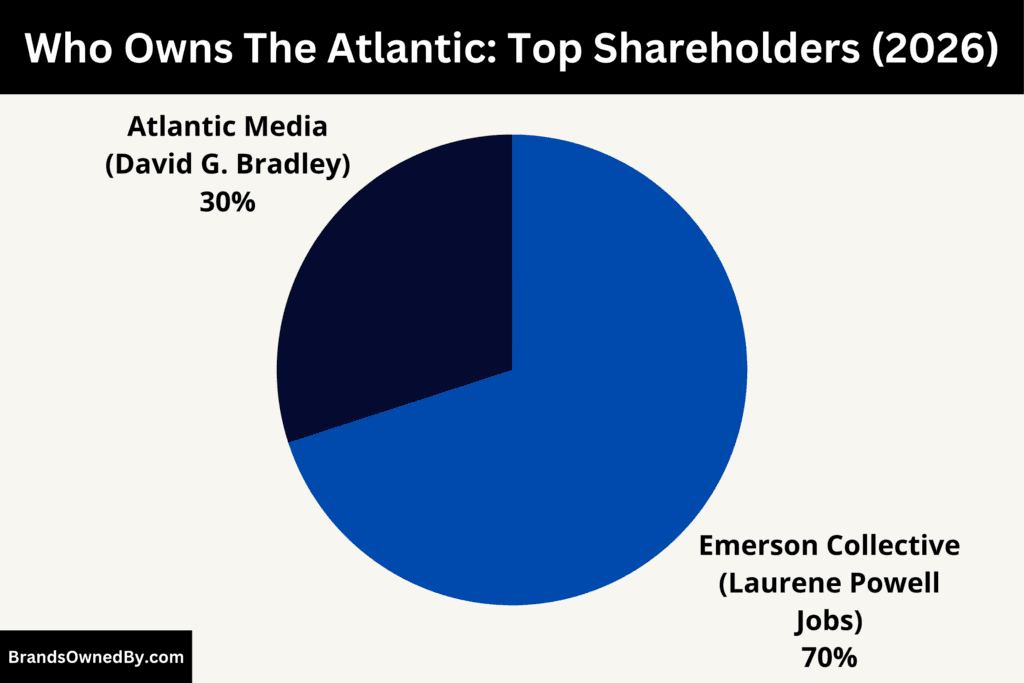
The ownership of The Atlantic is concentrated and straightforward. It operates as a privately held media company under The Atlantic Monthly Group LLC. Unlike publicly traded media firms, it has only a small number of shareholders. This structure allows for tighter control and long-term strategic decision-making.
As of March 2026, The Atlantic is primarily controlled by a single majority owner, with a secondary minority stakeholder. There are no public investors, institutional shareholders, or retail ownership. This makes its governance model closer to a privately controlled media asset rather than a corporate conglomerate.
Below is a detailed and updated breakdown of its shareholders and ownership structure.
Emerson Collective (Laurene Powell Jobs) – Majority Owner and Controlling Shareholder
Emerson Collective is the dominant shareholder of The Atlantic. It was founded by Laurene Powell Jobs and serves as a hybrid organization combining investment, philanthropy, and media ownership.
In 2017, Emerson Collective acquired a majority stake in The Atlantic from David G. Bradley.
As of 2025–2026 corporate disclosures, Emerson Collective holds an estimated around 70% ownership stake in The Atlantic Monthly Group.
This stake gives Laurene Powell Jobs full controlling power over the company.
Her ownership is strategic and mission-driven. Emerson Collective invests in journalism to support independent media and public-interest reporting. This distinguishes it from traditional media owners focused on profit maximization.
Over time, Powell Jobs has strengthened her control. Reports indicate that she consolidated influence after the initial acquisition, ensuring long-term stability and alignment with her vision.
Despite being the controlling owner, Emerson Collective does not manage daily editorial operations. Its role is focused on governance, funding, and long-term direction.
Atlantic Media (David G. Bradley) – Minority Shareholder
Atlantic Media, controlled by David G. Bradley, remains the only other significant shareholder.
Bradley originally acquired The Atlantic in 1999 and led its transformation into a modern media brand.
In 2017, he sold a majority stake to Emerson Collective but retained a minority position.
As of 2026, Atlantic Media continues to hold a minority stake, though it no longer has controlling power.
Bradley’s role today is limited. He is no longer involved in day-to-day operations or strategic control. However, his continued stake reflects continuity and his long-term association with the publication.
It is also important to note that since the 2017 deal, Atlantic Media has divested many of its other media assets. This has made The Atlantic a more focused and standalone business within its ownership structure.
The Atlantic Monthly Group LLC – Legal Ownership Entity
The Atlantic is owned and operated through The Atlantic Monthly Group LLC, which serves as the parent company.
This entity is jointly owned by:
- Emerson Collective (majority stake)
- Atlantic Media (minority stake).
Recent corporate disclosures confirm that these are the only two equity stakeholders.
This simplified ownership structure is intentional. It avoids complex shareholder layers and ensures clear governance.
The entity also includes all major operations of The Atlantic. This covers the magazine, digital platform, events business (AtlanticLIVE), and related media activities.
Competitor Ownership Comparison
To fully understand who owns The Atlantic magazine, it is useful to compare its ownership model with other major global publications. Each competitor operates under a distinct ownership structure. These structures directly influence editorial independence, investment strategy, and long-term sustainability.
| Publication | Ownership Type | Main Owner(s) | Control Structure | Key Characteristics | Comparison with The Atlantic |
|---|---|---|---|---|---|
| The Atlantic | Private (Majority-controlled) | Emerson Collective (Laurene Powell Jobs) | Concentrated ownership with majority control | Mission-driven investment. Strong editorial independence. No public shareholders. | Baseline model. Focused, privately controlled, long-term strategy. |
| The New York Times | Public company with dual-class shares | Sulzberger family + public shareholders | Family retains voting control despite public listing | Access to capital markets. Strong digital subscription model. Protected editorial control. | More complex structure. Faces market pressure unlike The Atlantic. |
| The Washington Post | Private (single-owner) | Jeff Bezos (via Nash Holdings) | Direct individual ownership | Strong financial backing. Heavy investment in tech and newsroom. Recent restructuring changes. | Similar private model, but controlled by one individual instead of an organization. |
| The Wall Street Journal | Corporate (conglomerate-owned) | News Corp (Murdoch family control) | Part of a large global media group | Large-scale operations. Cross-platform resources. Corporate-level strategy influence. | Less independent. One asset within a broader media empire. |
| Financial Times | Corporate (international ownership) | Nikkei Inc. | Controlled by a global media company | Strong global reach. Integrated with financial media ecosystem. Stable corporate backing. | More globally integrated. Less standalone than The Atlantic. |
| The Guardian | Trust-owned (non-profit model) | The Scott Trust | No shareholders. Trust ensures independence | Editorial freedom prioritized. Relies on reader revenue and donations. | Similar mission focus, but no private owner like The Atlantic. |
The New York Times – Public Company with Controlled Family Ownership
The New York Times follows a hybrid ownership structure. It is a publicly traded company. However, real control remains with the Sulzberger family through a dual-class share system.
This system gives the family superior voting rights. Even though millions of shares are held by public and institutional investors, the Sulzberger family maintains long-term control over strategic decisions.
This model provides access to capital markets. It supports large-scale investments in digital growth and global expansion. At the same time, it protects editorial independence through family control.
Compared to The Atlantic, this structure is more complex. The Atlantic avoids public markets entirely. Its ownership is concentrated in a single majority stakeholder. This reduces external pressure but also limits access to public capital.
The Washington Post – Privately Owned by Jeff Bezos
The Washington Post is owned by Jeff Bezos through Nash Holdings.
This is one of the closest comparable models to The Atlantic. Both are privately owned and not listed on stock exchanges.
However, there are key differences.
The Washington Post is directly controlled by a single individual. Bezos has full authority over financial and strategic decisions. His ownership has significantly influenced the company’s direction, including recent restructuring and layoffs in 2026.
In contrast, The Atlantic is owned through Emerson Collective. This creates a layer between the individual owner and the company. It reflects a more institutional and mission-driven approach.
Both models allow long-term investment. But The Atlantic’s structure emphasizes social impact alongside journalism.
The Wall Street Journal – Corporate Ownership under News Corp
The Wall Street Journal is owned by News Corp, a global media conglomerate controlled by the Murdoch family.
This represents a corporate ownership model. The publication is part of a large portfolio that includes newspapers, television networks, and digital media platforms.
Corporate ownership provides scale. It allows shared resources, global distribution, and cross-platform integration. However, it also introduces broader corporate priorities.
Editorial direction may be influenced by group-level strategy rather than the publication alone.
The Atlantic operates very differently. It is not part of a large media empire. It functions as a focused, standalone brand. This gives it greater flexibility and independence in editorial and business decisions.
Financial Times – International Corporate Ownership (Nikkei Inc.)
The Financial Times is owned by Nikkei Inc., a major Japanese media company. This represents an international corporate ownership model.
Under Nikkei, the Financial Times benefits from global distribution and financial backing. It also aligns with a broader corporate strategy that includes financial data and publishing businesses.
This structure is similar to News Corp’s model but with a stronger focus on financial journalism.
Compared to this, The Atlantic remains domestically controlled and privately structured. It is not integrated into a multinational corporate system. This allows it to maintain a more independent editorial voice.
The Guardian – Trust-Based Ownership Model
The Guardian operates under a unique ownership model. It is owned by The Scott Trust, which exists to secure the publication’s long-term editorial independence.
This model removes traditional shareholders entirely. There are no private owners or public investors. The trust reinvests profits into journalism.
This approach prioritizes editorial freedom above all else. However, it relies heavily on reader support, donations, and sustainable revenue strategies.
The Atlantic shares some similarities with this model. Its majority owner, Emerson Collective, also focuses on long-term impact rather than short-term profit.
However, The Atlantic is still privately owned. It has a controlling shareholder, whereas The Guardian does not.
Key Structural Differences Across Competitors
When comparing all major players, the differences become clear:
- The Atlantic: Private, majority-controlled ownership (Emerson Collective)
- The New York Times: Public company with family control
- The Washington Post: Privately owned by a single billionaire
- The Wall Street Journal: Owned by a global media conglomerate (News Corp)
- Financial Times: Owned by an international media corporation (Nikkei)
- The Guardian: Owned by a trust with no shareholders.
Each model comes with trade-offs.
Public companies gain capital but face market pressure. Corporate-owned publications gain scale but may lose independence. Trust-owned media gain editorial freedom but depend on sustainable funding.
Why The Atlantic’s Ownership Model Stands Out
As of 2026, The Atlantic occupies a distinct position in the media landscape.
It combines private ownership with a mission-driven approach. Laurene Powell Jobs, through Emerson Collective, provides financial backing without imposing short-term profit pressure.
Unlike The Washington Post, it is not directly tied to a single individual’s business priorities. Unlike News Corp or Nikkei-owned outlets, it is not part of a large corporate network.
This creates a balanced structure. It supports editorial independence, long-term investment, and strategic flexibility.
In a media environment facing financial pressure and rapid change, this ownership model gives The Atlantic a stable and differentiated position among its competitors.
Who Controls The Atlantic?
Control of The Atlantic is distributed across ownership, executive leadership, and editorial management. While Laurene Powell Jobs holds majority ownership through Emerson Collective, the day-to-day control of the company is exercised by its executive and editorial leaders. This separation ensures both strategic stability and editorial independence.
Role of Laurene Powell Jobs and Emerson Collective
Laurene Powell Jobs is the controlling owner of The Atlantic through Emerson Collective. Her influence is primarily strategic rather than operational.
She sets the long-term direction of the company. This includes investment priorities, growth strategy, and overall mission alignment. Emerson Collective supports journalism as part of a broader focus on social impact and public discourse.
However, she does not manage daily operations. She does not interfere in newsroom decisions or routine business management. This distinction is important. It allows The Atlantic to maintain credibility and editorial independence.
Her role can be described as governance-level control rather than hands-on management.
CEO Leadership – Nicholas Thompson
Nicholas Thompson serves as the CEO of The Atlantic as of 2026. He is responsible for the company’s business operations and strategic execution.
His role includes:
- Overseeing digital growth and subscriptions
- Managing revenue streams such as advertising and events
- Expanding audience reach across platforms
- Leading partnerships and innovation initiatives.
Thompson plays a central role in shaping how The Atlantic competes in the modern media landscape. He ensures the company remains financially sustainable while adapting to industry changes.
He reports to the ownership but operates with significant autonomy in executing strategy.
Editorial Control – Jeffrey Goldberg
Editorial control of The Atlantic is led by Jeffrey Goldberg, the editor-in-chief since 2016.
He is responsible for:
- Setting the editorial agenda
- Overseeing newsroom operations
- Maintaining journalistic standards
- Managing writers, editors, and contributors.
Goldberg has played a key role in defining The Atlantic’s voice in recent years. Under his leadership, the publication has strengthened its coverage of politics, global affairs, and long-form analysis.
Editorial independence is a core principle. Ownership does not dictate content. The editor-in-chief has the final say on what is published.
Separation of Ownership and Editorial Decision-Making
One of the most important aspects of The Atlantic’s control structure is the clear separation between ownership and editorial operations.
- Ownership (Emerson Collective) provides funding and strategic oversight
- Executive leadership (CEO) manages business operations
- Editorial leadership (editor-in-chief) controls content and journalism.
This layered structure ensures balance. It protects the newsroom from external pressure while maintaining strong financial backing.
Such separation is critical in modern media. It builds trust with readers and preserves journalistic integrity.
Governance and Decision-Making Structure
The Atlantic operates under a corporate governance framework typical of private companies.
Key decisions are made through:
- Executive leadership team led by the CEO
- Editorial leadership led by the editor-in-chief
- Oversight from ownership and board-level stakeholders.
Major strategic decisions, such as acquisitions or large investments, involve ownership input. However, operational and editorial decisions are handled internally by leadership teams.
This structure ensures efficiency while maintaining accountability.
Who Ultimately Controls The Atlantic?
In practical terms, control of The Atlantic can be summarized at three levels:
- Strategic control: Laurene Powell Jobs (through Emerson Collective)
- Operational control: CEO Nicholas Thompson
- Editorial control: Editor-in-chief Jeffrey Goldberg.
This multi-layered control model is one of the key reasons for The Atlantic’s stability. It combines strong ownership backing with independent leadership.
As of 2026, this structure continues to support the publication’s growth, credibility, and influence in the global media landscape.
The Atlantic Annual Revenue and Net Worth
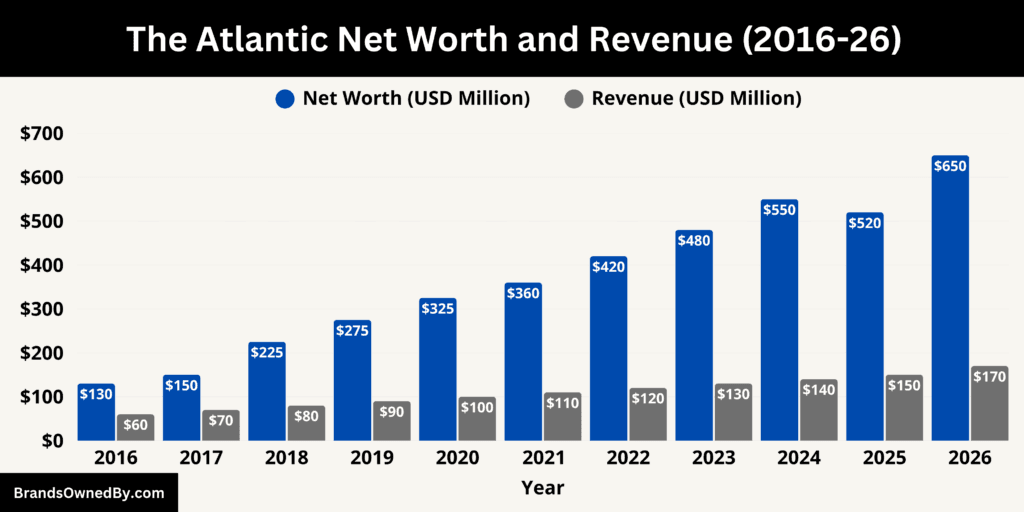
As of March 2026, the company generates an estimated $170 million in annual revenue and has an estimated net worth of $650 million. These figures reflect its successful transition into a digital-first media company supported by subscriptions, advertising, and events.
This financial position places The Atlantic among the most stable mid-sized premium publishers in the United States. Its growth has been consistent since the 2017 majority acquisition by Emerson Collective.
Revenue Breakdown and Business Model (2026)
The Atlantic’s revenue model is diversified across multiple streams. The company has reduced reliance on print and now earns most of its income from digital channels.
Digital subscriptions are the largest contributor. In 2026, subscription revenue accounts for approximately $75 million. This is driven by a subscriber base exceeding one million paid users. The subscription model provides recurring income and financial predictability.
Advertising remains a major revenue stream. Digital advertising, branded content, and sponsorships contribute around $60 million annually. The Atlantic’s premium audience allows it to maintain strong advertising rates compared to lower-tier digital publishers.
Events and experiences, primarily through AtlanticLIVE, generate approximately $20 million in revenue. These events include global summits, policy discussions, and corporate partnerships.
Other revenue streams, including podcasts, licensing, and partnerships, contribute about $15 million. These segments are smaller but continue to grow as the company expands its media formats.
This diversified structure ensures that no single revenue stream dominates the business, reducing financial risk.
Net Worth and Valuation Analysis (2026)
The Atlantic’s estimated net worth of $650 million, as of March 2026, is based on its revenue performance and industry valuation benchmarks.
Digital media companies with strong subscription models typically trade at revenue multiples of around 3.8x. Applying this multiple to The Atlantic’s $170 million revenue results in a valuation consistent with current estimates.
The company’s valuation is supported by its strong brand equity and loyal subscriber base. Its reputation for high-quality journalism increases its long-term value in the media industry.
Another key factor is its ownership structure. Backing from Emerson Collective provides financial stability and allows the company to invest in growth without relying on debt or public markets.
The Atlantic also benefits from a relatively lean cost structure compared to traditional print-heavy publishers. This improves its profitability and overall financial health.
Growth Drivers Behind Revenue Expansion
The Atlantic’s financial growth since 2016 has been driven by clear strategic shifts.
The most important driver has been the transition to a digital-first model. The company reduced its dependence on print and focused on digital subscriptions and online engagement.
The introduction of a paywall significantly increased recurring revenue. Subscriber growth accelerated during major global events and has remained strong.
Another major factor is the expansion of AtlanticLIVE. The events business has become a meaningful revenue contributor while also strengthening the brand’s influence.
The company also invested heavily in editorial quality and technology. This helped attract and retain a high-value audience willing to pay for premium content.
Support from Emerson Collective ensured that these investments could be made with a long-term perspective rather than short-term financial pressure.
Future Revenue Forecast (2027–2030)
Based on current growth trends and business expansion, The Atlantic’s revenue is expected to increase steadily over the next few years:
- 2027: $200 million
- 2028: $220 million
- 2029: $240 million
- 2030: $270 million.
This projected growth will likely be driven by continued subscription expansion, increased monetization of digital content, and growth in events and partnerships.
The Atlantic is expected to maintain its position as a premium media brand with steady and sustainable financial performance.
Brands Owned by The Atlantic Magazine
As of 2026, The Atlantic has expanded its ecosystem internally rather than through major acquisitions. Each entity plays a specific role in revenue generation, audience growth, and brand influence.
| Entity / Brand | Type | Primary Function | Revenue Contribution | Key Details |
|---|---|---|---|---|
| The Atlantic (Magazine & Digital Platform) | Core Media Brand | Long-form journalism, digital publishing, subscriptions | Highest (~$75M subscriptions + major ad share) | Flagship product. Includes print, website, and apps. Over 1 million subscribers. Main driver of revenue and brand authority. |
| AtlanticLIVE | Events Division | Conferences, summits, interviews, sponsored events | ~$20M | Hosts high-profile global events with policymakers and business leaders. Major contributor to sponsorship revenue and brand influence. |
| The Atlantic Podcasts | Audio Media | Podcasts on politics, culture, and storytelling | ~$10M (part of “other revenue”) | Expanding audio portfolio. Attracts younger audiences and supports ad monetization. |
| The Atlantic Newsletters | Audience Engagement Platform | Topic-specific newsletters for subscriber growth and retention | Indirect (supports subscriptions + ads) | Multiple newsletters written by top journalists. Drives traffic, engagement, and subscriber retention. |
| Atlantic Studios | Branded Content Division | Sponsored content, custom campaigns, multimedia storytelling | ~$50M (part of advertising revenue) | Works with major brands. Produces premium branded content aligned with editorial style. Key revenue driver. |
| The Atlantic Archive | Content Library | Historical content and premium archive access | Included in subscription revenue | Archive dating back to 1857. Enhances subscriber value and brand authority. |
| The Atlantic Video & Multimedia | Video Production | Documentaries, interviews, short-form video | ~$5M (part of ads & partnerships) | Distributed across website and social platforms. Supports audience growth and advertising. |
| Internal Product & Innovation Teams | Technology & Product | Platform development, data analytics, subscription optimization | Indirect (supports all revenue streams) | Improves user experience, paywall systems, and digital growth strategy. Critical for long-term scalability. |
The Atlantic
The Atlantic is the core brand and primary asset of the company. It includes both the print magazine and the digital platform.
The print edition remains a premium monthly publication. It focuses on long-form essays, investigative journalism, and cultural commentary. While print has a smaller share of revenue today, it still plays an important role in brand positioning.
The digital platform is now the center of the business. It includes the website, mobile apps, and subscriber-only content. The Atlantic has built a strong paywall system and a large base of paying subscribers. This platform drives the majority of revenue through subscriptions and digital advertising.
The brand is known for its in-depth reporting on politics, global affairs, technology, and society. It attracts a highly educated and influential audience.
AtlanticLIVE
AtlanticLIVE is the events arm of The Atlantic. It is one of the company’s most important business units outside of publishing.
This division organizes high-profile conferences, summits, and interviews with global leaders. Events cover topics such as policy, business, technology, and health. Speakers often include government officials, CEOs, and industry experts.
AtlanticLIVE serves two key purposes. First, it generates revenue through sponsorships and partnerships. Second, it strengthens The Atlantic’s influence and brand authority.
The events are held both in-person and virtually. This hybrid approach has expanded reach and increased participation since 2020.
The Atlantic Podcasts
The Atlantic operates a growing portfolio of podcasts. These are designed to reach audiences beyond traditional text-based journalism.
Its podcast lineup includes shows focused on politics, culture, and storytelling. Popular formats include interviews, narrative series, and daily analysis.
Podcasts contribute to both advertising revenue and audience engagement. They also help attract younger listeners and expand the brand’s digital footprint.
This segment has become increasingly important as audio consumption continues to grow globally.
The Atlantic Newsletters
Newsletters are a key part of The Atlantic’s audience strategy. The company operates multiple newsletters targeting different topics and reader segments.
These include newsletters on politics, technology, health, and culture. Many are written by well-known journalists and editors, which increases reader loyalty.
Newsletters serve as a direct communication channel with readers. They drive traffic to the website and support subscription growth.
They are also monetized through sponsorships and help improve user retention.
Atlantic Studios
Atlantic Studios is the branded content and creative division of the company. It produces sponsored content, custom storytelling, and multimedia campaigns for corporate clients.
This unit works with major brands to create content that aligns with The Atlantic’s editorial style. It includes articles, videos, and interactive experiences.
Atlantic Studios is a major contributor to advertising revenue. It allows The Atlantic to maintain premium pricing by offering high-quality branded storytelling rather than standard ads.
This division plays a critical role in the company’s commercial strategy.
The Atlantic Council Engagement (Editorial Collaborations and Partnerships)
While not a separate company, The Atlantic frequently collaborates with institutions, think tanks, and global organizations through editorial partnerships and event programming.
These collaborations enhance its influence in policy and global discussions. They also support its events and content strategy.
Such partnerships are carefully structured to maintain editorial independence while expanding reach and relevance.
The Atlantic Archive and Premium Content Library
The Atlantic maintains a vast archive of content dating back to 1857. This archive is a unique intellectual asset.
It includes essays, historical analysis, and literary works from some of the most influential writers in history. The archive is integrated into its digital platform and subscription offering.
This content library adds long-term value. It strengthens the brand’s authority and provides additional engagement for subscribers.
The Atlantic Video and Multimedia Division
The Atlantic has developed a dedicated video and multimedia unit. This division produces documentaries, interviews, and short-form videos.
Video content is distributed across the website, social media platforms, and streaming channels. It supports both audience growth and advertising revenue.
This segment reflects the company’s shift toward multi-format storytelling. It allows The Atlantic to compete in a digital-first media environment.
Internal Innovation and Product Teams
The Atlantic also operates internal teams focused on product development, data analytics, and digital innovation.
These teams are responsible for improving the user experience, optimizing subscriptions, and developing new media formats.
While not branded entities, they play a crucial role in the company’s growth. They ensure that The Atlantic remains competitive in a rapidly evolving media landscape.
Final Words
The answer to who owns The Atlantic magazine reflects a modern and focused media ownership model. Laurene Powell Jobs, through Emerson Collective, holds majority control and supports a long-term vision for the publication.
This structure gives The Atlantic the freedom to prioritize high-quality journalism and thoughtful reporting. With strong leadership and a clear direction, it remains one of the most influential and trusted media brands today.
FAQs
Who owns The Atlantic Monthly magazine?
The Atlantic Monthly magazine, now known as The Atlantic, is owned by Emerson Collective. Laurene Powell Jobs is the majority owner and key decision-maker at the ownership level.
Is The Atlantic magazine credible?
Yes, The Atlantic is widely considered a credible and respected publication. It is known for in-depth journalism, fact-checked reporting, and thoughtful analysis on politics, culture, and global issues. It has built a strong reputation over more than 160 years.
Where is the headquarters of The Atlantic magazine?
The Atlantic is headquartered in Washington, D.C., United States. This location places it close to major political institutions and policy discussions.
Does Steve Jobs’ widow own The Atlantic?
Yes, Laurene Powell Jobs, the widow of Steve Jobs, owns a majority stake in The Atlantic through her organization, Emerson Collective. She is the controlling owner of the company.
Is The Atlantic part of Apple News?
The Atlantic is not owned by Apple. However, its content is available on Apple News and Apple News+. This is a distribution partnership, not ownership.
Is The Atlantic magazine conservative or liberal?
The Atlantic is generally considered center-left or liberal-leaning in its editorial perspective. However, it publishes a wide range of opinions and analysis from different viewpoints, focusing more on thoughtful discussion than strict political alignment.