
- Cracker Barrel is a publicly traded company (NASDAQ: CBRL) with ownership spread among institutional investors and public shareholders. Institutional investors collectively control over 90% of the company’s outstanding shares.
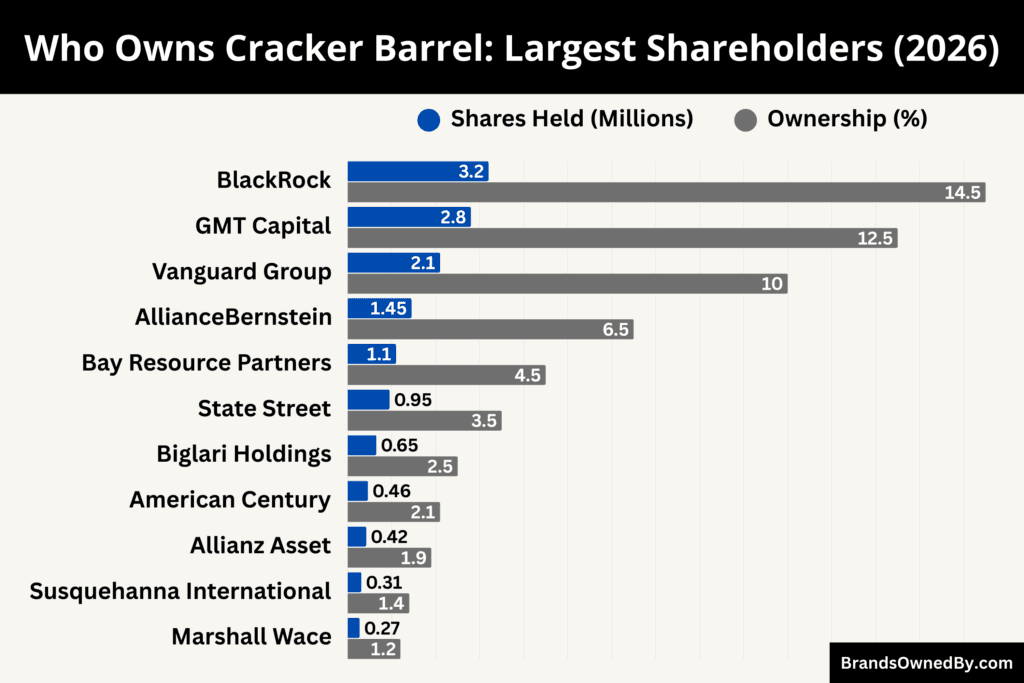
- BlackRock is the largest shareholder, holding about 14.5% of Cracker Barrel (3.2 million shares), followed by GMT Capital with about 12.5% (2.8 million shares) and Vanguard Group with about 10.0% (2.1 million shares).
- Other major institutional investors include AllianceBernstein (6.5%), Bay Resource Partners (4.5%), and State Street (3.5%), each holding significant stakes through mutual funds and investment portfolios.
- Biglari Holdings, controlled by Sardar Biglari, owns about 2.5% of the company (0.65 million shares) and has been one of the most active shareholders attempting to influence governance and board decisions.
Cracker Barrel Old Country Store is an American restaurant and retail chain known for its Southern-style comfort food and country store shopping experience. The company operates a unique concept that combines a full-service restaurant with a retail store located inside the same building.
The brand focuses on traditional American dishes such as biscuits, pancakes, fried chicken, and meatloaf. Each location also features a retail store selling candy, toys, home décor, and seasonal gifts inspired by rural American traditions.
Cracker Barrel operates under the corporate name Cracker Barrel Old Country Store, Inc. The company is headquartered in Lebanon, Tennessee and runs hundreds of restaurants across the United States as of March 2026.
Cracker Barrel’s concept blends dining with shopping. Customers typically enter through the retail store before reaching the restaurant area. This layout encourages guests to browse merchandise while waiting for a table or after finishing their meal.
The brand is also known for its nostalgic atmosphere. Most locations feature wooden rocking chairs on the front porch, antique decorations, and a country-style interior. This design reflects the feel of old American general stores.
The company originally focused on highway travelers. Many early locations were built near interstate exits to serve people traveling long distances. Over time, Cracker Barrel expanded nationwide while maintaining the same country-themed experience.
Cracker Barrel Founder
Cracker Barrel was founded in 1969 by entrepreneur Dan W. Evins. He created the concept after recognizing the need for quality restaurants along interstate highways. The founder’s idea was to combine home-style food with the atmosphere of a traditional country store.
His vision shaped the identity of the brand and guided its early expansion across the United States.
Dan W. Evins
Dan W. Evins is the primary founder of Cracker Barrel. Before starting the company, he worked as a sales representative for Shell Oil. His job required frequent travel, which helped him notice the lack of good dining options for highway travelers.
Evins opened the first Cracker Barrel restaurant in Lebanon, Tennessee in 1969. The location was built near Interstate 40 and quickly became popular with travelers and local residents.
He designed the restaurant to resemble old rural general stores where people gathered to eat, shop, and socialize. This concept became the foundation of the Cracker Barrel brand.
Evins led the company for many years and played a key role in expanding the chain across the United States.
Tommy Lowe
Tommy Lowe was another early contributor to the company’s formation. He helped support the development of the original restaurant concept and its early operations.
While Dan Evins is widely recognized as the main founder and visionary, Lowe contributed to building the foundation of the business during its early growth stage.
Ownership History
Cracker Barrel’s ownership structure has changed significantly since the company was founded. The business began as a privately owned restaurant operated by its founder, Dan W. Evins. Over time, the company expanded across the United States and eventually became a publicly traded corporation.
Today, Cracker Barrel Old Country Store, Inc. is listed on the NASDAQ under the ticker CBRL, and its ownership is distributed among institutional investors, investment funds, and public shareholders.
The transition from founder ownership to institutional ownership reflects the company’s growth into a large national restaurant chain.
Founder Ownership and Early Expansion (1969–1981)
When Cracker Barrel was founded in 1969, the company was privately owned by Dan W. Evins and a small group of early investors. Evins opened the first restaurant in Lebanon, Tennessee near Interstate 40. His goal was to create a comfortable place where highway travelers could enjoy home-style food.
During the early years, Evins controlled the company’s operations and strategic decisions. As the concept proved successful, new restaurants were opened across the southeastern United States. The brand’s combination of a restaurant and country store helped it stand out from other roadside dining options.
Ownership during this period remained concentrated among the founder and a limited group of private investors who supported the company’s expansion.
Public Listing and Ownership Transition (1981)
A major turning point in the company’s ownership occurred in 1981 when Cracker Barrel went public. The company launched an initial public offering (IPO), allowing shares to be traded on the stock market.
This step allowed the company to raise capital to support further expansion. It also significantly changed the ownership structure. Instead of being controlled by the founder and early investors, ownership became distributed among public shareholders.
Following the IPO, individuals, mutual funds, and institutional investors were able to purchase shares in the company. Although Dan Evins remained involved in leadership, the company gradually transitioned from founder-led ownership to shareholder ownership.
Rise of Institutional Investors
As Cracker Barrel continued to grow, large institutional investors began acquiring shares in the company. Institutional investors include asset management firms, pension funds, and mutual funds that manage investments for millions of clients.
Over time, these institutions became the dominant shareholders of the company. Investment firms often hold shares through index funds and exchange-traded funds that track major stock market indices.
By the 2000s and 2010s, institutional ownership represented the majority of the company’s shares. This type of ownership structure is typical for large publicly traded companies in the United States.
Activist Investor Influence
Cracker Barrel’s ownership history also includes involvement from activist investors. Activist investors attempt to influence corporate strategy by acquiring significant stakes in public companies.
One of the most notable investors in Cracker Barrel has been Biglari Holdings, controlled by investor Sardar Biglari. The firm accumulated a substantial stake in the company during the early 2010s and has remained one of the largest shareholders.
Biglari Holdings has repeatedly sought board representation and proposed changes to the company’s governance structure. These efforts led to several shareholder votes and discussions about corporate leadership.
Despite this activism, Cracker Barrel has remained an independent company with its management and board overseeing strategic decisions.
Ownership Structure as of March 2026
As of March 2026, Cracker Barrel Old Country Store remains an independent publicly traded company listed on NASDAQ. The company does not have a parent corporation or controlling owner.
Ownership is spread across a large number of shareholders. Institutional investors hold the majority of shares, while retail investors and smaller funds hold the rest.
Major asset managers such as Vanguard Group, BlackRock, and State Street are among the largest institutional shareholders. In addition, Biglari Holdings continues to hold a notable stake in the company.
Because no single shareholder owns a majority of the company, corporate control is exercised by the board of directors and executive leadership on behalf of shareholders. This widely distributed ownership structure reflects the company’s evolution from a founder-owned restaurant into a publicly traded national brand.
Who Owns Cracker Barrel: Major Shareholders
Cracker Barrel Old Country Store, Inc. is a publicly traded company listed on the NASDAQ under the ticker CBRL.
As of March 2026, institutional investors control the vast majority of the company’s shares. Large asset management firms and hedge funds hold significant stakes through mutual funds, ETFs, and managed portfolios. Institutional investors collectively own more than 90% of the company’s outstanding shares, which means they play a major role in shareholder voting and corporate governance.
The largest shareholders include major investment firms such as BlackRock, Vanguard Group, GMT Capital, and AllianceBernstein, along with other investment funds and asset managers.
BlackRock, Inc.
BlackRock is the largest institutional shareholder of Cracker Barrel. The global asset management firm manages trillions of dollars in investments across stocks, bonds, and funds.
As of recent filings around 2025–2026, BlackRock holds approximately 3.2 million shares of Cracker Barrel, representing roughly 14.5% of the company’s outstanding stock.
BlackRock’s investment in the company is held through several funds, including index funds and ETFs that track major U.S. stock market indices. Because of its large stake, the firm has substantial voting power in shareholder meetings and corporate governance decisions.
GMT Capital Corp.
GMT Capital Corp. is another major institutional shareholder of Cracker Barrel. The Atlanta-based investment firm specializes in value investing and often takes significant positions in companies it believes are undervalued.
As of early 2026, GMT Capital holds roughly 2.8 million shares of the company, representing about 12.5% of the total shares outstanding.
The firm has maintained a long-term investment interest in Cracker Barrel and has periodically increased or adjusted its holdings depending on market conditions.
The Vanguard Group
The Vanguard Group is one of the largest asset management firms in the world and a major shareholder of Cracker Barrel.
Vanguard owns over 2 million shares of the company through various mutual funds and index funds. This represents approximately 10% ownership of the company.
Many of these shares are held in funds that track the broader U.S. stock market. As a result, Vanguard’s holdings often reflect long-term investment strategies rather than short-term trading positions.
AllianceBernstein L.P.
AllianceBernstein is a global investment management firm that manages assets for institutions, pension funds, and individual investors.
The firm holds roughly 1.45 million shares of Cracker Barrel, giving it an ownership stake of about 6.5% of the company.
AllianceBernstein invests in the company through actively managed portfolios and institutional investment funds. Its holdings make it one of the key institutional investors influencing shareholder decisions.
Bay Resource Partners Offshore Master Fund
Bay Resource Partners Offshore Master Fund is a hedge fund that also holds a notable stake in Cracker Barrel.
The fund owns more than one million shares of the company, representing approximately 4.5% of the total shares.
Like many hedge funds, Bay Resource Partners focuses on strategic investments in companies where it sees potential for operational improvements or stock value growth.
State Street Corporation
State Street Corporation is another large institutional investor in Cracker Barrel. The company manages global investment funds and ETFs, including the well-known SPDR funds.
State Street holds shares in Cracker Barrel primarily through index funds and institutional investment portfolios. Its holdings represent a smaller but still influential percentage of the company’s total shares.
Because State Street manages many passive investment funds, it often appears among the top shareholders of major publicly traded companies.
Biglari Holdings and Sardar Biglari
Biglari Holdings, controlled by investor Sardar Biglari, has been one of the most visible individual investors in Cracker Barrel.
Biglari began investing in the company in 2011 and gradually accumulated a significant stake. Over the years, he has launched several proxy battles and campaigns to influence the company’s leadership and strategy.
As of recent disclosures, Biglari and his affiliated investment funds own roughly 2–3% of Cracker Barrel’s shares.
Although this stake is smaller than those of some institutional investors, Biglari has remained a vocal shareholder and has repeatedly attempted to gain board representation.
Other Institutional Investors
In addition to the major shareholders, several other institutional investors also hold notable stakes in Cracker Barrel Old Country Store, Inc. These investors typically hold shares through diversified portfolios, hedge funds, or actively managed investment funds. While each individual stake is smaller than that of the largest shareholders, collectively they represent a meaningful portion of the company’s total ownership.
As of March 2026, some of the additional institutional shareholders include:
- American Century Companies – approximately 2.1%
American Century Companies is a U.S.-based asset management firm that manages mutual funds and institutional investment portfolios. The firm holds shares in Cracker Barrel through several actively managed funds focused on consumer and value-oriented equities. - Allianz Asset Management – approximately 1.9%
Allianz Asset Management, part of the global financial services group Allianz, invests in Cracker Barrel through its investment subsidiaries and managed funds. The firm typically focuses on long-term investments in established consumer brands and service companies. - Susquehanna International Group – approximately 1.4%
Susquehanna International Group is a global trading and investment firm. Its stake in Cracker Barrel is held through investment portfolios that include positions in consumer discretionary companies and publicly traded restaurant chains. - Marshall Wace LLP – approximately 1.2%
Marshall Wace is a global hedge fund known for its quantitative and fundamental investment strategies. The firm holds a smaller but notable position in Cracker Barrel as part of its diversified equity investments. - Franklin Resources (Franklin Templeton) – approximately 1.0%
Franklin Resources, operating under the Franklin Templeton brand, manages mutual funds and institutional portfolios worldwide. The firm maintains an investment position in Cracker Barrel through several of its equity-focused funds.
Together, these institutional investors hold a combined stake of roughly 7–8% of Cracker Barrel’s outstanding shares. Their investments contribute to the company’s broad institutional ownership base.
Because Cracker Barrel’s shares are widely distributed among many institutional investors, no single shareholder holds majority control of the company. Strategic decisions remain under the authority of the board of directors and executive leadership, who operate the company on behalf of all shareholders.
Insider Shareholders
Company insiders also hold a small portion of Cracker Barrel shares. Insider ownership typically includes executives, board members, and senior management.
These shares help align leadership with the interests of shareholders. However, insider ownership represents a relatively small percentage compared with institutional investors.
Overall, the company’s ownership structure reflects a typical publicly traded corporation where large institutional investors hold most shares while management oversees operations on behalf of shareholders.
Competitor Ownership Comparison
Cracker Barrel competes with several well-known restaurant chains in the family dining and breakfast restaurant market. These competitors operate under different ownership structures. Some are publicly traded companies owned by shareholders, while others are controlled by private equity firms or parent corporations. Comparing these ownership models helps explain how major restaurant brands are managed and financed in the industry.
| Company | Ownership Type | Parent Company / Main Owner | Ownership Structure | Key Notes |
|---|---|---|---|---|
| Cracker Barrel Old Country Store | Publicly traded | Public shareholders | Institutional investors hold most shares | Independent restaurant company listed on NASDAQ (CBRL). Major shareholders include large asset management firms and investment funds. |
| Denny’s | Private equity (pending/ongoing transition) | TriArtisan Capital Advisors, Treville Capital, and Yadav Enterprises | Private equity consortium ownership | A $620 million acquisition deal announced to take the company private, shifting control from public shareholders to investment firms. |
| IHOP | Subsidiary brand | Dine Brands Global | Owned through publicly traded parent company | IHOP operates as part of Dine Brands Global, which also owns Applebee’s. Most IHOP restaurants operate under a franchise model. |
| Waffle House | Private company | Rogers family and private stakeholders | Family-controlled ownership | Shares are not publicly traded. The founding family maintains strong operational control over the business. |
| Bob Evans Restaurants | Private equity ownership | 4×4 Capital | Portfolio company within an investment firm | Acquired from Golden Gate Capital in February 2026. Operates as a privately held restaurant chain. |
| First Watch Restaurants | Publicly traded with major institutional investors | Public shareholders and institutional investors | Public company listed on NASDAQ (FWRG) | Fast-growing breakfast chain with strong institutional investor ownership following its IPO. |
Denny’s
Denny’s is one of Cracker Barrel’s most direct competitors in the family dining segment. The chain operates hundreds of restaurants across the United States and focuses on diner-style meals and all-day breakfast.
As of early 2026, Denny’s is undergoing a major ownership transition. Private equity firms TriArtisan Capital Advisors, Treville Capital, and Yadav Enterprises agreed to acquire the company in a deal valued at about $620 million. The acquisition will take the company private once finalized.
Before this deal, Denny’s was a publicly traded company owned by institutional investors and public shareholders. Under private equity ownership, strategic decisions are expected to be guided by the investment firms, which typically focus on improving profitability and restructuring operations.
IHOP
IHOP is another major competitor to Cracker Barrel, especially in the breakfast and family dining segment. However, IHOP is not an independent company.
The brand is owned by Dine Brands Global, a publicly traded restaurant holding company that also owns Applebee’s. This corporate structure allows the parent company to manage multiple restaurant brands under one organization.
Because Dine Brands Global is publicly traded, ownership of IHOP ultimately belongs to its shareholders. These shareholders include institutional investors, mutual funds, and individual investors.
IHOP operates largely under a franchise model. Most of its restaurants are owned by franchise operators rather than the corporate parent. This approach allows Dine Brands to expand the brand while keeping corporate operating costs relatively low.
Waffle House
Waffle House is another well-known competitor, particularly in the southeastern United States, where many Cracker Barrel locations operate.
Unlike Cracker Barrel, Waffle House is a privately owned company. The chain is controlled primarily by the founding Rogers family along with a small group of private stakeholders.
Because the company is privately held, it does not trade shares on public stock exchanges and does not disclose detailed financial or shareholder information. Private ownership allows Waffle House to maintain strong centralized control over its operations, brand strategy, and expansion plans.
Bob Evans Restaurants
Bob Evans Restaurants historically competed closely with Cracker Barrel in the family dining market. The company has undergone several ownership changes over the years.
In 2017, the restaurant division was sold to the private equity firm Golden Gate Capital. In February 2026, Golden Gate Capital sold the chain to another investment firm, 4×4 Capital, which now owns the brand.
Under this ownership structure, Bob Evans operates as a portfolio company within a private equity investment platform. Private equity owners typically focus on improving operational performance, expanding the brand, and eventually exiting the investment through a sale or recapitalization.
First Watch
First Watch is a fast-growing breakfast and brunch restaurant chain that competes with Cracker Barrel in the daytime dining market.
The company is publicly traded under the corporate name First Watch Restaurants, Inc. Although it is publicly listed, the private equity firm Advent International previously acquired a majority stake in the company and remains a major investor.
First Watch operates hundreds of restaurants across the United States and focuses primarily on breakfast, brunch, and lunch service. The company’s ownership structure combines public shareholders with institutional and private equity investors.
Key Differences in Ownership Models
These competitors illustrate the different ownership models used across the restaurant industry.
Cracker Barrel operates as an independent publicly traded company with ownership distributed among institutional investors and public shareholders.
IHOP operates as a subsidiary of a larger restaurant holding company, meaning its ownership is tied to the shareholders of Dine Brands Global.
Denny’s is transitioning from a publicly traded structure to private equity ownership through an acquisition deal.
Bob Evans Restaurants is privately owned by an investment firm after being sold by its previous private equity owner in 2026.
Waffle House remains privately controlled by its founding family, while First Watch combines public ownership with private equity investment.
These differences influence how each company raises capital, expands its restaurant network, and makes strategic decisions within the competitive family dining market.
Who Controls Cracker Barrel?
Cracker Barrel Old Country Store, Inc. is a publicly traded company, so control is exercised through its executive leadership and board of directors rather than a single owner. Institutional investors hold large stakes, but they do not manage the company directly. Operational authority sits with the CEO and senior leadership team, while strategic oversight is handled by the board.
As of March 2026, the company is led by President and CEO Julie Masino, with governance oversight provided by an independent board chaired by Gail Johnson.
CEO Leadership
The primary decision-maker at Cracker Barrel is the Chief Executive Officer. The CEO is responsible for the company’s corporate strategy, operational performance, and financial management.
As of March 2026, Julie Masino serves as President and Chief Executive Officer. She assumed the role in November 2023.
Masino oversees the company’s nationwide restaurant and retail operations. Her responsibilities include:
- Setting the company’s long-term strategic direction
- Improving restaurant performance and guest experience
- Managing executive leadership and corporate departments
- Overseeing new initiatives in digital ordering, retail merchandising, and off-premise dining.
She also reports directly to the board of directors and is accountable to shareholders for the company’s performance.
Key Executive Leadership
Cracker Barrel’s operational control is also supported by a senior executive team responsible for specific business functions.
Major executives as of 2026 include:
- Craig Pommells — Chief Financial Officer
Oversees financial strategy, capital allocation, investor relations, and financial reporting. - Sarah Moore — Chief Marketing Officer
Leads brand marketing, advertising strategy, and customer engagement initiatives. - Nicholas Flannery — Senior Vice President of Restaurant Operations
Responsible for operational performance across the company’s restaurant locations. - Carey Krueger — Senior Vice President of Supply Chain
Manages procurement, food sourcing, logistics, and distribution networks that support restaurant operations.
These executives manage the core operational systems that keep the company’s restaurants, retail stores, and supply chain running efficiently.
Board Leadership
Strategic oversight of Cracker Barrel is handled by its board of directors. The board supervises the CEO, approves major strategic decisions, and represents the interests of shareholders.
As of March 2026, the board is chaired by Gail Johnson, who serves as Independent Chair of the Board.
Other notable directors include:
- Julie Masino – President and CEO
- Norman E. “Gene” Lee Jr. – former CEO of Darden Restaurants
- Glenda J. Flanagan – former CFO of Whole Foods Market
- Carlos Sepulveda – technology executive and former Cisco Systems leader
- Penelope Pritchard – former senior executive at Walgreens Boots Alliance.
These directors bring experience in the restaurant, retail, finance, and technology sectors. Their role is to supervise management performance, review corporate strategy, and ensure the company operates in the interests of its shareholders.
How Control Is Exercised
Control of Cracker Barrel is divided between corporate leadership and the board rather than concentrated in a single owner.
- The CEO and executive leadership team manage daily operations and implement strategy.
- The board of directors oversees leadership decisions and approves major corporate actions.
- Institutional investors influence governance by voting on board members and shareholder proposals.
Because no shareholder owns a controlling stake in the company, authority is distributed among these leadership bodies. This structure ensures that operational decisions remain in the hands of management while shareholders retain influence through board elections and corporate governance votes.
Cracker Barrel Annual Revenue and Net Worth
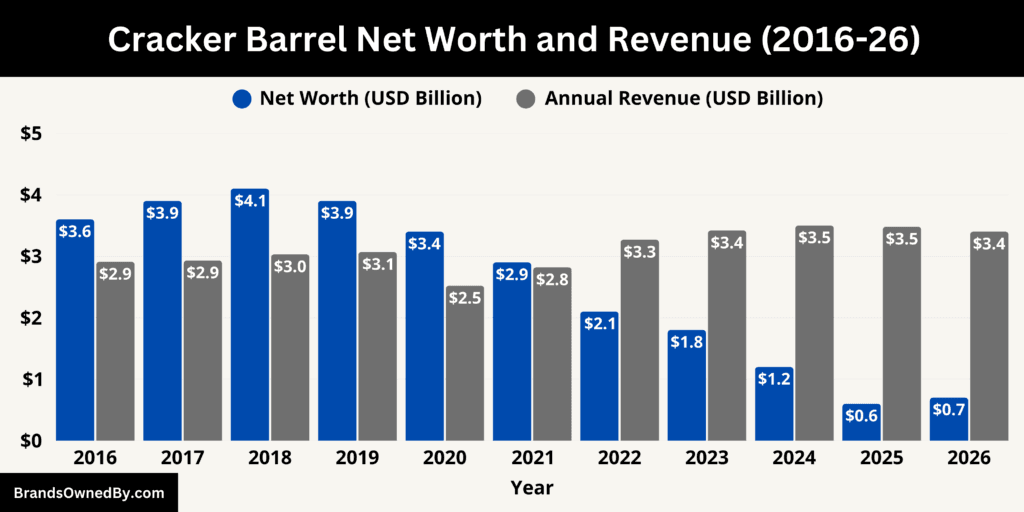
As of March 2026, Cracker Barrel reported annual revenue of about $3.40 billion and a net worth (market capitalization) of approximately $0.70 billion. Revenue is largely driven by food sales in its restaurants, while a smaller but meaningful portion comes from retail merchandise sold inside its country stores. Despite steady revenue levels, the company’s market valuation has declined in recent years due to lower stock prices and broader challenges affecting the casual dining sector.
2026 Revenue Breakdown
Cracker Barrel’s $3.40 billion revenue in 2026 is generated through two primary business segments: restaurant operations and retail merchandise.
Restaurant operations remain the company’s largest revenue driver. This segment contributes roughly 78%–80% of total revenue, primarily from dine-in meals, takeout orders, and catering services across more than 650 restaurant locations in the United States. Based on the 2026 revenue level, restaurant sales generate approximately $2.65 billion to $2.72 billion annually.
The second major revenue source is the company’s retail business. Every Cracker Barrel restaurant includes a country store that sells packaged food products, candy, clothing, toys, seasonal décor, and home goods. Retail merchandise typically contributes 20%–22% of total revenue, which equals roughly $680 million to $750 million annually based on the 2026 revenue figures.
This dual revenue model is a defining feature of Cracker Barrel’s business strategy. Unlike most restaurant chains, the company benefits from both dining and retail purchases during a single customer visit.
Net Worth
Cracker Barrel’s net worth is best represented by its market capitalization, which measures the total market value of the company’s outstanding shares.
As of March 2026, Cracker Barrel’s market capitalization is approximately $0.70 billion. This valuation is significantly lower than previous years, when the company’s market value exceeded $3 billion.
The decline in valuation reflects a prolonged drop in the company’s stock price. Several factors contributed to this trend, including weaker restaurant traffic, rising labor costs, higher food prices, and changing consumer spending patterns in the casual dining sector.
Despite the lower market valuation, the company continues to generate strong annual revenue above $3 billion, supported by its established national restaurant network and diversified revenue streams.
Revenue Trends Over the Past Decade
Over the past decade, Cracker Barrel’s revenue has remained relatively stable. Between 2016 and 2019, annual revenue grew from $2.91 billion to $3.07 billion as the company expanded its restaurant footprint and strengthened its retail offerings.
The company experienced a temporary decline in 2020 when revenue dropped to $2.52 billion due to pandemic-related disruptions that affected the entire restaurant industry. Restaurant closures and reduced dining capacity significantly impacted sales during that period.
Revenue gradually recovered in the following years. By 2022, annual revenue reached $3.27 billion, followed by $3.42 billion in 2023, $3.50 billion in 2024, and $3.48 billion in 2025. In 2026, revenue remains around $3.40 billion, reflecting stable demand despite slower traffic growth.
Revenue Forecast Through 2030
Cracker Barrel’s future revenue growth is expected to remain gradual rather than rapid. The company is focusing on improving restaurant efficiency, increasing off-premise dining sales, and strengthening its retail merchandise business rather than aggressive location expansion.
Based on current performance trends and industry growth projections, revenue is expected to increase modestly over the next several years. Annual revenue could reach approximately $3.45 billion in 2027, $3.50 billion in 2028, $3.55 billion in 2029, and about $3.60 billion by 2030.
Future growth will likely come from improvements in restaurant productivity, menu innovation, digital ordering systems, and loyalty programs designed to increase repeat visits. The company is also investing in retail merchandising and seasonal product offerings to strengthen its secondary revenue stream.
Although the company’s market valuation has fluctuated significantly, its ability to generate consistent multi-billion-dollar revenue demonstrates the strength of its restaurant network and the long-standing popularity of the Cracker Barrel brand.
Brands Owned by Cracker Barrel
Cracker Barrel Old Country Store, Inc. operates a focused portfolio built around its core restaurant brand and related hospitality concepts. Unlike large restaurant conglomerates that own dozens of chains, Cracker Barrel primarily manages a small group of brands and operating entities tied closely to its dining and retail model.
As of March 2026, it owns and operates several brands, subsidiaries, and operating entities that support its restaurant operations, retail merchandising business, and fast-casual expansion strategy.
Cracker Barrel Old Country Store
Cracker Barrel Old Country Store is the company’s flagship and primary operating brand. The chain combines a full-service restaurant with a country-style retail store located inside the same building.
The brand was founded in 1969 in Lebanon, Tennessee. It has grown into one of the largest casual dining chains in the United States. As of 2026, the company operates more than 650 restaurant locations across over 40 U.S. states.
Cracker Barrel restaurants specialize in Southern-style comfort food. Popular menu items include fried chicken, meatloaf, biscuits, pancakes, country ham, and traditional breakfast plates.
Each location also features a retail store positioned at the entrance of the restaurant. These stores sell packaged foods, candy, toys, home décor, seasonal gifts, and clothing. The combination of restaurant dining and retail shopping is a core part of the brand’s identity and a major contributor to its revenue.
Maple Street Biscuit Company
Maple Street Biscuit Company is a fast-casual breakfast and brunch restaurant chain owned by Cracker Barrel.
The brand was founded in 2012 in Jacksonville, Florida. Cracker Barrel acquired the company in 2019 as part of its strategy to expand into the fast-casual restaurant segment.
Maple Street Biscuit Company focuses on Southern-inspired breakfast and brunch items. Its menu features biscuit sandwiches, fried chicken biscuits, gravy-based breakfast dishes, and specialty coffee drinks.
Unlike traditional Cracker Barrel locations, Maple Street restaurants are typically located in urban or suburban neighborhoods rather than along interstate highways. The concept targets younger consumers and offers a more modern dining environment.
As of 2026, Maple Street Biscuit Company operates more than 60 restaurant locations across the United States and continues to expand gradually.
Cracker Barrel Country Store
Cracker Barrel Country Store refers to the retail business operated inside each Cracker Barrel restaurant. Although it operates alongside the restaurant brand, the retail division functions as a distinct business segment within the company.
The retail stores sell a wide range of products including:
- Packaged food products
- Old-fashioned candy and snacks
- Seasonal decorations and home décor
- Toys and gifts
- Clothing and accessories.
These stores are designed to replicate the feel of traditional rural general stores. The merchandise assortment changes throughout the year to reflect holidays and seasonal trends.
Retail sales typically generate around 20% of the company’s total revenue, making the retail business one of Cracker Barrel’s most unique competitive advantages.
Cracker Barrel Food Products
Cracker Barrel Food Products represents the company’s branded packaged food business. Through this segment, the company sells products that allow customers to recreate Cracker Barrel meals at home.
These products include pancake mixes, biscuit mixes, syrups, cornbread mixes, and various candy items.
Most of these products are sold in the retail stores attached to Cracker Barrel restaurants. Some items are also distributed through grocery retailers and specialty food outlets.
The packaged food business helps extend the brand beyond restaurant visits and strengthens brand recognition among consumers.
Cracker Barrel Hospitality and Real Estate Entities
Cracker Barrel also operates several corporate entities responsible for managing restaurant properties, supply chains, and operational infrastructure.
Many of the company’s restaurant locations are owned rather than leased. These properties are managed through internal subsidiaries that oversee property development, maintenance, and leasing arrangements.
Owning real estate provides the company with greater control over its restaurant network and long-term cost stability.
These internal entities also manage logistics, procurement systems, and distribution networks that support the company’s nationwide operations.
Strategic Growth Entities
To support expansion and acquisitions, Cracker Barrel maintains corporate structures designed to manage new business initiatives.
For example, separate operational entities were created to integrate and manage the Maple Street Biscuit Company following its acquisition.
These entities allow the company to operate new concepts while maintaining strategic alignment with its core restaurant brand.
Although Cracker Barrel’s portfolio is relatively small compared with major restaurant conglomerates, the company focuses on expanding complementary brands that strengthen its core restaurant and retail business model.
Final Words
Cracker Barrel remains one of the most recognizable restaurant chains in the United States, known for combining traditional dining with a country retail store experience. Understanding who owns Cracker Barrel shows that the company operates as a publicly traded business with ownership spread among institutional investors and public shareholders.
While investors hold shares in the company, control of the business rests with its executive leadership and board of directors. The company continues to focus on its core restaurant brand while expanding complementary concepts such as Maple Street Biscuit Company.
With hundreds of restaurant locations and a strong national brand, Cracker Barrel maintains a unique position in the casual dining industry through its blend of Southern-style food, retail merchandise, and hospitality-focused dining experience.
FAQs
Who is the largest shareholder of Cracker Barrel?
The largest shareholder of Cracker Barrel Old Country Store, Inc. is BlackRock, Inc. As of 2026, the global asset management firm holds about 3.2 million shares of the company, representing roughly 14.5% of its outstanding stock. BlackRock holds these shares primarily through its index funds and exchange-traded funds.
Is Cracker Barrel a franchise?
No, Cracker Barrel is not primarily a franchise restaurant chain. Most Cracker Barrel locations are company-owned and operated by Cracker Barrel Old Country Store, Inc. This allows the company to maintain consistent menu standards, store layouts, and the combined restaurant and retail concept across all locations.
What company owns Cracker Barrel?
Cracker Barrel is owned by Cracker Barrel Old Country Store, Inc., a publicly traded company listed on the NASDAQ stock exchange under the ticker CBRL. The company is owned collectively by institutional investors, investment funds, and individual shareholders.
What is Cracker Barrel’s parent company?
Cracker Barrel does not have a parent company. It operates as an independent publicly traded corporation. Ownership is distributed among its shareholders rather than being controlled by a larger corporate parent.
Where was Cracker Barrel founded?
Cracker Barrel was founded in Lebanon, Tennessee, United States. The first restaurant opened in 1969 near Interstate 40 and was designed to serve travelers driving along major highways.
Who created Cracker Barrel?
Cracker Barrel was created by Dan W. Evins, an American entrepreneur. He founded the restaurant chain in 1969 with the idea of offering home-style meals and a country store atmosphere for interstate travelers.
Who was the original owner of Cracker Barrel?
The original owner of Cracker Barrel was its founder, Dan W. Evins. He opened the first restaurant and led the company during its early growth before it became a publicly traded corporation in 1981.
Who is over the CEO of Cracker Barrel?
The CEO of Cracker Barrel reports to the company’s board of directors. As of 2026, the board is chaired by Gail Johnson, who serves as the Independent Chair of the Board and oversees corporate governance and executive leadership.
Is Dolly Parton affiliated with Cracker Barrel?
Dolly Parton is not an owner of Cracker Barrel, but she has collaborated with the company on special promotions and branded merchandise. These partnerships included limited-time menu items and retail products sold in Cracker Barrel stores.
How many Cracker Barrel’s are there?
As of 2026, Cracker Barrel operates more than 650 restaurant locations across over 40 U.S. states. Most of these locations include both a full-service restaurant and a country store retail shop.