
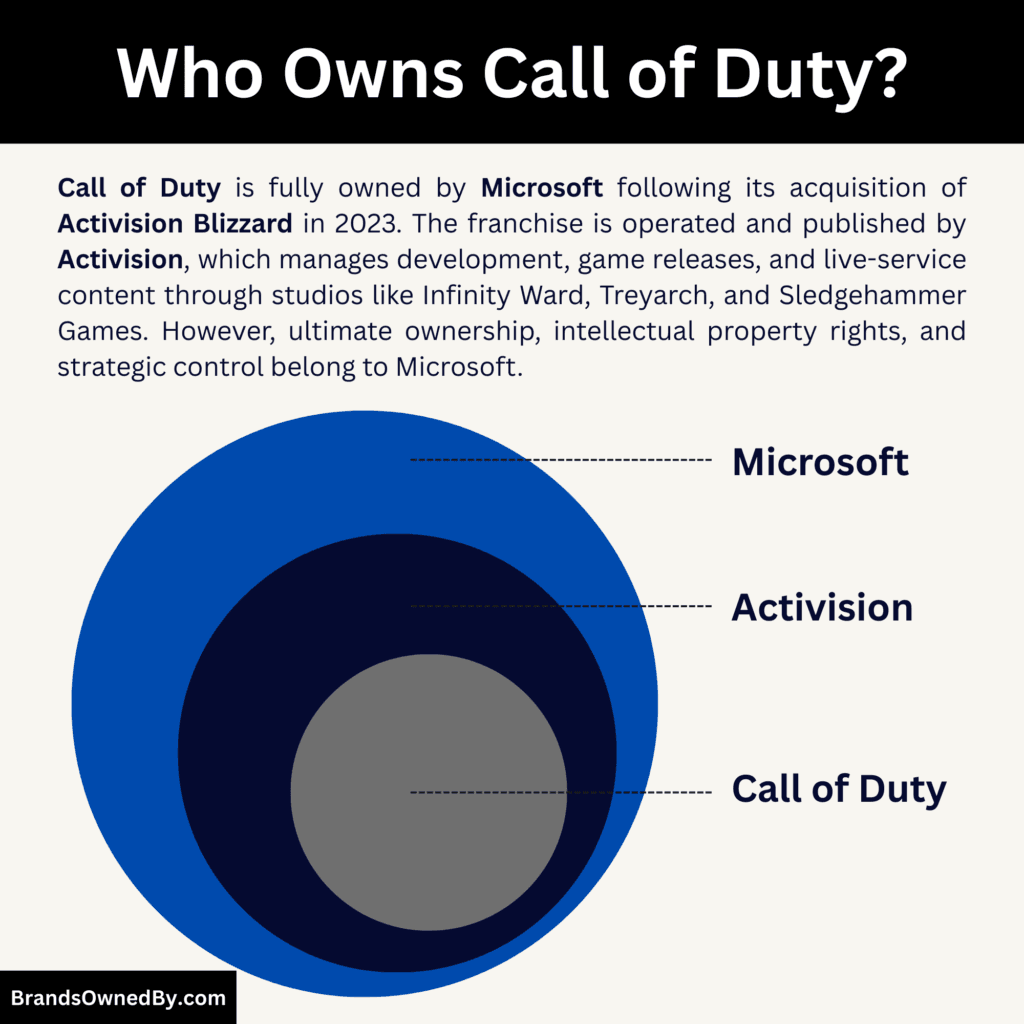
- Microsoft is the sole owner of Call of Duty. After completing its $68.7 billion acquisition of Activision Blizzard in 2023, Microsoft owns 100% of the franchise and controls all strategic decisions.
- Activision operates the franchise, but does not own it independently. Activision manages development, publishing, and live-service operations, while ultimate corporate authority rests with Microsoft.
- Since Activision Blizzard became a wholly owned Microsoft subsidiary, the franchise no longer has independent institutional or public investors.
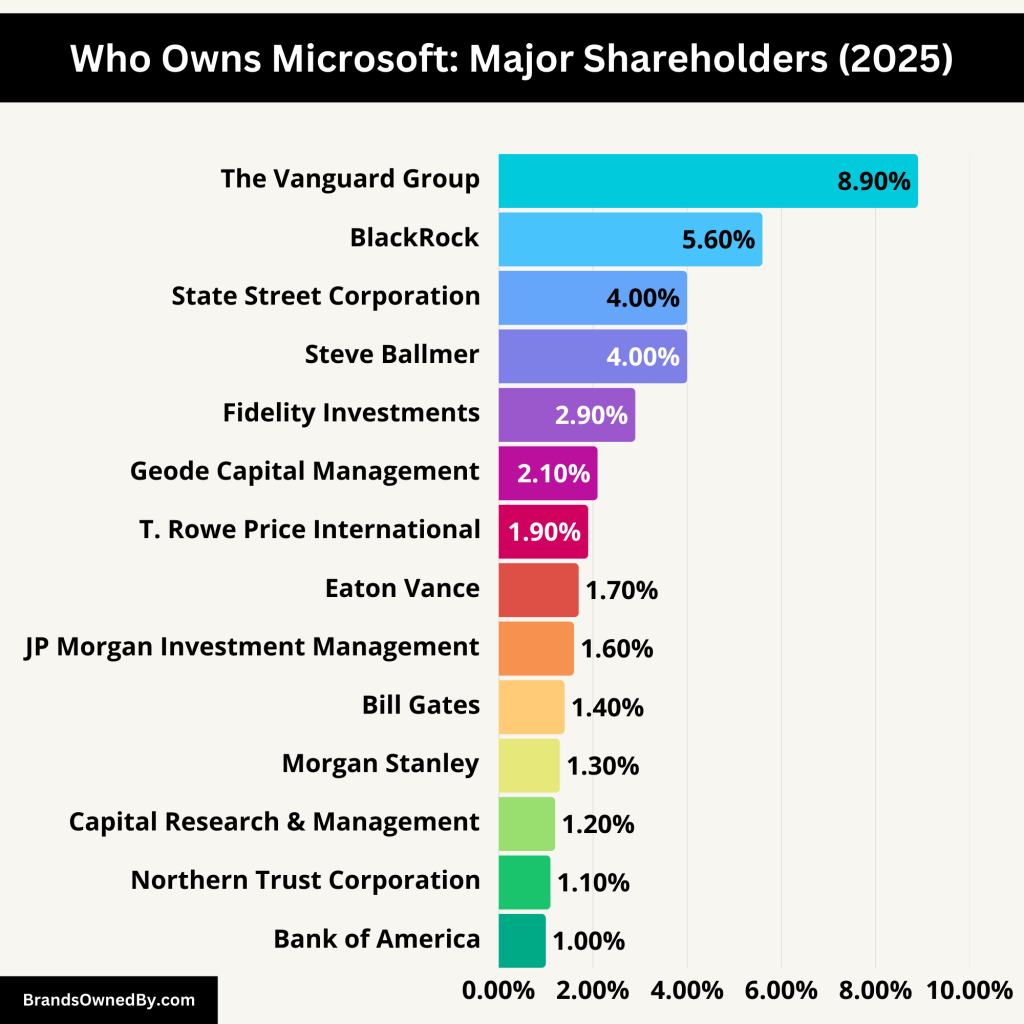
- Microsoft shareholders indirectly own Call of Duty. Anyone holding Microsoft stock has proportional ownership exposure to the franchise as part of Microsoft’s gaming division portfolio.
Call of Duty is a leading first-person shooter franchise published by Activision and owned by Microsoft. It launched in 2003 and quickly became a defining brand in modern gaming. The series is known for cinematic campaigns, competitive multiplayer, and evolving live-service content. It spans console, PC, and mobile platforms and operates as a long-running entertainment ecosystem supported by multiple development studios.
Call of Duty is developed through a multi-studio model managed by Activision Publishing. The core development studios include Infinity Ward, Treyarch, and Sledgehammer Games.
Infinity Ward created the original Call of Duty and later developed the Modern Warfare series. Treyarch is known for the Black Ops series and its Zombies mode. Sledgehammer Games has contributed to multiple major titles and co-developed large-scale releases.
This rotating studio system ensures continuous innovation, stable release cycles, and technical upgrades. The franchise includes campaign storytelling, multiplayer competition, cooperative modes, and large-scale battle royale gameplay through Warzone. It also operates a global player network, seasonal content system, and cross-platform integration within Microsoft’s gaming ecosystem.
Founders of Call of Duty
Call of Duty was originally created by key developers at Infinity Ward. The core founders behind the studio and the game include Vince Zampella, Grant Collier, and Jason West.
These developers previously worked on Medal of Honor: Allied Assault. They left their former studio in 2002 and formed Infinity Ward. Their goal was to build a more immersive and cinematic war shooter.
Vince Zampella served as the studio head and creative leader. Jason West was the technical and design architect behind early gameplay systems. Grant Collier managed production and studio operations.
Together, they created the original Call of Duty in 2003. The game introduced squad-based combat, cinematic mission design, and realistic battlefield immersion. These innovations set the foundation for the franchise’s long-term success.
Although leadership has changed over time, the original creators established the creative DNA that still defines Call of Duty today.
Evolution of the Franchise
After the success of the first game, Call of Duty expanded into multiple sub-franchises. Modern Warfare shifted the setting into contemporary warfare and became one of the most influential shooter series ever. Black Ops introduced Cold War themes, psychological storytelling, and the popular Zombies mode.
The franchise later expanded into free-to-play and mobile gaming through Warzone and Call of Duty Mobile. It now operates as a global multi-platform ecosystem supported by Microsoft’s technology infrastructure and long-term gaming strategy.
This detailed overview shows that Call of Duty is not just a video game series. It is a large-scale entertainment franchise built by specialized studios, shaped by its original creators, and supported by one of the world’s most powerful technology companies.
Ownership History
The ownership of Call of Duty has changed through major industry shifts and corporate deals. The franchise began under Activision, later became part of Activision Blizzard, and is now fully owned by Microsoft. Each phase reshaped how the brand was managed, expanded, and positioned in the global gaming market.
Creation and Early Ownership Under Activision (2003–2007)
Call of Duty was launched in 2003 by Infinity Ward and published by Activision. From the beginning, Activision owned the full intellectual property rights. It controlled publishing, distribution, marketing, and long-term franchise planning.
The first game focused on World War II and introduced cinematic combat and squad-based gameplay. Its success encouraged Activision to turn Call of Duty into a recurring franchise. During this period, Activision operated as an independent public company, meaning the franchise was fully under its direct corporate ownership.
This phase laid the foundation for the franchise’s structure. Activision began investing in multiple studios and built the rotational development model that still exists today.
Merger and Shift to Activision Blizzard (2008)
In 2008, Activision merged with Vivendi Games. This merger created Activision Blizzard, one of the largest publishers in the world at the time.
Following the merger, ownership of Call of Duty moved from Activision alone to Activision Blizzard as the new parent company. The franchise continued to be managed by Activision Publishing, but strategic ownership shifted upward.
During this era, Call of Duty experienced massive global expansion. Titles such as Modern Warfare and Black Ops transformed the franchise into a cultural and commercial powerhouse. Vivendi initially held a controlling stake in Activision Blizzard, meaning ultimate corporate influence came from Vivendi’s ownership position.
Transition to Full Independence (2013)
In 2013, Activision Blizzard completed a major share buyback from Vivendi. This transaction removed Vivendi as the controlling shareholder and made Activision Blizzard an independent publicly traded company.
After this shift, ownership of Call of Duty remained entirely within Activision Blizzard, but the company now operated without a dominant external parent. Institutional investors and public shareholders collectively owned the company.
This period saw the franchise expand beyond traditional annual releases. Digital content, online multiplayer ecosystems, and live-service elements became central to Call of Duty’s business model. The franchise strengthened its global player base and became a long-term entertainment platform rather than just a yearly game series.
Microsoft Announces Historic Acquisition (2022)
In January 2022, Microsoft announced its plan to acquire Activision Blizzard for $68.7 billion. This became one of the largest acquisitions ever in the technology and gaming industries.
The announcement triggered extensive regulatory reviews worldwide. Authorities examined competition risks, especially related to Call of Duty’s availability on rival platforms such as PlayStation. During this review period, Activision Blizzard continued operating independently while awaiting approvals.
This phase marked the beginning of a major ownership transition that would redefine the franchise’s future.
Microsoft Finalizes Acquisition (2023)
In October 2023, Microsoft officially completed its acquisition of Activision Blizzard. With this deal, Microsoft became the full and sole owner of Activision Blizzard and all its assets, including Call of Duty.
This was a turning point in the franchise’s ownership history. Call of Duty moved from a publicly traded gaming company into the ecosystem of one of the world’s largest technology corporations. The franchise now operates within Microsoft’s gaming division, often referred to as Xbox or Microsoft Gaming.
Although Activision Publishing continues to manage development, publishing, and studio coordination, the ultimate corporate owner is now Microsoft.
Current Ownership Structure
As of 2026, Microsoft holds 100% ownership of Activision Blizzard, making it the sole owner of Call of Duty. The franchise is still developed by core studios such as Infinity Ward, Treyarch, and Sledgehammer Games. However, strategic direction, platform expansion, and long-term investments align with Microsoft’s broader gaming strategy.
This ownership journey shows how Call of Duty evolved from a single studio project into a flagship property within a global technology powerhouse. Each ownership phase strengthened the franchise’s scale, reach, and long-term positioning in the gaming industry.
Who Owns Call of Duty in 2026?
Call of Duty is operated by Activision, governed by Activision Blizzard, and fully owned by Microsoft. The 2023 acquisition centralized ownership and positioned the franchise within one of the world’s largest technology ecosystems. This structure ensures strong financial backing, global technological support, and long-term strategic growth for one of gaming’s most influential franchises.
Direct Owner and Operator: Activision Publishing
The direct owner and operational manager of Call of Duty is Activision. Activision holds the publishing rights, manages the intellectual property, and oversees the entire lifecycle of the franchise.
Activision coordinates a multi-studio development structure. Core studios include Infinity Ward, Treyarch, and Sledgehammer Games. Each studio leads different titles while collaborating on shared technologies such as game engines, multiplayer infrastructure, and live-service systems. Activision controls production timelines, content strategy, marketing campaigns, and global distribution.
The company also manages the franchise’s live ecosystem. This includes seasonal updates, battle passes, esports integration, and the free-to-play Warzone platform. While Activision runs day-to-day operations, it does not function as an independent owner anymore. Its authority exists within a larger corporate hierarchy.
Parent Company: Activision Blizzard
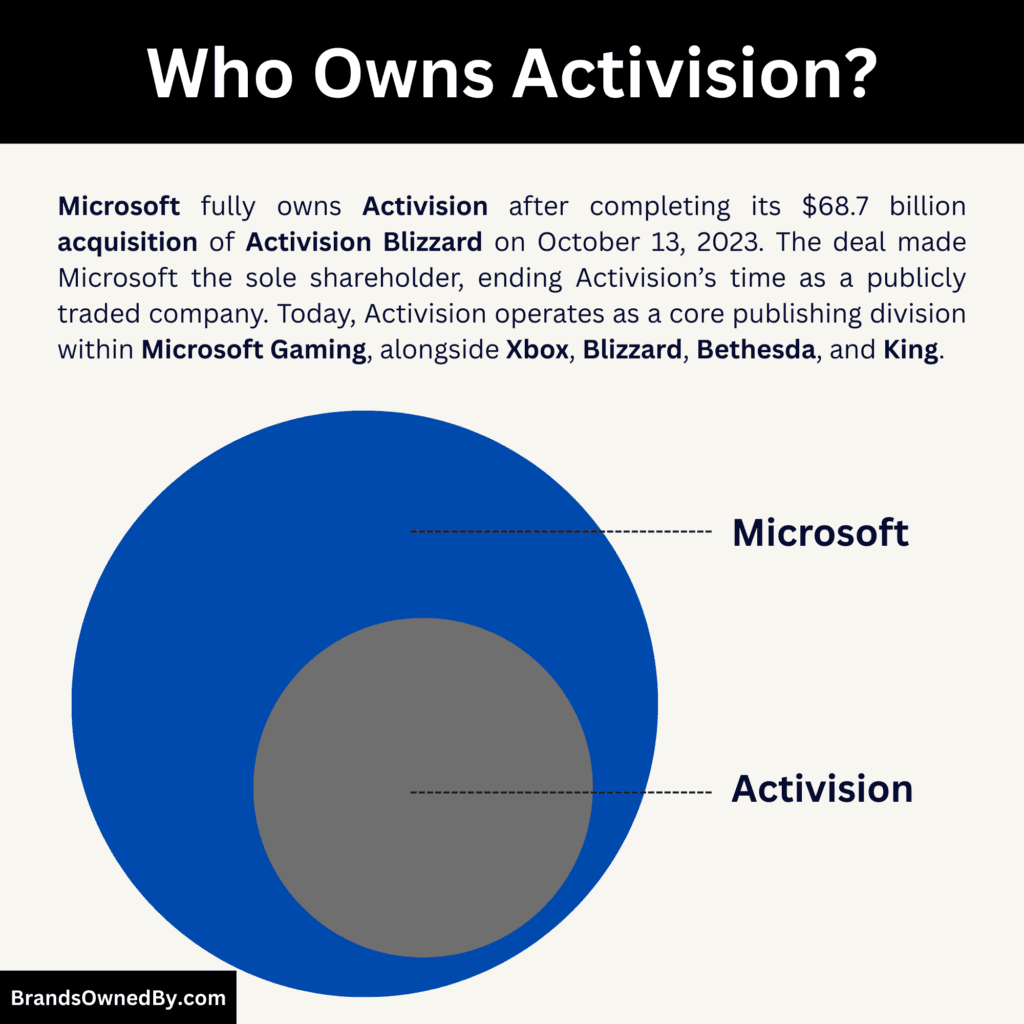
Above Activision sits Activision Blizzard, which historically owned the Call of Duty intellectual property along with other major gaming brands.
Before 2023, Activision Blizzard operated as a publicly traded company. Ownership was distributed among institutional investors, asset management firms, and public shareholders. No single gaming company controlled Call of Duty outright during this phase. Instead, it remained part of Activision Blizzard’s central portfolio and was one of the company’s most strategically important assets.
Activision Blizzard provided financial resources, corporate governance, and long-term franchise investment. It enabled large-scale development budgets, global distribution, and the transition of Call of Duty into a live-service platform. This parent layer ensured the franchise could expand beyond annual releases into continuous digital engagement.
Ultimate Owner: Microsoft
The ultimate and current owner of Call of Duty is Microsoft. Microsoft owns 100% of Activision Blizzard, which gives it full legal and strategic ownership of the Call of Duty franchise.
Within Microsoft, the franchise operates under Microsoft Gaming, commonly associated with the Xbox ecosystem. This integration connects Call of Duty to Microsoft’s global technology infrastructure, including cloud gaming, subscription services, and cross-platform distribution.
Microsoft’s ownership means it controls long-term strategy, platform availability, licensing rights, and investment decisions. Activision continues to operate the franchise, but ultimate authority lies with Microsoft’s corporate leadership.
Acquisition Background and Strategic Insights
In January 2022, Microsoft announced its intention to acquire Activision Blizzard in a $68.7 billion deal. This was one of the largest acquisitions in the history of the technology and gaming sectors.
The proposed acquisition faced extensive regulatory scrutiny across major global markets. Authorities examined whether Microsoft could use Call of Duty to gain an unfair competitive advantage, particularly against rival console platforms. The central concern was whether the franchise might become exclusive to Xbox.
To address these concerns, Microsoft entered into long-term agreements to keep Call of Duty available on multiple platforms. This commitment played a key role in securing regulatory approvals. After nearly two years of legal and regulatory processes, Microsoft officially completed the acquisition in October 2023.
The acquisition transformed Call of Duty from a flagship property of an independent game publisher into a core asset within a global technology ecosystem. It significantly strengthened Microsoft’s competitive position in console gaming, PC gaming, and cloud gaming.
Ownership Structure After the Acquisition
After the completion of the deal, the ownership hierarchy became centralized and clear. Microsoft sits at the top as the sole parent company. Activision Blizzard operates as a wholly owned subsidiary. Activision Publishing manages the Call of Duty franchise directly. Development studios such as Infinity Ward, Treyarch, and Sledgehammer Games function under Activision’s operational structure.
This layered structure separates operational management from corporate ownership. Activision focuses on development, publishing, and live-service operations. Microsoft handles strategic direction, global expansion, technology integration, and long-term investment.
Strategic Importance of Call of Duty Within Microsoft
Call of Duty is one of the most valuable gaming assets within Microsoft’s portfolio. The franchise plays a major role in expanding Xbox Game Pass, strengthening multiplayer ecosystems, and supporting cross-platform engagement.
It also supports Microsoft’s broader strategy in cloud gaming and digital distribution. With Microsoft’s infrastructure, Call of Duty benefits from global server networks, AI-driven development tools, and long-term content scalability.
Because Microsoft owns the full intellectual property, it controls licensing, distribution rights, and franchise expansion across console, PC, and mobile platforms. This level of ownership ensures continued investment, technological integration, and long-term franchise stability.
Competitor Ownership Comparison
To fully understand the ownership position of Call of Duty, it is important to compare it with its main competitors. The shooter and live-service gaming market is dominated by a few major franchises. Each operates under a different ownership model. These structures influence funding, platform strategy, exclusivity, and long-term control.
| Franchise | Direct Owner / Developer | Parent Company | Ownership Type | Strategic Position |
|---|---|---|---|---|
| Call of Duty | Activision | Microsoft | Fully owned subsidiary | Integrated into Microsoft’s global gaming, cloud, and subscription ecosystem |
| Battlefield | DICE (EA Studio) | Electronic Arts | Public company ownership | Operates within a traditional publisher-driven franchise model |
| Fortnite | Epic Games | Epic Games (independent, Tencent minority stake) | Privately controlled | Platform-style ecosystem with creator economy and live virtual experiences |
| Apex Legends | Respawn Entertainment | Electronic Arts | Public company ownership | Live-service battle royale integrated into EA’s digital distribution network |
| Halo | 343 Industries | Microsoft | First-party Microsoft franchise | Core Xbox ecosystem shooter supporting console, PC, and cloud gaming |
Call of Duty vs Battlefield Ownership
Call of Duty is ultimately owned by Microsoft through Activision. In contrast, the Battlefield franchise is owned by Electronic Arts.
Electronic Arts is an independent publicly traded gaming company. It owns Battlefield through its internal studio DICE. Unlike Call of Duty, Battlefield is not backed by a large technology parent like Microsoft. Its strategy depends entirely on EA’s internal publishing and development ecosystem.
This creates a structural difference. Call of Duty benefits from Microsoft’s cloud infrastructure, subscription ecosystem, and cross-platform network. Battlefield operates within a traditional publisher-controlled framework.
Call of Duty vs Fortnite Ownership
Fortnite is owned by Epic Games. Epic Games is a privately held company. It is controlled by founder Tim Sweeney, with a minority investment from Tencent.
Unlike Call of Duty, Fortnite is not part of a large public technology corporation. Epic operates independently and controls its own engine, platform ecosystem, and distribution strategy. Fortnite functions more as a platform than a traditional game. It integrates social events, creator economies, and virtual experiences.
Call of Duty, however, sits inside Microsoft’s structured gaming ecosystem. It relies on a multi-studio model and large-scale publishing operations rather than a single-company platform strategy.
Call of Duty vs Apex Legends Ownership
Apex Legends is also owned by Electronic Arts through its studio Respawn Entertainment. This means both Battlefield and Apex Legends share the same parent company.
However, Apex Legends operates under a live-service, free-to-play model similar to Call of Duty Warzone. The difference lies in corporate backing. Apex is fully controlled by EA, while Call of Duty is backed by Microsoft’s broader technology and gaming infrastructure.
This gives Call of Duty stronger integration across console, PC, and cloud ecosystems. Apex relies primarily on EA’s publishing and digital distribution capabilities.
Call of Duty vs Halo Ownership
Halo is owned directly by Microsoft through Xbox Game Studios and developed by 343 Industries. This makes Halo and Call of Duty part of the same corporate parent.
However, their origins differ. Halo was always a first-party Microsoft franchise. Call of Duty was acquired later through the Activision Blizzard purchase. Despite different histories, both franchises now support Microsoft’s gaming ecosystem, including Xbox services and cross-platform infrastructure.
This internal alignment strengthens Microsoft’s position in the shooter genre by controlling multiple flagship franchises.
Ownership Structure Differences Across Competitors
The key difference lies in corporate scale and structure. Call of Duty is part of a global technology corporation with diversified business segments. Battlefield and Apex Legends are owned by a traditional gaming publisher. Fortnite is controlled by a private developer-led company. Halo is a first-party Microsoft property.
These ownership models shape long-term strategy. Microsoft uses Call of Duty to strengthen subscription gaming, cloud distribution, and cross-platform engagement. EA focuses on franchise-based publishing. Epic focuses on platform ecosystem growth.
Because of Microsoft’s full ownership, Call of Duty benefits from long-term capital, global infrastructure, and strategic technology integration. This positions it differently from competitors that rely solely on gaming-focused corporate structures.
Who Controls Call of Duty?
Microsoft owns Call of Duty, but control is shared across corporate, operational, and creative layers. Satya Nadella oversees overall corporate direction. Phil Spencer manages gaming strategy and ecosystem integration. Activision Publishing runs the franchise day to day, while development studios control creative execution.
This structured control model allows Call of Duty to operate as both a major entertainment franchise and a strategic asset within Microsoft’s global gaming empire.
Ultimate Corporate Control: Microsoft Leadership
At the highest level, Call of Duty is controlled by Microsoft. The company sets long-term strategic direction, capital allocation, platform strategy, and global expansion.
The CEO of Microsoft is Satya Nadella. He oversees the entire corporation, including the gaming division. Major decisions such as acquisitions, platform positioning, cloud gaming integration, and long-term investment in franchises like Call of Duty fall under Microsoft’s executive leadership.
Microsoft’s board and senior leadership influence high-level policies. These include platform availability, cross-platform agreements, subscription integration, and global market strategy.
Operational Control: Microsoft Gaming (Xbox Division)
Day-to-day strategic gaming control sits within Microsoft Gaming, often referred to as the Xbox division. This unit manages all gaming assets, including Xbox Game Studios, Bethesda, and Activision Blizzard.
The head of Microsoft Gaming is Phil Spencer. As CEO of Microsoft Gaming, he oversees the integration of Activision Blizzard and guides the long-term vision for Call of Duty within Microsoft’s ecosystem.
Phil Spencer’s responsibilities include platform strategy, Game Pass expansion, cloud gaming growth, and cross-platform presence. His division ensures that Call of Duty aligns with Microsoft’s broader gaming strategy rather than operating independently.
Franchise-Level Control: Activision Publishing
While Microsoft sets corporate strategy, the operational control of the Call of Duty franchise itself lies with Activision.
Activision Publishing manages the full lifecycle of the franchise. This includes production planning, development coordination, marketing campaigns, and global release management. Activision decides the annual release schedule, content roadmap, multiplayer structure, and live-service updates.
The company also oversees Warzone, seasonal content, esports initiatives, and monetization systems. Although Activision operates the franchise, it does so within Microsoft’s strategic framework.
Development Control: Core Studio Leadership
Creative and technical control of individual Call of Duty titles rests with the core development studios. These include Infinity Ward, Treyarch, and Sledgehammer Games.
Each studio leads specific game releases and contributes to shared technologies. Studio leadership controls gameplay design, engine development, multiplayer systems, and creative direction. However, major franchise-wide decisions such as release timing, monetization structure, and platform strategy are coordinated through Activision and Microsoft.
This multi-studio governance model allows Call of Duty to maintain consistent releases while evolving technically and creatively.
Leadership Transition After Microsoft Acquisition
Before Microsoft acquired Activision Blizzard, Bobby Kotick served as the long-time CEO of Activision Blizzard and had a major influence over the Call of Duty franchise.
Following the completion of Microsoft’s acquisition in 2023, Bobby Kotick stepped down. Control shifted more directly into Microsoft’s gaming leadership structure. This transition centralized strategic authority while leaving operational development largely unchanged under Activision.
Decision-Making Structure
Control of Call of Duty is distributed across three levels.
Microsoft leadership controls long-term corporate strategy and global positioning. Microsoft Gaming controls platform integration, subscription strategy, and ecosystem alignment. Activision controls franchise execution, development coordination, and live-service operations.
This layered structure ensures that Call of Duty benefits from Microsoft’s global infrastructure while retaining specialized franchise management through Activision and its studios.
Call of Duty Annual Revenue and Net Worth
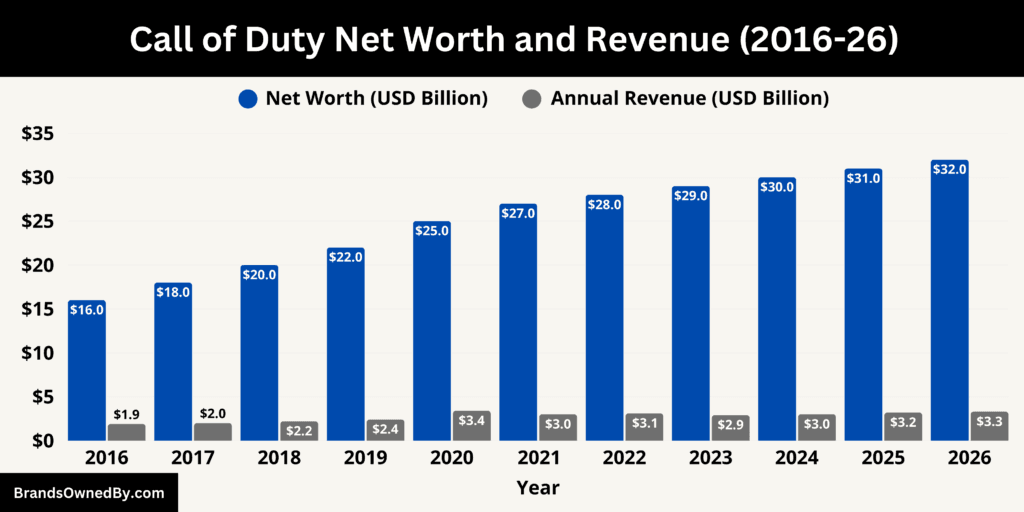
As of February 2026, the franchise generates an estimated $3.3 billion in annual revenue and holds an estimated franchise value of about $32 billion. This valuation reflects long-term brand strength, recurring digital income, and its strategic importance within Microsoft’s gaming ecosystem.
2026 Revenue Breakdown
In 2026, Call of Duty’s estimated revenue of $3.3 billion comes from multiple interconnected streams rather than a single game release. The franchise now operates as a continuous live-service platform.
A major portion of revenue comes from premium game sales, particularly the yearly flagship title. These releases typically contribute around $1.2–$1.4 billion annually, depending on launch performance and player retention.
Another large share comes from in-game purchases and microtransactions, including skins, bundles, and seasonal battle passes. This segment contributes approximately $1.1–$1.3 billion, making it one of the most stable recurring income sources.
Warzone and free-to-play ecosystem revenue adds another significant portion. Although Warzone is free, it generates income through cosmetic purchases and seasonal content. This segment contributes roughly $500–$600 million annually.
Mobile gaming, primarily through Call of Duty Mobile, contributes an estimated $300–$400 million. The mobile segment remains important for global expansion, especially in Asia and emerging markets.
Additional revenue comes from licensing, esports partnerships, and digital platform integrations, contributing roughly $100–$150 million.
2026 Franchise Net Worth and Valuation Drivers
As of February 2026, the estimated franchise value of $32 billion reflects the long-term commercial strength of Call of Duty rather than a single-year performance. Several factors drive this valuation.
The franchise maintains one of the largest active player bases in gaming. Its multi-platform presence across console, PC, and mobile ensures stable global engagement. The transition to a live-service model significantly increased long-term monetization potential.
Integration within Microsoft’s ecosystem also increased the franchise’s strategic value. Call of Duty supports subscription services, cloud gaming expansion, and cross-platform multiplayer infrastructure. This ecosystem-driven positioning enhances long-term profitability and brand durability.
Strong intellectual property value, recurring digital income, and long-term franchise stability continue to push the valuation upward each year.
Historical Growth Context
Over the past decade, Call of Duty’s annual revenue has remained consistently above $2 billion. The most significant growth occurred after the introduction of Warzone and the expansion of digital monetization. The shift from one-time game purchases to continuous live-service engagement created a more predictable and scalable revenue structure.
Franchise value has steadily increased due to long-term brand dominance and global market expansion. The Microsoft acquisition further strengthened its financial positioning by embedding the franchise into a broader technology and gaming infrastructure.
Future Revenue Forecast (2026–2030)
Call of Duty is expected to maintain steady financial growth over the next several years. The franchise benefits from recurring digital income, live-service monetization, and integration within Microsoft’s gaming ecosystem. Continued expansion in mobile gaming, cloud distribution, and subscription-based access is likely to support long-term revenue stability.
Below is a projected revenue outlook through 2030 based on current growth trends, player engagement patterns, and industry trajectory.
- 2027: $3.45 billion — Gradual increase driven by expanded live-service content, improved player retention, and deeper integration with subscription and cloud gaming platforms.
- 2028: $3.6 billion — Growth supported by mobile market expansion, increased digital microtransaction spending, and larger global player base.
- 2029: $3.75 billion — Continued rise from recurring monetization systems, long-term content ecosystems, and cross-platform engagement improvements.
- 2030: $3.9 billion — Projected maturity stage where revenue growth stabilizes, supported by sustained live-service income, global franchise strength, and Microsoft ecosystem integration.
This forecast reflects moderate but consistent growth rather than rapid spikes. The franchise’s shift to a recurring revenue model ensures long-term financial stability, making Call of Duty one of the most durable and valuable entertainment properties globally.
List of Call of Duty Games
The Call of Duty franchise has evolved across multiple gameplay eras, technological shifts, and console generations. Each phase introduced new mechanics, storytelling formats, and multiplayer systems.
Below is a detailed breakdown of the major Call of Duty games, organized by era and sub-series, with deeper context about their impact and evolution:
| Game Title | Release Year | Lead Developer | Era / Series | Key Features and Innovations |
|---|---|---|---|---|
| Call of Duty | 2003 | Infinity Ward | WWII Era | Introduced squad-based combat and cinematic battlefield storytelling |
| Call of Duty 2 | 2005 | Infinity Ward | WWII Era | Regenerative health system and improved realism |
| Call of Duty 3 | 2006 | Treyarch | WWII Era | Larger multiplayer battles and Normandy campaign |
| Call of Duty: World at War | 2008 | Treyarch | WWII Era | Introduced Zombies mode and darker narrative tone |
| Call of Duty 4: Modern Warfare | 2007 | Infinity Ward | Modern Warfare | Modern combat setting and multiplayer progression system |
| Call of Duty: Modern Warfare 2 | 2009 | Infinity Ward | Modern Warfare | Killstreak rewards and expanded multiplayer customization |
| Call of Duty: Modern Warfare 3 | 2011 | Infinity Ward / Sledgehammer | Modern Warfare | Concluded original trilogy and expanded cooperative gameplay |
| Call of Duty: Modern Warfare (Reboot) | 2019 | Infinity Ward | Modern Warfare | New engine, cross-platform play, Warzone integration |
| Call of Duty: Modern Warfare II | 2022 | Infinity Ward | Modern Warfare | Advanced AI systems and deeper Warzone integration |
| Call of Duty: Modern Warfare III | 2023 | Sledgehammer Games | Modern Warfare | Refined multiplayer and unified engine ecosystem |
| Call of Duty: Black Ops | 2010 | Treyarch | Black Ops | Cold War setting and expanded Zombies mode |
| Call of Duty: Black Ops II | 2012 | Treyarch | Black Ops | Branching storyline and multiple endings |
| Call of Duty: Black Ops III | 2015 | Treyarch | Black Ops | Futuristic combat and advanced mobility mechanics |
| Call of Duty: Black Ops 4 | 2018 | Treyarch | Black Ops | Introduced Blackout battle royale mode |
| Call of Duty: Black Ops Cold War | 2020 | Treyarch / Raven | Black Ops | Integrated progression with Warzone |
| Call of Duty: Ghosts | 2013 | Infinity Ward | Experimental Era | New storyline and dynamic environmental destruction |
| Call of Duty: Advanced Warfare | 2014 | Sledgehammer Games | Experimental Era | Exoskeleton suits and vertical mobility |
| Call of Duty: Infinite Warfare | 2016 | Infinity Ward | Experimental Era | Space combat and interplanetary warfare |
| Call of Duty: WWII | 2017 | Sledgehammer Games | WWII Return | Return to grounded historical combat |
| Call of Duty: Mobile | 2019 | TiMi Studios / Activision | Mobile Expansion | Multiplayer and battle royale on smartphones |
| Call of Duty: Warzone | 2020 | Infinity Ward / Raven | Live-Service | Free-to-play battle royale and shared progression |
| Call of Duty: Warzone 2.0 | 2022 | Infinity Ward | Live-Service | New engine and unified ecosystem integration |
The World War II Era (2003–2008)
This era established the foundation of the franchise. The focus was on historical realism, squad-based combat, and cinematic battlefield immersion.
Call of Duty (2003): Developed by Infinity Ward and published by Activision, the original title emphasized authenticity. Players experienced campaigns from American, British, and Soviet perspectives. The game stood out because it simulated coordinated military operations rather than lone-hero gameplay. Its AI squad mechanics and scripted cinematic moments became the blueprint for future entries.
Call of Duty 2 (2005): This sequel improved visual realism and introduced regenerative health, replacing traditional health bars. The game became one of the defining early titles for the Xbox 360, helping the franchise transition successfully into high-definition gaming.
Call of Duty 3 (2006): Developed by Treyarch, this title expanded multiplayer to support larger battles. It focused on the Normandy Breakout campaign and increased the scale of online combat.
Call of Duty: World at War (2008): This game marked a major shift. It introduced darker storytelling and brutal Pacific Theater combat. Most importantly, it launched the Zombies mode. This cooperative survival experience became a long-running sub-brand within the franchise.
This era built Call of Duty’s reputation for immersive war storytelling and polished multiplayer mechanics.
The Modern Warfare Series
The Modern Warfare series transformed the franchise from a historical shooter into a contemporary global phenomenon.
Call of Duty 4: Modern Warfare (2007): Often considered the most influential entry in the series, this game moved combat into modern geopolitical conflicts. It introduced the Create-a-Class system and a progression-based multiplayer ranking model. This innovation reshaped online shooters across the industry.
Modern Warfare 2 (2009): Expanded cinematic storytelling with controversial and emotionally intense missions. Multiplayer introduced killstreak rewards, customizable loadouts, and refined matchmaking systems. It became one of the most culturally impactful shooters of its time.
Modern Warfare 3 (2011): Concluded the original trilogy with large-scale global warfare. It refined cooperative modes and competitive multiplayer balance.
Modern Warfare (2019): A reboot rather than a sequel. It introduced a new engine, photorealistic graphics, tactical gunplay, and cross-platform multiplayer. It also integrated tightly with Warzone, marking the beginning of the franchise’s unified ecosystem.
Modern Warfare II (2022): Expanded on the reboot storyline and introduced advanced AI systems, improved physics, and deeper Warzone integration. It emphasized realism and tactical gameplay.
Modern Warfare III (2023): Built upon shared engine systems and unified multiplayer content. It continued the reboot narrative and refined large-scale online modes.
The Modern Warfare series remains the most commercially powerful branch of the franchise.
The Black Ops Series
The Black Ops sub-series is known for covert operations, espionage themes, and psychological storytelling.
Black Ops (2010): Developed by Treyarch, this entry introduced branching interrogation-style storytelling. It expanded Zombies mode and introduced Cold War-era settings.
Black Ops II (2012): Pushed innovation further with multiple endings and player-driven story choices. It also introduced near-future combat technology while retaining historical connections.
Black Ops III (2015): Focused on advanced cybernetic warfare and mobility mechanics such as wall-running and thrust jumps. It leaned heavily into futuristic combat.
Black Ops 4 (2018): Removed the traditional single-player campaign and focused entirely on multiplayer. It introduced Blackout, the franchise’s first battle royale mode, which laid the groundwork for Warzone.
Black Ops Cold War (2020): Returned to Cold War espionage themes and integrated directly with Warzone’s shared progression system.
The Black Ops series consistently experiments with storytelling structure and multiplayer systems.
The Futuristic and Experimental Era (2013–2017)
During this phase, the franchise experimented with movement systems and futuristic settings.
Ghosts (2013): Introduced a new storyline separate from the previous series. It featured dynamic environmental destruction and a post-apocalyptic narrative tone.
Advanced Warfare (2014): Developed by Sledgehammer Games, it introduced exoskeleton suits that allowed vertical mobility and faster-paced combat. This significantly altered multiplayer dynamics.
Infinite Warfare (2016): Expanded into space combat and interplanetary warfare. It featured spaceship dogfights and a fully futuristic narrative.
WWII (2017): Marked a return to grounded historical combat after the futuristic phase. It reintroduced traditional movement and focused on emotional, character-driven storytelling.
This era showed the franchise’s willingness to experiment before returning to realism.
Warzone and the Unified Live-Service Model
Warzone (2020): A major strategic shift. Warzone introduced a free-to-play battle royale platform that connected multiple annual releases into a shared ecosystem. It used a unified progression system and cross-platform integration. Warzone significantly increased recurring digital revenue and expanded the player base.
Warzone 2.0 (2022): Built on a new engine architecture with updated mechanics and new maps. It strengthened the live-service infrastructure and reinforced cross-title continuity.
Warzone transformed Call of Duty from a yearly product into a continuous platform.
Mobile Expansion
Call of Duty: Mobile (2019): Designed for smartphones, this title combined classic multiplayer maps, battle royale modes, and seasonal updates. It expanded the franchise into high-growth international markets and introduced millions of new players to the ecosystem.
The mobile version operates with independent seasonal content while remaining connected to the broader Call of Duty brand.
Conclusion
So, who owns Call of Duty?
Microsoft is the ultimate owner.
The franchise operates under Activision, which is fully owned by Microsoft after the 2023 acquisition. This ownership structure places Call of Duty inside one of the world’s most powerful technology ecosystems. That position strengthens its long-term growth in console, PC, mobile, and cloud gaming.
FAQs
Who owns the rights to Call of Duty?
The rights to Call of Duty are owned by Microsoft. Microsoft acquired full ownership in October 2023 after completing its purchase of Activision Blizzard. Activision Publishing manages the franchise operationally, but Microsoft holds the intellectual property rights and ultimate corporate ownership.
Who made Call of Duty?
The original Call of Duty (2003) was created by Infinity Ward. The studio was founded by developers including Vince Zampella and Jason West. They previously worked on Medal of Honor and aimed to create a more immersive and cinematic war shooter experience.
Who makes Call of Duty?
Call of Duty is developed by multiple studios under Activision. The main developers include Infinity Ward, Treyarch, and Sledgehammer Games. These studios rotate lead development responsibilities while collaborating on shared technology and live-service systems.
Who is the COD publisher?
The publisher of Call of Duty is Activision. Activision handles marketing, distribution, release scheduling, and franchise coordination. It operates as a subsidiary of Microsoft following the 2023 acquisition.
Who is the current CEO of Call of Duty?
Call of Duty does not have its own standalone CEO because it is a franchise, not a separate company. The ultimate corporate authority is Satya Nadella as CEO of Microsoft. Gaming operations, including Call of Duty, are overseen by Phil Spencer, CEO of Microsoft Gaming.
Who is the real owner of CODM?
Call of Duty: Mobile (CODM) is owned by Microsoft through Activision. The game is published by Activision and developed in partnership with TiMi Studios. Despite the mobile collaboration, the intellectual property and ownership rights belong to Microsoft as the parent company.
Why did Call of Duty get sued?
Call of Duty has faced lawsuits over the years for various reasons. These have included intellectual property disputes, likeness claims from individuals who alleged unauthorized use of their image, and regulatory scrutiny during Microsoft’s acquisition of Activision Blizzard. Some lawsuits involved patent claims related to gameplay mechanics, while others were tied to broader corporate or workplace issues affecting Activision Blizzard. These cases are part of the normal legal risks associated with large global entertainment franchises.