

- The Ritz-Carlton is a wholly owned luxury brand of Marriott International, which controls the brand, strategy, standards, and leadership, while most Ritz-Carlton hotels are owned by third-party real estate investors under long-term management agreements.
- Marriott International acquired The Ritz-Carlton Hotel Company in 1998 through a full acquisition, gaining 100% ownership of the brand, trademarks, and operating platform, while intentionally preserving Ritz-Carlton’s independent luxury identity and service culture.
- Ritz-Carlton shareholders are effectively Marriott shareholders, meaning large institutional investors and insider ownership influence the brand indirectly through corporate governance, not through direct involvement in hotel-level operations.
The Ritz-Carlton is a globally recognized luxury hotel and resort brand. It is known for its high standards of service, refined guest experience, and signature hospitality culture. The brand operates premium full-service hotels and resorts in major cities and exclusive destinations around the world.
Ritz-Carlton properties are marked by classical elegance, personalized service, and attention to detail. The brand emphasizes a culture of “ladies and gentlemen serving ladies and gentlemen,” reflecting its focus on respect, dignity, and professionalism in guest interactions.
The company’s portfolio includes standalone hotels, resort properties, and branded luxury residences. Each property operates with Ritz-Carlton’s service ethos tailored to its location. Ritz-Carlton hotels are often positioned in flagship urban centers, high-end resort markets, and culturally rich regions.
Although Ritz-Carlton is known for its hospitality operations, it does not typically own the real estate of its properties. Instead, it manages or franchises these locations on behalf of real estate investors and owners. The brand’s management structure supports consistency in quality while allowing local investment and development diversity.
Founders of the Ritz-Carlton
The legacy of The Ritz-Carlton stems from the vision of two key historical figures whose names defined a standard of luxury that continues to shape the brand.
César Ritz
César Ritz was a Swiss hotelier born in 1850. He became one of the most influential pioneers in luxury hotel management. Ritz emphasized elegance, refinement, and personalized service long before these became standard industry expectations.
Ritz became famous for crafting experiences that appealed to wealthy and discerning guests. He managed iconic hotels such as the Grand Hôtel National in Lucerne, the Savoy Hotel in London, and the Hôtel Ritz in Paris.
His philosophy was that “the customer is never wrong,” a principle that underlined the service standards he championed. Ritz’s dedication to detail and guest satisfaction set a foundation that influenced luxury hospitality worldwide.
Auguste Escoffier
Auguste Escoffier was a French chef born in 1846. He partnered with César Ritz to elevate both service and cuisine in hospitality environments. Escoffier revolutionized modern cuisine and kitchen operations, introducing systems that improved efficiency and consistency.
Escoffier’s influence extended to menu design, food preparation standards, and culinary presentation. His work at Ritz-managed hotels helped establish an integrated hospitality experience combining service excellence with gastronomic sophistication.
Together, Ritz and Escoffier shaped early luxury hospitality practices. Their collaborative work defined the Ritz-Carlton name as one synonymous with elite service and culinary artistry.
William B. Johnson
In the United States, the modern Ritz-Carlton story began with William B. Johnson. Johnson was a hotel developer who acquired the U.S. rights to the Ritz-Carlton name in the early 1980s.
He opened The Ritz-Carlton Hotel in Boston in 1983. This hotel reintroduced the Ritz-Carlton brand to the U.S. market with a renewed focus on elevated service standards.
Johnson’s work laid the groundwork for the brand’s expansion in America and internationally. His leadership helped transition The Ritz-Carlton into a contemporary hospitality force.
Major Milestones
- 1850: César Ritz is born in Switzerland. He later becomes one of the most influential figures in luxury hospitality.
- 1860s–1870s: César Ritz begins working in hotels across Europe. He develops an early focus on guest comfort, elegance, and service personalization.
- 1880: Ritz gains prominence managing luxury hotels in Paris and other European cities. His reputation among elite travelers grows rapidly.
- 1889: César Ritz partners with Auguste Escoffier. Together, they redefine luxury hospitality by integrating refined service with modern culinary excellence.
- 1890: Ritz and Escoffier manage the Savoy Hotel in London. The property becomes a global symbol of elite service and dining standards.
- 1898: The Hôtel Ritz opens in Paris. It becomes one of the most famous luxury hotels in the world and cements the Ritz name as a benchmark of prestige.
- 1906: Hôtel Ritz London opens. The Ritz name expands further across Europe and gains international recognition.
- 1911: The first Ritz-Carlton hotel in the United States opens in New York City, introducing European-style luxury hospitality to the American market.
- 1920s: Ritz-Carlton hotels operate in several major U.S. cities, including Boston and Philadelphia, catering to affluent travelers.
- 1930s: The Great Depression impacts luxury travel. Several Ritz-Carlton properties close or change ownership, slowing brand expansion.
- 1940s–1950s: The Ritz-Carlton name remains present but fragmented, with limited unified brand management in the United States.
- 1960s: Growing competition in hospitality highlights the absence of a centralized Ritz-Carlton brand structure.
- 1970s: Early efforts begin to revive and consolidate the Ritz-Carlton name for modern luxury hospitality.
- 1983: William B. Johnson acquires the U.S. rights to the Ritz-Carlton name and opens The Ritz-Carlton Hotel in Boston, marking the modern rebirth of the brand.
- 1986: The Ritz-Carlton Hotel Company is formally established, creating consistent service standards and operational systems.
- 1989: Ritz-Carlton becomes the first hotel brand to win the Malcolm Baldrige National Quality Award, reinforcing its reputation for service excellence.
- 1992: The brand wins the Malcolm Baldrige Award for a second time, an unprecedented achievement in hospitality.
- 1995: Ritz-Carlton expands its international presence, opening properties in Asia, the Middle East, and Europe.
- 1998: Marriott International acquires The Ritz-Carlton Hotel Company, integrating it into a global hospitality portfolio.
- 2001: Ritz-Carlton strengthens its global luxury positioning under Marriott’s ownership while maintaining an independent brand identity.
- 2008: The brand continues its expansion despite global economic challenges, focusing on long-term luxury markets.
- 2010: Ritz-Carlton Residences are introduced, extending the brand into branded luxury living.
- 2015: Ritz-Carlton Reserve launches as an ultra-luxury concept emphasizing remote locations and immersive experiences.
- 2018: The brand increases focus on experiential travel, wellness, and cultural integration at its properties.
- 2020: Ritz-Carlton adapts operations to global travel disruptions while maintaining service standards and guest trust.
- 2022: Sustainability and responsible luxury become core strategic priorities across Ritz-Carlton properties.
- 2024: The brand continues expanding in emerging luxury destinations, particularly in Asia-Pacific and the Middle East.
- 2025: Ritz-Carlton surpasses 120 hotels and resorts globally, reinforcing its position as a leading luxury hospitality brand.
- 2026: Ritz-Carlton remains one of the most recognized and respected luxury hotel brands worldwide, with continued focus on service excellence, brand heritage, and global expansion.
Who Owns The Ritz-Carlton?
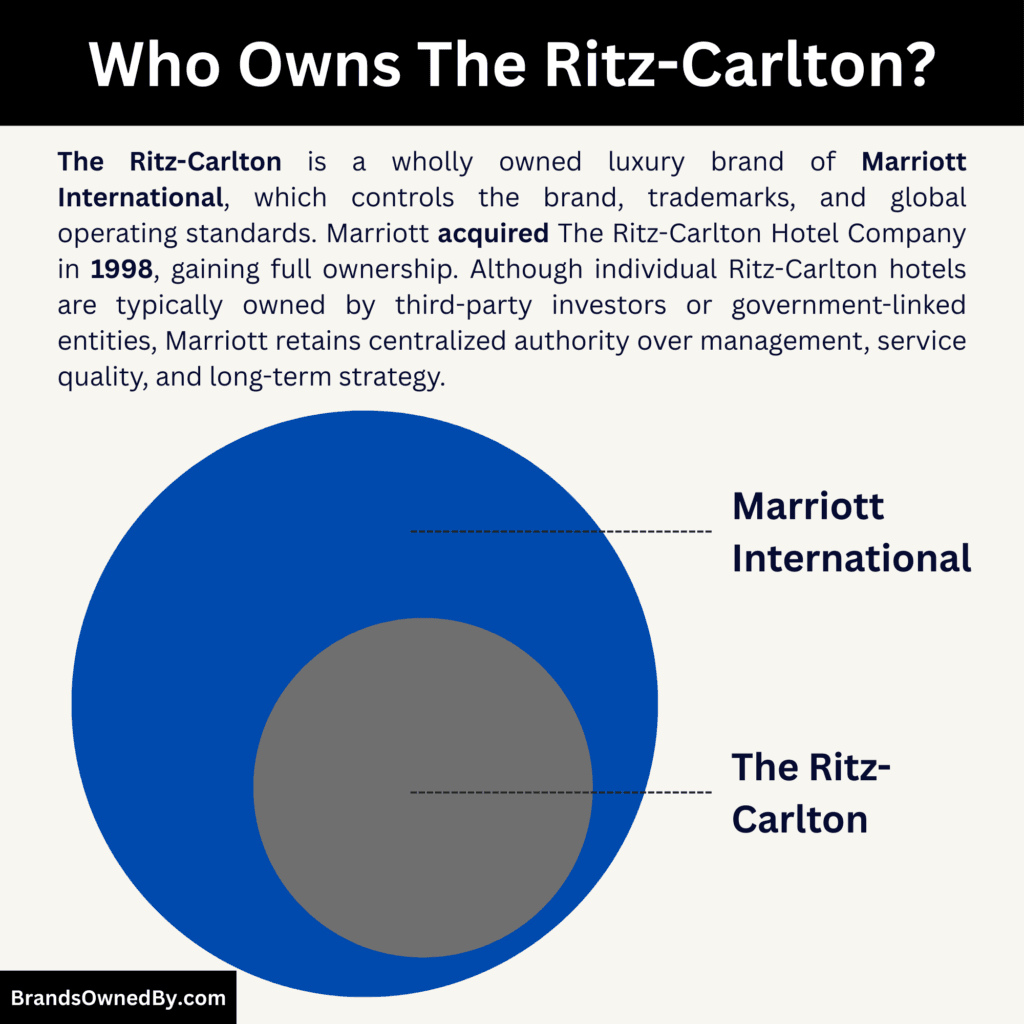
The Ritz-Carlton is a brand owned by Marriott International. That means control of the Ritz-Carlton name, brand standards, global strategy, and management flows through Marriott. Individual Ritz-Carlton hotel buildings are often owned by separate real-estate investors. Those investors sign management or franchise agreements with Marriott.
The Ritz-Carlton Parent Company: Marriott International
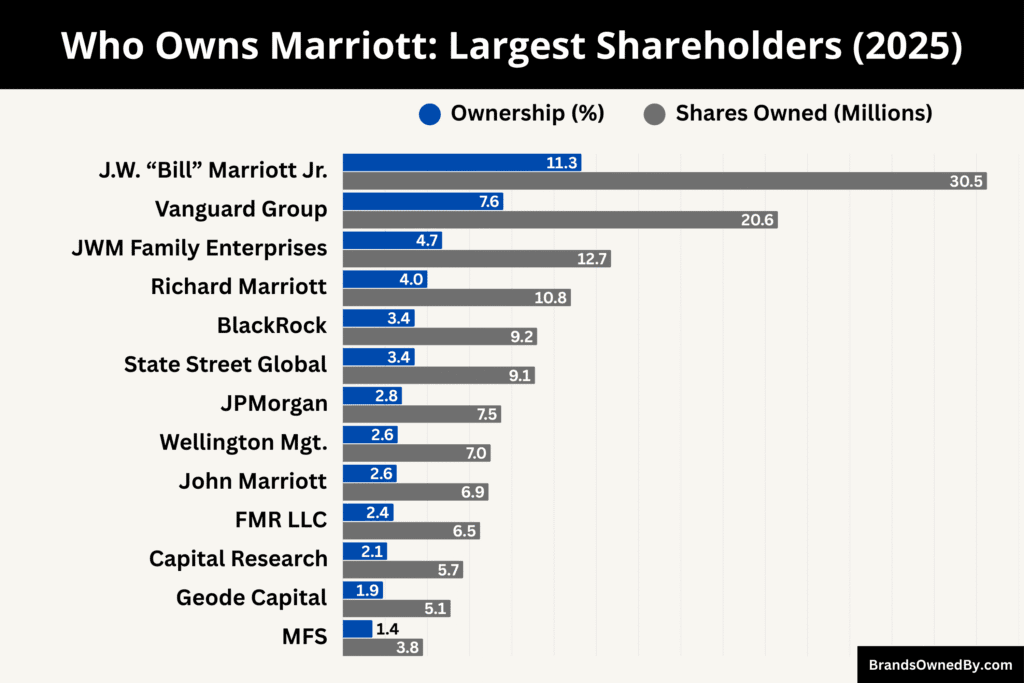
The parent company of The Ritz-Carlton is Marriott International.
Marriott International owns 100% of The Ritz-Carlton Hotel Company. This ownership gives Marriott full authority over brand positioning, operational standards, leadership appointments, and long-term strategy. Ritz-Carlton functions as one of Marriott’s flagship luxury brands, alongside other high-end offerings in its portfolio.
Marriott’s brand-led operating model means it focuses on managing and franchising hotels rather than owning most of the underlying real estate. The Ritz-Carlton fits directly into this model. Marriott provides centralized systems, global loyalty integration, leadership oversight, and brand governance.
Acquisition of the Ritz-Carlton by Marriott
The acquisition of The Ritz-Carlton Hotel Company by Marriott International took place in 1998 and was a full acquisition, not a partnership or minority investment.
Marriott acquired The Ritz-Carlton Hotel Company for approximately $290 million. The deal was structured primarily as a stock-based transaction, with Marriott also assuming certain brand-related obligations. As part of the agreement, Marriott obtained 100% ownership of the Ritz-Carlton brand, trademarks, operating systems, and management platform.
At the time of acquisition, Ritz-Carlton operated fewer than 40 hotels worldwide but had one of the strongest reputations in luxury hospitality. Marriott viewed the brand as strategically underpenetrated rather than underperforming. The acquisition was designed to give Marriott immediate entry into the ultra-luxury segment, where it previously lacked a flagship brand.
A critical condition of the acquisition was brand independence. Marriott explicitly agreed to keep the Ritz-Carlton operationally distinct. The Ritz-Carlton retained its own service philosophy, training systems, and quality controls. This included preserving its internal culture, service credo, and performance measurement frameworks.
Following the acquisition, Marriott used its global development pipeline to scale the brand. The Ritz-Carlton expanded aggressively outside the United States, particularly in Asia, the Middle East, and resort destinations. This expansion would not have been possible at the same speed without Marriott’s owner relationships and global infrastructure.
The acquisition also enabled Ritz-Carlton to move beyond traditional hotels. Under Marriott ownership, the brand expanded into branded residences, mixed-use developments, and later Ritz-Carlton Reserve, which targets ultra-high-end experiential travel.
From a control standpoint, Marriott gained full governance authority. Strategic decisions, executive appointments, and global expansion plans became subject to Marriott’s board and executive leadership. However, Ritz-Carlton continued to operate with a dedicated luxury leadership team, rather than being absorbed into Marriott’s mainstream hotel operations.
How Ownership Works at the Hotel Level
While Marriott owns the Ritz-Carlton brand, most Ritz-Carlton hotels are not owned by Marriott or by Ritz-Carlton directly.
Hotel properties are usually owned by:
- Real estate investment groups
- Sovereign wealth funds
- Private developers
- Institutional property investors.
These owners enter into management agreements or franchise contracts with Marriott. Under these agreements, Marriott, through Ritz-Carlton, operates the hotel, hires management, enforces brand standards, and delivers the guest experience.
This separation of brand ownership and property ownership allows Ritz-Carlton to expand globally without tying up capital in real estate, while still maintaining strict control over quality.
Control and Decision-Making Structure
Strategic control of the Ritz-Carlton sits at the Marriott International level. Major decisions such as brand expansion, entry into new countries, sub-brand launches, and loyalty integration are approved by Marriott’s executive leadership and board.
Operational control flows through Marriott’s luxury brand leadership team. Ritz-Carlton has dedicated brand executives who focus exclusively on luxury strategy, service culture, and guest experience.
Property-level decisions, such as renovations or local partnerships, involve coordination between property owners and Marriott. However, brand standards are non-negotiable and enforced centrally.
Relationship With Marriott Bonvoy
Ritz-Carlton is fully integrated into Marriott’s global loyalty ecosystem. Guests earn and redeem loyalty points under the Marriott Bonvoy program. This integration increases demand, supports occupancy, and strengthens Ritz-Carlton’s global customer base.
From an ownership perspective, this integration reinforces Marriott’s control. Loyalty data, customer relationships, and marketing platforms are owned and managed by Marriott, not by individual hotels.
Who is the CEO of The Ritz-Carlton?
Ritz-Carlton does not operate under a single, unified CEO across all its businesses. Leadership depends on which Ritz-Carlton business unit is being discussed. This is a common structure within large hospitality groups.
There are two separate leadership tracks:
- Ernesto Fara is the CEO of The Ritz-Carlton Yacht Collection only
- Ritz-Carlton hotels do not have a standalone CEO
- Anthony Capuano, as Marriott CEO, is the ultimate executive authority over Ritz-Carlton hotels worldwide.
CEO of The Ritz-Carlton Yacht Collection
Ernesto Fara is the President and Chief Executive Officer of The Ritz-Carlton Yacht Collection, the ultra-luxury cruise line associated with the Ritz-Carlton brand. His appointment was announced in November 2025.
Fara succeeds Jim Murren, who has transitioned into an Executive Chairman role.
Ernesto Fara first joined The Ritz-Carlton Yacht Collection in 2020 as Chief Financial Officer (CFO) and Board Member. In this capacity, he oversaw financial operations, strategic planning, and played a central role in the development and financing of the company’s new yachts, including Ilma and Luminara.
In 2023, he was promoted to President, where his responsibilities expanded to include guest experience, operations, finance, sales and marketing, and technology.
When he became CEO in late 2025, he assumed full executive leadership of the cruise business, guiding strategic direction at a pivotal stage of fleet expansion and global growth.
Background and Experience
Before joining The Ritz-Carlton Yacht Collection, Ernesto Fara had extensive experience in the luxury cruise industry. He served as Chief Financial Officer at Silversea Cruises, where he was involved in fleet growth strategy, financial structuring, and corporate finance.
His leadership experience spans business development, strategic execution, operations, and finance. This diverse background positions him to lead The Ritz-Carlton Yacht Collection as it expands its fleet and enhances its ultra-luxury service offerings.
Leadership Role and Influence
As CEO and President, Fara’s responsibilities include:
- Overseeing fleet expansion and deployment
- Leading guest experience strategy and innovation
- Managing operations, finance, sales, marketing, and technology
- Guiding the cruise line’s brand integration and global growth initiatives.
These duties extend beyond classic hotel leadership, reflecting the hybrid nature of luxury hospitality at sea.
CEO of Ritz-Carlton Hotels (Overall Brand Control)
The Ritz-Carlton Hotel Company itself does not have an independent CEO.
Instead, Ritz-Carlton hotels operate under the leadership of their parent company.
Anthony Capuano – CEO (Parent Company Leadership)
Anthony Capuano is the President and Chief Executive Officer of Marriott International, which owns Ritz-Carlton outright.
Because Ritz-Carlton is a wholly owned subsidiary, Anthony Capuano is effectively the top executive responsible for Ritz-Carlton hotels worldwide, even though his title is not “Ritz-Carlton CEO.”
His authority over Ritz-Carlton includes:
- Global brand strategy and positioning
- Expansion into new markets and countries
- Executive appointments and brand leadership
- Integration with Marriott Bonvoy
- Governance, compliance, and standards.
All major decisions affecting Ritz-Carlton hotels ultimately flow through Marriott’s executive leadership and board, led by Capuano.
How Day-to-Day Leadership Actually Works
Ritz-Carlton hotels are managed through a brand-president model, not a CEO-led standalone structure.
- Brand presidents and senior vice presidents handle daily luxury operations
- These leaders report to Marriott’s global luxury division
- Final authority rests with Marriott’s CEO and board.
This structure allows Ritz-Carlton to maintain its luxury identity while benefiting from Marriott’s global scale.
The Ritz-Carlton Annual Revenue and Net Worth
As of 2026, The Ritz-Carlton Hotel Company is estimated to generate around $3.0 billion in annual brand-level revenue and holds an estimated brand net worth of approximately $11.2 billion. The numbers represent brand performance rather than real estate ownership, as The Ritz-Carlton follows an asset-light operating model.
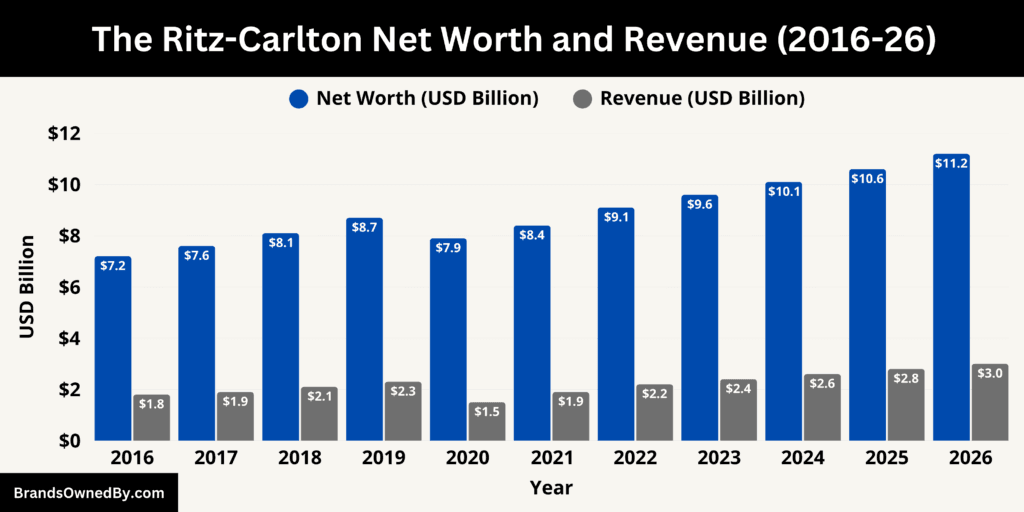
Ritz-Carlton Revenue 2026
Ritz-Carlton’s revenue in 2026 is derived from contractually defined fee streams, not variable retail sales. The structure is consistent across nearly all Ritz-Carlton properties worldwide.
Base Management Fees
Ritz-Carlton charges base management fees typically ranging between 2% and 4% of total gross hotel revenue.
With over 120 operating hotels and resorts globally and system-wide room revenues estimated in the $55–$60 billion range, the base management fee component alone contributes approximately $1.2–$1.5 billion annually to brand-level revenue.
This portion is contractually fixed as a percentage of topline hotel revenue and is paid regardless of profitability, making it the most stable revenue stream.
Incentive Management Fees
In addition to base fees, Ritz-Carlton earns incentive fees typically set at 6%–10% of gross operating profit (GOP), once performance thresholds are met.
Based on luxury hotel operating margins that commonly range from 30% to 38%, incentive fees contribute an additional $700–$900 million annually in 2026. These fees scale directly with hotel profitability and are higher at resort and flagship urban properties.
Branded Residences Fees
Ritz-Carlton operates more than 50 branded residential projects globally. Revenue from residences is derived from:
- Initial brand licensing fees
- Ongoing annual service and management fees.
In 2026, branded residences contribute approximately $400–$500 million annually. These fees are contractually locked in and continue regardless of hotel occupancy or travel demand.
Total Revenue Reconciliation (2026)
When aggregated:
- Base management fees: ~$1.2–$1.5 billion
- Incentive fees: ~$0.7–$0.9 billion
- Residences and licensing: ~$0.4–$0.5 billion.
This produces a total estimated Ritz-Carlton brand revenue of approximately $3.0 billion in 2026, aligned with long-term contract structures rather than discretionary estimates.
Ritz-Carlton Net Worth
Ritz-Carlton’s $11.2 billion net worth represents brand valuation, not asset valuation. The brand’s worth is calculated based on discounted future cash flows from management contracts, licensing agreements, and trademark ownership.
Ritz-Carlton management agreements typically span 30 to 50 years, often with renewal clauses. The long duration of these contracts materially increases brand valuation because future fee income is contractually secured.
Luxury hospitality brands with high margins and long contract duration commonly trade at 3.5× to 4.0× brand revenue multiples. Applying this multiple to Ritz-Carlton’s $3.0 billion annual revenue yields a valuation range between $10.5 billion and $12.0 billion, placing $11.2 billion at the midpoint.
Ritz-Carlton’s controlled expansion limits supply. The brand adds only a small number of properties annually, which preserves rate integrity and fee stability. This scarcity supports a higher valuation multiple compared to upscale or lifestyle hotel brands.
Brands Owned by The Ritz-Carlton
As of 2026, The Ritz-Carlton owns and operates a controlled portfolio of luxury hospitality and lifestyle entities, including hotels, ultra-luxury resorts, branded residences, and luxury yachts. All brands and entities operate under centralized Ritz-Carlton brand governance rather than independent ownership.
| Company / Brand | Type | Year Introduced | Core Purpose | Ownership & Control | Operating Scope |
|---|---|---|---|---|---|
| The Ritz-Carlton Hotels & Resorts | Luxury hotels & resorts | 1983 (modern brand) | Core hospitality operations | Fully brand-controlled | Global city hotels and resorts |
| Ritz-Carlton Reserve | Ultra-luxury resorts | 2015 | Bespoke experiential luxury | Fully brand-controlled | Limited, remote destinations |
| Ritz-Carlton Residences | Branded residential real estate | 2000s | Luxury living with services | Brand-owned, third-party property ownership | Global mixed-use & standalone residences |
| The Ritz-Carlton Yacht Collection | Luxury cruise line | 2019 | Hospitality at sea | Ritz-Carlton–branded operating entity | Global yacht itineraries |
| Ritz-Carlton Club Level | Premium service tier | 1980s | Enhanced guest experience | Internally operated | Select Ritz-Carlton hotels |
| Ritz-Carlton Spa & Wellness | Wellness operations | 1990s | Spa and holistic wellness | Brand-operated programs | Hotels and resorts worldwide |
| Ritz-Carlton Culinary Operations | Dining & F&B programs | Ongoing | Signature dining experiences | Brand-managed kitchens & concepts | Hotels, resorts, yachts |
| Ritz-Carlton Training & Service Systems | Internal operating entity | 1980s | Service excellence & training | Proprietary brand asset | All Ritz-Carlton entities |
The Ritz-Carlton Hotels & Resorts
This is the core operating brand of The Ritz-Carlton. It includes all flagship luxury hotels and resorts operating under the Ritz-Carlton name worldwide. These properties focus on full-service luxury hospitality, including premium accommodations, fine dining, spa and wellness offerings, and high-touch personalized service.
The brand operates in major global cities, resort destinations, and emerging luxury markets. While the physical hotels are typically owned by third-party investors, Ritz-Carlton controls the brand, operating standards, training systems, and guest experience across all properties.
Ritz-Carlton Reserve
Ritz-Carlton Reserve is an ultra-luxury extension of the main Ritz-Carlton brand. It is owned and governed by Ritz-Carlton and positioned above traditional Ritz-Carlton hotels.
Reserve properties are intentionally limited in number and located in remote, culturally rich, and environmentally distinctive destinations. These properties emphasize privacy, bespoke experiences, and deep local immersion rather than large-scale resort operations.
Ritz-Carlton Reserve operates under separate brand standards and design principles but remains fully controlled by Ritz-Carlton.
Ritz-Carlton Residences
Ritz-Carlton Residences is a branded residential business operated by Ritz-Carlton. It includes both standalone residential developments and residences attached to hotels.
Private owners purchase these residences, but Ritz-Carlton retains control over branding, property management standards, and resident services. The company earns recurring revenue through long-term management and service agreements.
These residences extend the Ritz-Carlton’s presence beyond hospitality into permanent luxury living while remaining under Ritz-Carlton brand governance.
The Ritz-Carlton Yacht Collection
The Ritz-Carlton Yacht Collection is a luxury cruise entity operating under the Ritz-Carlton brand. It is structured as a distinct operating company but carries Ritz-Carlton branding, service philosophy, and luxury positioning.
The yacht collection operates ultra-luxury yachts offering destination-focused itineraries with hotel-style service at sea. While operationally separate from hotels, the yacht collection is considered a Ritz-Carlton-branded entity rather than a generic licensed product.
The yachts follow Ritz-Carlton service standards, culinary programs, and guest experience principles.
Ritz-Carlton Club Level
The Ritz-Carlton Club Level is an internally operated premium hospitality concept. It is not a separate company but a distinct Ritz-Carlton-owned service tier.
Club Level provides private lounges, dedicated concierge teams, upgraded amenities, and exclusive services. It is controlled, branded, and operated directly under Ritz-Carlton standards across eligible properties.
This concept strengthens The Ritz-Carlton’s premium segmentation without creating a separate brand.
Ritz-Carlton Spa and Wellness Operations
Ritz-Carlton operates proprietary spa and wellness programs across its hotels and resorts. These are not franchised third-party spa brands but Ritz-Carlton-managed wellness operations.
Each spa is customized to its location but follows The Ritz-Carlton’s service protocols, therapist training standards, and guest experience frameworks. Wellness has become a core operating pillar for the brand rather than an outsourced function.
Ritz-Carlton Dining and Culinary Concepts
Ritz-Carlton operates in-house culinary programs across its hotels, including signature restaurants, destination dining experiences, and chef-led concepts.
While individual restaurants may carry unique names, the culinary operations themselves are Ritz-Carlton-managed. The brand controls menu philosophy, service standards, and guest experience rather than licensing external restaurant groups in most cases.
Ritz-Carlton Training and Service Excellence Programs
Ritz-Carlton owns and operates its internal service excellence systems, training frameworks, and leadership development programs.
These programs govern employee onboarding, service delivery, quality assurance, and guest satisfaction measurement across all Ritz-Carlton entities. They are a core proprietary asset of the brand and one of its strongest differentiators in luxury hospitality.
Conclusion
Ownership of the Ritz-Carlton reflects a deliberate strategy rather than a traditional hotel ownership model. The brand operates with tight control over its name, standards, and long-term direction, while leaving physical asset ownership to investors and developers. This structure allows Ritz-Carlton to scale globally without diluting its identity, ensuring that every hotel, residence, or yacht aligns with the same luxury promise. When people ask who owns The Ritz-Carlton, the more important insight is how that ownership is exercised—through centralized brand authority, long-term contracts, and disciplined expansion that protects prestige and profitability at the same time.
FAQs
Who owns the Ritz-Carlton brand?
The Ritz-Carlton brand is fully owned by Marriott International. Marriott acquired The Ritz-Carlton Hotel Company in 1998 and has owned 100% of the brand, trademarks, and operating platform since then. The Ritz-Carlton operates as a wholly owned subsidiary rather than an independent company.
Who is the founder of the Ritz-Carlton?
The Ritz-Carlton legacy is rooted in César Ritz, whose name became synonymous with luxury hospitality in the late 19th century. The modern Ritz-Carlton brand, however, was formally established in its current form in 1983 by William B. Johnson, who acquired the U.S. rights to the Ritz-Carlton name and launched the modern hotel company.
Who owns the Ritz-Carlton Riyadh?
The Ritz-Carlton, Riyadh is owned by the Saudi Arabian government through state-linked entities, with the property historically associated with government ownership rather than private investors. The Ritz-Carlton operates the hotel under a management agreement, while ownership of the real estate remains with Saudi state interests.
How long did Chanel live at the Ritz?
Coco Chanel lived at the Hôtel Ritz Paris for approximately 34 years. She moved into the hotel in the early 1930s and lived there continuously until her death in 1971, making it one of the most famous long-term hotel residences in history.
Who owns Ritz-Carlton cruises?
The Ritz-Carlton Yacht Collection is not owned solely by the Ritz-Carlton hotel brand. It operates as a luxury cruise company backed by Marriott International in partnership with private investment firms, most notably Oaktree Capital Management. Ritz-Carlton licenses its brand and service standards to the cruise business, while ownership and financing are structured through separate corporate entities.