

- Pizza Hut is wholly owned by Yum! Brands, a publicly traded restaurant group listed on the NYSE, and does not operate as an independent or publicly listed company.
- Pizza Hut was acquired by PepsiCo in 1977 for approximately $300 million in a stock-based deal, giving it access to large-scale capital and global expansion infrastructure.
- In 1997, Pizza Hut became part of Tricon Global Restaurants through a corporate spin-off from PepsiCo; Tricon later rebranded as Yum! Brands in 2002, with Pizza Hut’s ownership remaining unchanged.
- Pizza Hut has no direct shareholders of its own; all ownership is indirect and held through Yum! Brands’ institutional and individual shareholders, who influence governance at the parent-company level only.
Pizza Hut is a global pizza restaurant brand known for its wide menu, franchised business model, and international reach. The company operates through dine-in, delivery, and carryout formats, adapting its store designs to local markets and consumer behavior. Pizza Hut is widely recognized for product innovation, including pan pizza and stuffed crust, which helped differentiate it from competitors.
The brand operates primarily through franchise partners, allowing rapid global expansion while maintaining centralized brand standards. Pizza Hut’s operations focus on convenience, digital ordering, and localized menus. Its presence spans North America, Asia, Europe, the Middle East, Africa, and Latin America, making it one of the most internationally established pizza brands.
Pizza Hut Founders
Pizza Hut was founded in 1958 by brothers Dan Carney and Frank Carney in Wichita, Kansas. At the time, both were college students with no prior restaurant experience. They borrowed $600 from their mother to open their first pizza restaurant in a small building near Wichita State University.
The founders focused on affordability, consistency, and customer experience. Dan Carney emphasized operations and marketing, while Frank Carney handled administration and franchising strategy. Their decision to franchise early became a defining factor in Pizza Hut’s growth.
By prioritizing standardized recipes and branding, the Carney brothers laid the foundation for Pizza Hut’s national and later global expansion.
Their entrepreneurial approach transformed Pizza Hut from a single neighborhood restaurant into one of the most recognizable food brands in the world.
Major Milestones
- 1958: Pizza Hut is founded in Wichita, Kansas, by Dan and Frank Carney
- 1959: The brand begins using the iconic red roof design, which later becomes its global visual identity
- 1960: The first franchised Pizza Hut location opens, establishing franchising as the core growth model
- 1965: Pizza Hut reaches 145 locations across the United States
- 1966: Pizza Hut becomes the largest pizza chain in the U.S. by number of restaurants
- 1969: The first international Pizza Hut opens in Canada
- 1971: Pizza Hut becomes the world’s largest pizza chain
- 1977: Pizza Hut is acquired by Yum! Brands, integrating it into a multi-brand restaurant group
- 1980: Expansion accelerates into Europe, Asia, and the Middle East
- 1986: Delivery service becomes widely available across U.S. locations
- 1994: Pizza Hut places one of the world’s first online food orders through PizzaNet
- 1995: Pizza Hut launches its official website and expands digital ordering trials
- 1996: Introduction of Stuffed Crust Pizza, one of the brand’s most successful innovations
- 2000: Increased focus on carryout and delivery formats over traditional dine-in
- 2008: Pizza Hut begins large-scale refranchising to reduce company-owned locations
- 2010: Mobile ordering platforms and app-based ordering are introduced
- 2015: Global brand refresh begins, modernizing logos, menus, and restaurant designs
- 2017: Shift toward smaller footprint restaurants focused on delivery and takeout
- 2020: Digital sales and contactless delivery become central to operations
- 2021: Expansion of express and urban-format Pizza Hut locations
- 2023: Increased focus on loyalty programs and AI-driven digital personalization
- 2024: Continued rollout of delivery-only and hybrid restaurant models globally
- 2026: Pizza Hut operates as a digitally driven, franchise-led global pizza brand with strong emphasis on convenience and accessibility
Who Owns Pizza Hut?
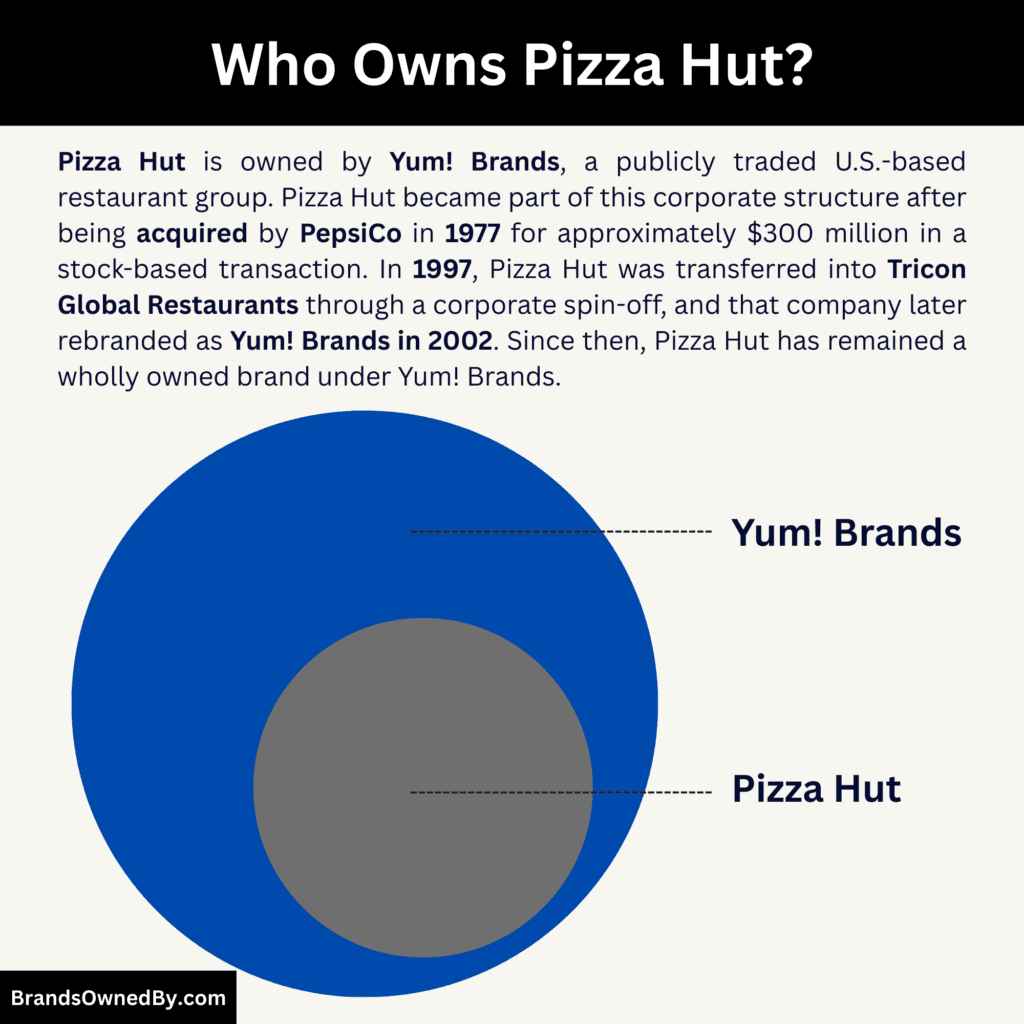
Pizza Hut is owned by Yum! Brands. Yum! Brands is a publicly traded restaurant group listed on the New York Stock Exchange. Pizza Hut is a wholly owned subsidiary of Yum! Brands, not an independent public company.
Below is a quick summary of Pizza Hut ownership as of January 2026:
- Brand Name: Pizza Hut
- Founded: 1958
- Founders: Carney brothers
- Current Owner: Yum! Brands
- Ownership Type: Wholly owned
- Publicly Traded: No
- Parent Company Status: Public company
- Stock Exchange: NYSE
- Ticker Symbol: YUM
- Control Structure: Centralized
- Decision Authority: Parent-led
- Operating Model: Franchise-led
- Brand Autonomy: Operational
- Global Presence: 100+ countries
- Ownership Stability: Long-term
- Ownership Since: 1977.
Parent Company: Yum! Brands
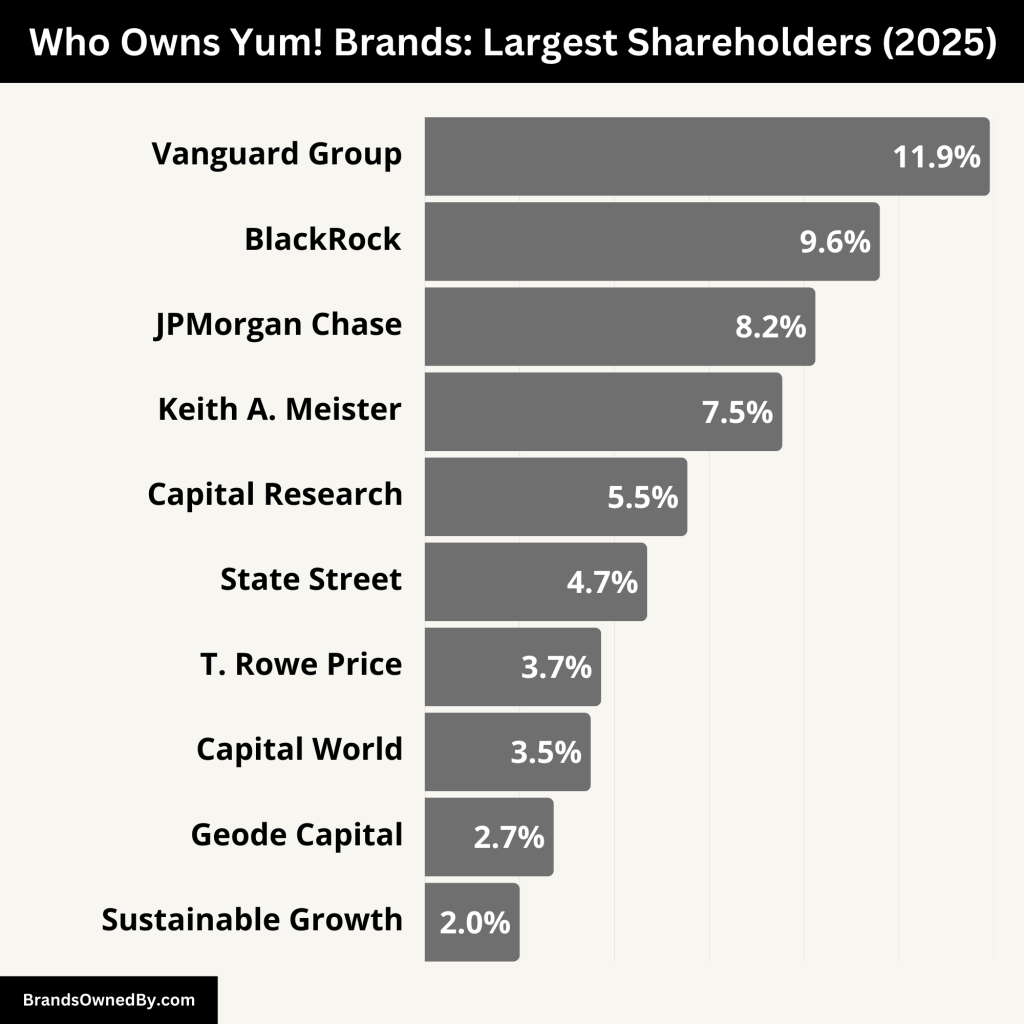
Yum! Brands is one of the world’s largest quick-service restaurant operators. It owns and manages multiple global food brands through a centralized corporate structure. Pizza Hut is one of Yum! Brands’ four core brands, alongside KFC, Taco Bell, and The Habit Burger Grill.
Yum! Brands is listed on the New York Stock Exchange under the ticker symbol YUM. The company operates primarily through a franchise-led model, with more than 98% of its restaurants globally owned by franchise partners.
This structure allows Yum! Brands to scale brands like Pizza Hut efficiently while maintaining strong brand standards, supply chain control, and digital infrastructure.
Under Yum! Brands, Pizza Hut benefits from shared technology platforms, global marketing capabilities, data analytics, and franchise development systems. However, Pizza Hut maintains its own brand leadership team responsible for menu innovation, customer experience, and regional strategy.
Acquisition History and Ownership Transition
Pizza Hut was originally an independent company after its founding in 1958. The brand went public in the early 1970s, which accelerated its expansion across the United States and internationally.
PepsiCo Acquisition
Pizza Hut was acquired by PepsiCo in 1977. The deal value was approximately $300 million. The acquisition was structured as a stock-based transaction, not a cash buyout.
At the time of the deal, Pizza Hut was a publicly traded company and already the largest pizza chain in the world by unit count. PepsiCo acquired Pizza Hut as part of a broader strategy to build a vertically integrated food and beverage ecosystem. The agreement allowed Pizza Hut to continue operating as a distinct brand while gaining access to PepsiCo’s capital, supply chain, and international expansion capabilities.
Under the acquisition terms, Pizza Hut restaurants were aligned closely with PepsiCo’s beverage portfolio. This resulted in long-term exclusivity arrangements for Pepsi-branded soft drinks in Pizza Hut locations, a practice that continued for decades.
Following the acquisition, Pizza Hut operated as a wholly owned subsidiary of PepsiCo. The brand retained its management structure, but major strategic decisions, capital allocation, and international growth plans were overseen by PepsiCo’s corporate leadership.
During this period, Pizza Hut expanded aggressively outside the United States. PepsiCo’s global infrastructure played a key role in accelerating Pizza Hut’s entry into Asia, Latin America, and the Middle East.
Spin-Off Into Tricon Global Restaurants
In 1997, PepsiCo announced the spin-off of its restaurant division into a separate publicly traded company named Tricon Global Restaurants. This transaction was executed as a tax-free corporate spin-off to PepsiCo shareholders.
Pizza Hut, along with KFC and Taco Bell, became part of Tricon Global Restaurants. No sale price was assigned to Pizza Hut at this stage because ownership was transferred through equity distribution rather than a purchase transaction.
The rationale behind the spin-off was operational focus. PepsiCo wanted to concentrate on beverages and packaged foods, while Tricon was designed to operate exclusively as a restaurant-focused company.
Transition to Yum! Brands
In 2002, Tricon Global Restaurants officially changed its name to Yum! Brands. This was a rebranding, not an acquisition or merger. Ownership of Pizza Hut remained unchanged during this transition.
From that point onward, Pizza Hut has remained 100% owned by Yum! Brands, with no partial divestments, private equity involvement, or additional acquisition activity involving the brand.
Who is the CEO of Pizza Hut?
Aaron M. Powell is the Chief Executive Officer of the Pizza Hut Division at Yum! Brands, the parent company that owns Pizza Hut globally.
He leads the strategic direction and operational execution for the brand in all markets worldwide. Powell reports directly to Yum! Brands’ CEO and is responsible for steering Pizza Hut’s global growth agenda, franchise performance, digital transformation, and customer engagement strategies.
Powell assumed this role effective September 20, 2021. He succeeded the previous Pizza Hut leadership as part of Yum! Brands’ restructuring of brand-level leadership to accelerate global performance.
Professional Background
Before joining Pizza Hut, Aaron Powell built his career in global consumer goods and consulting:
- He served as President of Asia-Pacific Consumer Business at Kimberly-Clark Corporation, where he managed operations in more than 30 countries, including Australia, China, India, and South Korea.
- Prior to that, he held leadership roles at Kimberly-Clark Professional and led regional business units in Europe, the Middle East & Africa.
- Earlier in his career, Powell worked at Bain & Company as a management consultant and at Procter & Gamble in sales and brand management.
Aaron Powell holds an MBA from the Wharton School of the University of Pennsylvania and a bachelor’s degree from Washington University in St. Louis.
Leadership Responsibilities
As CEO of the Pizza Hut Division, Powell’s responsibilities include:
- Franchise system oversight: Working with more than 1,500 franchise partners operating tens of thousands of locations globally to drive consistent brand performance.
- Growth strategy: Expanding menu innovation, enhancing digital ordering capabilities, and leading format changes like delivery-focused and express stores.
- International coordination: Aligning regional strategies in major markets, including North America, Asia, the Middle East, Latin America, and Europe.
- Brand positioning: Overseeing marketing, product rollout, customer experience initiatives, and transition to digital and off-premise channels.
Under Powell’s leadership, Pizza Hut expanded its global footprint significantly, with Pizza Hut opening over 1,500 new locations worldwide in 2022, bringing its total to more than 19,000 restaurants globally.
Compensation and Salary
Aaron Powell’s executive compensation package reflects his role as a division leader at a major global restaurant company:
- Total Compensation (recent year): Approximately $5.21 million.
- Base Salary: About $821,000.
- Incentive Plan Compensation: Around $948,000 (performance-based bonus).
- Stock Awards: Approximately $1.78 million in equity compensation.
- Other Compensation: Roughly $98,000 in additional benefits.
Total compensation figures are derived from the most recently available regulatory filings and compensation reports, reflecting the typical mix of base salary, bonus incentive, stock-based awards, and other benefits.
Relationship with Yum! Brands Leadership
While Powell leads Pizza Hut operationally, ultimate authority resides with Yum! Brands’ corporate leadership and board of directors. Strategic shifts such as refranchising, global restructuring, and technology investments are approved at the parent level. Powell works within this framework to execute Pizza Hut’s brand strategy.
This structure ensures Pizza Hut remains aligned with Yum! Brands’ broader goals while retaining enough autonomy to adapt menus, marketing, and formats to local markets.
As of 2026, this governance model remains unchanged and central to how Pizza Hut is managed globally.
Powell leads Pizza Hut’s brand division, he operates under the broader corporate leadership of Yum! Brands:
- Yum! Brands’ CEO leadership transitioned in October 2025, when Chris Turner (former CFO) took over the company’s top role, succeeding David Gibbs. This change affects long-term corporate strategy, which in turn guides Pizza Hut’s strategic priorities.
- Powell coordinates with Yum! Brands’ executive team on global initiatives, investments, and cross-brand technology platforms.
Pizza Hut Annual Revenue and Net Worth
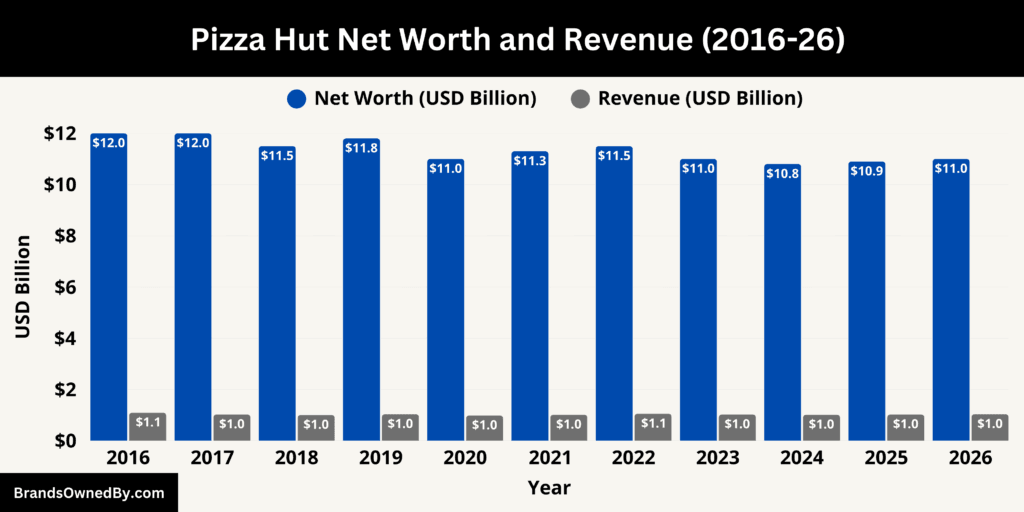
As of 2026, Pizza Hut remains one of the largest global pizza brands by scale and systemwide presence. The brand generates an estimated $1.03 billion in annual revenue at the corporate level and carries a brand net worth of approximately $11 billion as of January 2026.
Annual Revenue Performance
Pizza Hut does not publish standalone financial statements because it operates as a wholly owned subsidiary of Yum! Brands. Its revenue is reported as part of the Pizza Hut Division within the parent company’s consolidated financials. In 2026, Pizza Hut’s estimated revenue stands at around $1.03 billion, representing income derived primarily from franchise royalties, licensing fees, development fees, and company-aligned operations.
This revenue model is largely asset-light. More than 98% of Pizza Hut restaurants worldwide are franchised, meaning Pizza Hut earns recurring royalty income based on a percentage of franchisee sales rather than direct restaurant sales. This structure creates stable, predictable revenue even when consumer demand fluctuates across markets.
While corporate revenue remains just over $1 billion, Pizza Hut’s global system sales exceed $15 billion annually, reflecting total consumer spending across all Pizza Hut restaurants worldwide. These system sales do not appear directly on the company’s income statement, but they form the foundation for royalty income and long-term brand strength.
Net Worth and Brand Value
As of January 2026, Pizza Hut’s implied net worth is estimated at approximately $11 billion. This valuation is supported by several factors, including its global footprint across more than 100 countries, long-term franchise agreements, consistent royalty streams, and strong brand recognition built over decades.
Despite increased competition in the pizza delivery segment, Pizza Hut’s brand equity remains significant due to its international scale, localized menus, and diversified store formats. The brand’s value is also reinforced by Yum! Brands’ centralized infrastructure which supports marketing, technology, supply chain efficiency, and franchise development.
Revenue Stability and Long-Term Trends
Over the past decade, Pizza Hut’s revenue has remained relatively stable, generally ranging between $1.0 billion and $1.1 billion annually at the corporate level. While growth has been slower compared to some digital-first competitors, Pizza Hut has offset pressure in mature markets with expansion in international regions and operational restructuring.
In recent years, Pizza Hut has focused on smaller, delivery-focused restaurant formats, improved digital ordering platforms, and tighter franchise performance standards. These initiatives have helped stabilize revenue and protect brand value, even in highly competitive and price-sensitive markets.
Financial Outlook Beyond 2026
Looking ahead, Pizza Hut’s financial outlook remains closely tied to franchise performance, digital engagement, and international expansion rather than company-owned restaurant growth. Continued emphasis on carryout, delivery efficiency, and localized pricing strategies is expected to support revenue consistency.
As a core brand within Yum! Brands’ portfolio, Pizza Hut’s implied net worth is likely to remain in the low double-digit billion range, provided it maintains franchise profitability and adapts effectively to evolving consumer preferences. The brand’s long operating history, global reach, and franchise-led model continue to underpin its financial resilience in 2026 and beyond.
Brands Owned by Pizza Hut
Below is a list of the major brands and internal divisions owned by Pizza Hut as of January 2026:
| Brand / Entity | Type | Launch Period | Primary Purpose | Operating Model | Key Markets |
|---|---|---|---|---|---|
| Pizza Hut Restaurants | Traditional dine-in format | 1958 | Full-service pizza dining | Franchise-led | Global |
| Pizza Hut Delivery | Delivery-focused format | Early 2000s | Delivery and carryout efficiency | Franchise-led | Global, urban markets |
| Pizza Hut Express | Quick-service format | Late 1990s | High-traffic, fast service | Franchise-led | Airports, malls, campuses |
| Pizza Hut Bistro | Modern dine-in concept | 2010s | Casual dining experience | Franchise-led | Asia, Middle East, Europe |
| WingStreet | Food brand (wings) | 2003 | Menu expansion, upselling | In-store brand | Primarily U.S., select markets |
| Pizza Hut Digital Platforms | Digital infrastructure | Mid-1990s onward | Online ordering and loyalty | Centrally operated | Global |
| Localized Pizza Hut Formats | Regional brand extensions | Ongoing | Market localization | Franchise-led | Country-specific |
WingStreet
WingStreet is a chicken wings concept created and owned by Pizza Hut. It was launched in 2003 to expand Pizza Hut’s menu beyond pizza and directly compete in the growing wings category. WingStreet operates primarily as an in-store brand rather than a standalone chain. It focuses on bone-in wings, boneless wings, sauces, and rubs.
WingStreet is tightly integrated into Pizza Hut locations, especially in the United States and select international markets. The brand strengthens average order value and supports Pizza Hut’s delivery and carryout strategy. WingStreet does not operate independently and has no separate ownership or franchise structure outside Pizza Hut.
Pizza Hut Express
Pizza Hut Express is a fast-service restaurant format owned and operated by Pizza Hut. It is designed for high-traffic locations such as airports, malls, universities, stadiums, and travel hubs. The format emphasizes speed, simplified menus, and limited seating.
Pizza Hut Express locations focus on personal pan pizzas, slices, and quick meals. These outlets play a strategic role in brand visibility and impulse purchases. They are often operated by franchise partners under Pizza Hut’s licensing structure but remain fully owned as a brand format by Pizza Hut.
Pizza Hut Delivery
Pizza Hut Delivery is a delivery-first store model introduced to support the brand’s shift away from traditional dine-in restaurants. These locations typically have smaller footprints and minimal or no seating. The format prioritizes delivery efficiency, digital ordering, and cost control.
Pizza Hut Delivery stores are central to the brand’s modern strategy. They support higher order volume, lower real estate costs, and faster service times. This format is widely used in urban markets and international regions where delivery demand is high.
Pizza Hut Bistro
Pizza Hut Bistro is a modernized dine-in concept developed by Pizza Hut for select international markets. The Bistro format focuses on upgraded interiors, expanded menus, and a more casual dining experience compared to traditional Pizza Hut restaurants.
Pizza Hut Bistro locations often include pasta, desserts, and localized menu items. The format is used strategically in markets where dine-in demand remains strong, particularly in parts of Asia, the Middle East, and Europe.
Pizza Hut Restaurants (Traditional Format)
Pizza Hut Restaurants refers to the classic full-service Pizza Hut locations historically associated with the brand. These restaurants feature sit-down dining, table service in some markets, and a broader menu.
While Pizza Hut has reduced reliance on this format in recent years, it continues to operate in regions where dine-in pizza remains culturally relevant. The traditional restaurant format remains fully owned as a concept by Pizza Hut, even when operated by franchisees.
Pizza Hut Online and Digital Platforms
Pizza Hut Digital Platforms are proprietary digital assets owned and operated by Pizza Hut. These include its website, mobile applications, loyalty programs, and backend ordering systems.
These platforms support online ordering, promotions, customer data analytics, and delivery coordination. Digital channels account for a significant share of Pizza Hut’s global orders and are a core operational asset rather than a third-party dependency.
Localized Pizza Hut Sub-Brands
In several international markets, Pizza Hut operates localized sub-brands or naming variations tailored to regional preferences. These entities operate under the Pizza Hut trademark and brand ownership while offering country-specific menus and store designs.
These localized formats are not separate companies. They are controlled brand extensions designed to improve market penetration and customer relevance in specific regions.
Conclusion
The question of who owns Pizza Hut is closely tied to how the brand is structured and managed worldwide. Pizza Hut operates as a wholly owned brand under Yum! Brands, which shapes its long-term strategy, leadership decisions, and global expansion. This ownership model explains why Pizza Hut focuses heavily on franchising, delivery-driven formats, and centralized brand standards rather than company-owned restaurant growth.
Over the years, Pizza Hut has evolved beyond a traditional dine-in pizza chain into a diversified global brand with multiple formats, digital platforms, and internally developed concepts such as WingStreet. Its stable ownership, consistent revenue performance, and strong international presence position the brand to remain a major player in the global pizza market while adapting to changing consumer behavior and competitive pressures.
FAQs
Who is the main owner of Pizza Hut?
Pizza Hut is wholly owned by Yum! Brands. Pizza Hut does not have separate public shareholders and operates as a core brand within Yum! Brands.
Is Pizza Hut still owned by PepsiCo?
No. Pizza Hut is not owned by PepsiCo today. PepsiCo acquired Pizza Hut in 1977, but the brand moved to a separate restaurant company in 1997 and has been under Yum! Brands since 2002.
Who owns Pizza Hut UK?
Pizza Hut UK is owned by Yum! Brands at the brand level. Individual Pizza Hut restaurants in the UK are operated by licensed franchise partners who run day-to-day operations under Yum! Brands’ brand standards.
What is the Pizza Hut owner company?
The owner company of Pizza Hut is Yum! Brands. It is a publicly traded restaurant group listed on the New York Stock Exchange.
Who owns Pizza Hut Australia?
Pizza Hut Australia is owned by Yum! Brands as the brand owner. Local franchise operators manage and operate Pizza Hut restaurants across Australia under franchise agreements.
Who owns Pizza Hut franchise?
Individual Pizza Hut franchise locations are owned by independent franchisees. These franchisees do not own the Pizza Hut brand. The brand, trademarks, and operating system are owned by Yum! Brands.
When was Pizza Hut founded?
Pizza Hut was founded in 1958 by Dan and Frank Carney in Wichita, Kansas, United States.
Who owns Pizza Hut restaurants?
Yum! Brands owns the Pizza Hut brand and intellectual property. Most Pizza Hut restaurants are owned and operated by franchise partners rather than by the company itself.
Which country owns Pizza Hut?
Pizza Hut is an American-owned brand. It was founded in the United States and is owned by Yum! Brands, a U.S.-based company.
Is Yum! Brands owned by PepsiCo?
No. Yum! Brands is not owned by PepsiCo. Yum! Brands operates as an independent, publicly traded company following its spin-off from PepsiCo in 1997.