- Best Western International, Inc. owns the Best Western brand. It was founded in 1946 in the United States. The company operates as a private cooperative. It is not publicly traded.
- The real owners of Best Western are independent hotel members. More than 4,000 hotel owners and operators collectively own the organization. Each member holds equal voting rights. No single shareholder has a majority stake.
- Large institutional investors do not own Best Western. There is no outside equity ownership. All control rests with the cooperative membership and the elected board representing those members.
Best Western is a global hospitality network of hotels and resorts. It began as a concept to unite independent hotel owners under a shared brand. The organization provides marketing, reservation technology, quality standards, and brand identity to its members.
Unlike many hotel corporations, Best Western does not own most of the physical hotel properties. Instead, it operates as a cooperative where independent hoteliers join the network and benefit from shared resources. The brand spans more than 100 countries with thousands of member hotels ranging from economy to upscale segments.
Best Western focuses on delivering consistent guest experiences while allowing local owners operational autonomy. Its structure and global reach place it among the most recognized names in the travel and lodging industry.
Founder and Origin
Best Western was founded in 1946 in California, United States. The founder was M.K. Guertin. His full name was Maurice King Guertin. He was an experienced hotelier. He worked in the lodging business long before starting Best Western.
In the years after World War II, Guertin noticed a problem. Independent hotels had no common identity. Guests did not know which hotels to trust. Reservations were handled locally. Marketing budgets were small. Guertin created a simple solution. He linked independent hotel owners into one referral group. That group became Best Western in 1946.
Guertin personally built the network. He traveled from city to city. He met hotel owners face-to-face. He convinced them to join the cooperative. His goal was not to buy hotels. His goal was to help them succeed together. He created shared reservation directories. He promoted the brand through roadside signage. He set early quality guidelines.
The name Best Western came from geography. Most early members were located west of the Mississippi River. Over time, the brand grew beyond that region. But the founding idea remained the same. Hotels stayed independently owned. The brand stayed collectively owned. Guertin served as a guiding leader until his death in 1990. His vision shaped the company for the long term.
Major Milestones
- 1946: Best Western is officially founded by M.K. Guertin in California as a cooperative referral network.
- 1948: The brand directory system begins, allowing travelers to book rooms at any member hotel.
- 1951: Best Western grows to 699 hotels across the United States.
- 1952: A centralized reservation system is created using printed reservation books shared among members.
- 1963: The organization adopts the name Best Western International to reflect national unity.
- 1964: Best Western membership passes 1,000 hotels.
- 1972: The first European hotels join the network.
- 1976: The first hotel outside North America opens, marking true global expansion.
- 1981: Best Western introduces modern toll-free reservation numbers for guests.
- 1988: Computer-based reservation technology is rolled out to replace printed books.
- 1993: Best Western loyalty program is launched, later called Best Western Rewards.
- 1997: The Best Western Plus tier is formally introduced for higher quality hotels.
- 2001: Best Western operates more than 3,000 hotels worldwide.
- 2005: Online booking becomes a major sales channel for the cooperative.
- 2011: A full global rebranding refreshes the logo and visual identity.
- 2015: Best Western expands into upscale segments with the Premier Collection.
- 2016: The SureStay Hotel Group is launched as a value-oriented brand family.
- 2019: Best Western reaches more than 4,200 hotels globally.
- 2020: Major digital upgrades improve mobile apps and global connectivity.
- 2021: Long-time CEO David Kong retires after 17 years of leadership.
- 2022: Larry Cuculic becomes President and CEO, continuing the cooperative model.
- 2023: New lifestyle brands such as Aiden and Sadie expand the portfolio.
- 2024: Sustainability and modern guest experience standards are strengthened.
- 2025: Best Western integrates new cloud-based reservation platforms.
- 2026: Best Western continues operating as a member-owned cooperative across more than 100 countries.
Who Owns Best Western?
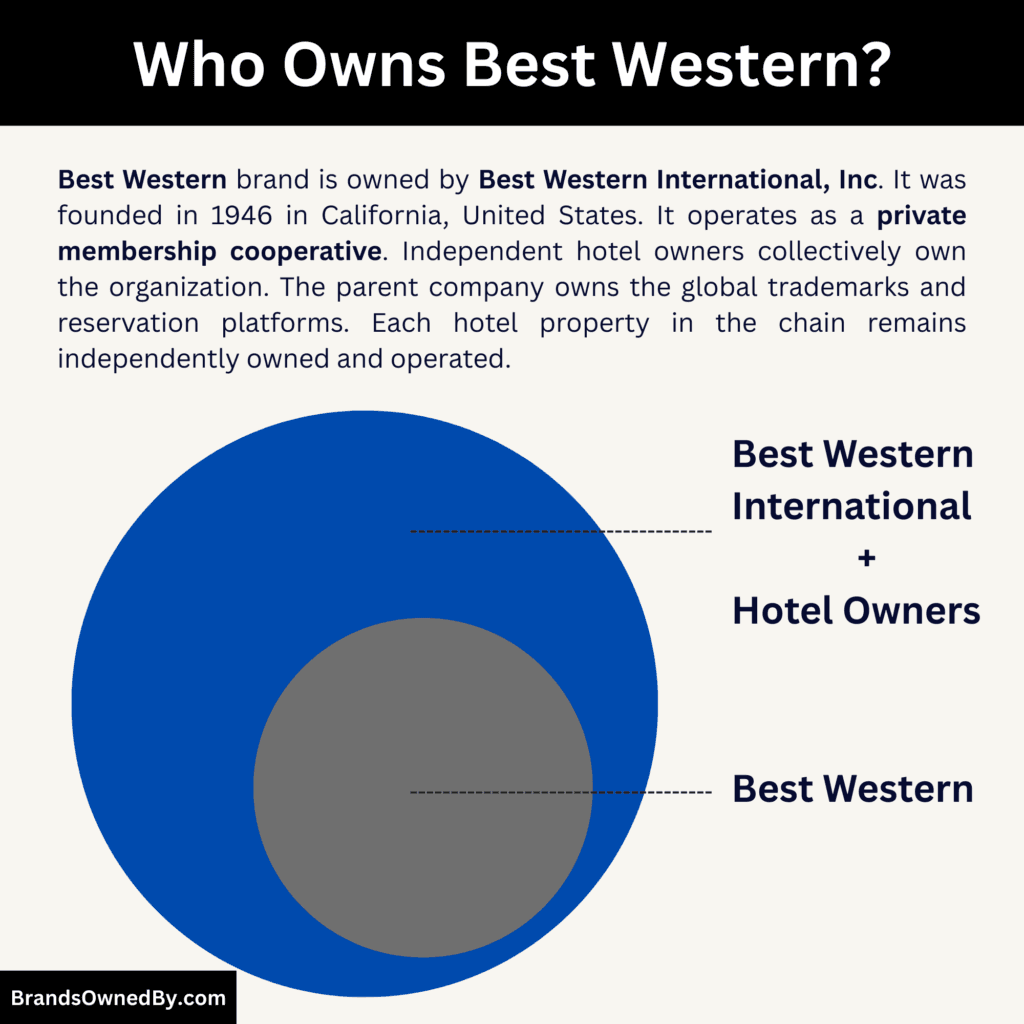
Best Western does not have a traditional corporate ownership structure like publicly traded hotel groups. Instead, ownership of Best Western is collective and member-based. The Best Western Hotels & Resorts brand is held by Best Western International, Inc., which is a privately held membership organization. This entity licenses the Best Western brand to thousands of independently owned hotel properties around the world.
Each hotel owner who joins the network becomes part of the cooperative and gains a voice in governance. This model is fundamentally different from chains where a single corporation or external investors control brand rights. Best Western’s structure empowers local hoteliers, giving them shared ownership and influence over strategic decisions.
Here’s a quick summary of Best Western ownership:
- No Public Shares: Best Western is not a public company and does not issue stock to outside investors. There are no traditional institutional or retail shareholders in the normal sense.
- Member Voting Rights: Hotel owners have voting rights that determine major strategic directions and governance.
- Cooperative Structure: Ownership is based on membership, where each hotel owner contributes fees and meets operational standards to remain part of the network.
- Decentralized Control: While a central corporate entity exists (Best Western International, Inc.), ultimate control rests with the collective group of member owners.
| Ownership Aspect | Details |
|---|---|
| Official Owner | Best Western International, Inc. |
| Founded | 1946 |
| Ownership Model | Private cooperative membership organization |
| Traditional Shareholders | None |
| Real Stakeholders | Independent hotel owners who join the Best Western network |
| Brand Rights | Fully owned by Best Western International |
| Hotel Property Ownership | Held by individual franchise owners, not by Best Western corporate entity |
| Governance Control | Elected Board of Directors chosen by member owners |
| Executive Leadership | CEO and management team run daily operations |
| Public Trading Status | Not publicly traded |
Best Western International, Inc.
Best Western International, Inc. is the parent organization that owns and manages the Best Western brand globally. It is headquartered in Phoenix, Arizona. The corporation operates as a membership-based organization, not as a traditional franchisor seeking profit from external shareholders.
Instead, hotel members collectively support the brand and its operations through fees for licensing, marketing, and reservation services.
Each member that operates a Best Western-branded hotel enters into an agreement with Best Western International, Inc. They pay annual dues and meet brand standards in exchange for access to global systems, marketing campaigns, loyalty programs, and booking platforms. The organization delivers centralized support but does not directly own the majority of the physical hotel assets.
Member Owners
Best Western’s member owners are the backbone of its ownership model. These members are independent hoteliers who own and operate Best Western hotels worldwide. There are more than 4,300 such hotels across over 100 countries and territories as of 2026. Each member has voting rights in the organization and participates in governance through elected representatives. Members influence brand policies, strategic direction, and cooperative initiatives.
Member owners vary in size and portfolio scale. Some operate a single property while others own and manage multiple hotels. All members contribute to the cooperative’s success by maintaining brand standards and guest experience quality. The collective nature of this ownership makes Best Western unique when compared with corporate-controlled hotel brands.
Board of Directors
Although Best Western does not have traditional “shareholders” with equity stakes, its Board of Directors functions similarly to a shareholder representative body. Directors are elected by member hotel owners, and they serve to represent owners’ interests in key decisions. The Board governs broader policy, strategic initiatives, and leadership oversight.
Members of the board often include experienced hoteliers who own Best Western properties. These individuals may operate hotels in various regions and bring operational insight. Their role includes:
- Setting cooperative policies
- Approving major strategic initiatives
- Representing member interests
- Working with executive leadership for operational effectiveness.
Because they are chosen by peers within the system, the Board reflects the diversity of hotel owners across continents.
Franchisees and Licensees
In addition to individual hotel owners, franchise groups or corporate hospitality groups that own multiple Best Western properties can be seen as significant parties within the system. These groups operate several Best Western, Best Western Plus, Best Western Premier, or other affiliated brand hotels. They do not own the Best Western brand itself but hold substantial influence through their scale of membership, operational expertise, and contributions to cooperative initiatives.
These franchisees benefit from Best Western’s global marketing reach, reservation systems, and loyalty programs. At the same time, their scale often gives them considerable voting weight within membership governance. While specific ownership percentages or equity stakes are not publicly disclosed (because the organization is not publicly traded and ownership resides in membership agreements rather than equity), larger franchise groups with extensive hotel portfolios represent influential stakeholders within the cooperative structure.
Who is the CEO of Best Western?
As of January 2026, the President and Chief Executive Officer of Best Western Hotels & Resorts is Larry Cuculic. His role focuses on global growth, brand development, and member support.
Larry Cuculic: Current CEO
Larry Cuculic has been President and CEO of Best Western since 2022. He succeeded long-time leader David Kong, who retired after many years at the helm. Cuculic brought extensive hospitality experience when he joined Best Western’s leadership team.
Prior to becoming CEO, he held senior roles at major hotel companies, including Hilton and Wyndham. His background includes commercial operations, global strategy, and franchise development.
As CEO, Cuculic’s responsibilities include:
- Overseeing global brand performance
- Strengthening member relations and satisfaction
- Enhancing technology platforms and reservation systems
- Driving strategic partnerships and loyalty program growth
- Supporting sustainable practices for member hotels.
Cuculic is known for a collaborative leadership style. He regularly engages with member owners to understand their priorities. This approach aligns with the cooperative nature of Best Western’s ownership.
Leadership Structure and Decision Making
In Best Western’s cooperative model, the CEO implements policies set by the board of directors. The board represents the member owners. It guides high-level strategic direction. The CEO ensures that daily operations and long-term plans reflect the board’s decisions.
Best Western’s leadership structure consists of:
- Board of Directors: Elected by member owners. Sets strategy and governance policies.
- Executive Team: Led by the CEO; responsible for implementation and operational management.
- Regional Leaders: Oversee performance across global markets, including the Americas, Europe, Asia, and the Middle East.
This structure keeps decision-making balanced among members, board representatives, and executive leadership.
Previous CEOs of Best Western
A review of recent leadership provides context for the current CEO’s role:
- David Kong (2004–2021): One of Best Western’s longest-serving CEOs, Kong led major brand modernization and international expansion. He played a key role in refreshing the brand identity and boosting the loyalty program.
- Interim/Transition Leadership (2021–2022): After Kong retired, the company underwent a leadership transition before appointing Cuculic.
- Larry Cuculic (2022–Present): Focused on innovation, digital transformation, and member engagement.
Each CEO has contributed to Best Western’s evolution. Their leadership has guided the cooperative through changing travel trends and competitive markets.
CEO Salary and Compensation
Best Western does not publicly disclose executive compensation in the same way as publicly traded companies must. However, industry analysis and executive compensation research indicate that CEOs of major global hotel groups typically earn base salaries plus bonuses and long-term incentives tied to performance. As of 2026, credible salary estimates place Larry Cuculic’s annual compensation in a competitive range among global hotel CEOs.
- Estimated Base Salary: Approximately $1.5 million per year
- Performance Bonuses: Variable, based on global performance and member satisfaction
- Total Estimated Annual Compensation: Between $2 million and $3 million
- Long-Term Incentives: May include performance-based awards aligned with strategic goals.
These figures reflect industry norms for executives leading multi-billion-dollar hospitality networks. Because Best Western is privately held, compensation details are not officially published.
Larry Cuculic’s Net Worth
Executive net worth estimates typically consider salary, previous compensation, investments, and assets accumulated over a career. As of January 2026, Larry Cuculic’s net worth is widely estimated to be around $15 million. This estimation accounts for his long tenure in senior hospitality roles, compensation packages, and typical executive wealth accumulation patterns.
Net worth estimates for private executives are approximate. They are based on industry benchmarks rather than official disclosures.
Best Western Annual Revenue and Net Worth
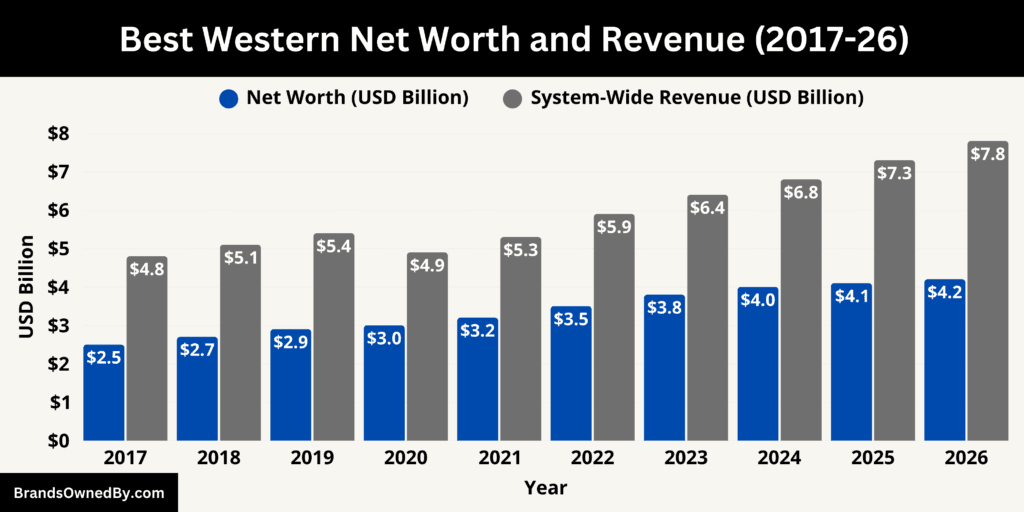
As of January 2026, the Best Western system reported annual revenue of approximately $7.8 billion. This figure reflects the combined sales of all member hotels under the Best Western brand, including room bookings, food and beverage services, loyalty program contributions, and ancillary services such as event hosting and corporate partnerships. Best Western’s revenue is distinct from the corporate income of Best Western International, Inc., because the cooperative’s financial reporting aggregates system-wide performance rather than revenue earned directly by the central corporate entity.
Best Western’s estimated net worth or brand valuation is approximately $4.2 billion as of January 2026. This valuation reflects the strength of the brand name, the loyalty program, the reservation technology, and the collective size of the global membership network.
System-Wide Revenue
Best Western’s revenue figure of $7.8 billion in 2026 is a system-wide calculation. It encompasses revenue generated by all hotels operating under Best Western, Best Western Plus, Best Western Premier, and affiliated brands.
Because most Best Western properties are independently owned and operated, the collective performance of these hotels contributes to the overall revenue figure. Guests around the world book rooms, dine at hotel restaurants, attend meetings, and participate in Best Western Rewards loyalty activities.
All these revenue streams are aggregated to reflect the network’s performance. This revenue growth in recent years has been supported by steady global travel demand, expansion into emerging markets in Asia and the Middle East, and enhanced digital booking platforms that improve customer engagement and conversion.
Best Western International, Inc. itself receives a portion of system-wide revenue through membership and licensing fees paid by hotel owners.
These fees fund centralized services such as global marketing, technology platforms, loyalty program management, and quality assurance. Because Best Western does not own the physical assets for most properties, the revenue recognized by the central organization differs from total system-wide sales.
However, system-wide revenue remains a key indicator of the brand’s health, reach, and competitiveness in the global hospitality industry.
Net Worth and Brand Valuation
Best Western’s estimated net worth of approximately $4.2 billion in 2026 reflects its brand value and corporate worth, rather than fixed assets such as real estate holdings.
Since the cooperative does not own most physical hotel properties, traditional net worth calculations based on property ownership do not apply in the same way they do for asset-heavy hotel corporations. Instead, net worth for Best Western is derived from the brand’s intellectual property, loyalty program strength, reservation and distribution technology, global market presence, and the consistency of its cooperative model.
Brand valuation takes into account customer perception, market share, loyalty program engagement, and long-term revenue potential. Best Western Rewards, the company’s loyalty program, boasts millions of members worldwide and remains a significant driver of repeat business.
This loyalty ecosystem adds measurable value to the brand. In addition, reservation technology and global distribution systems supported by the central organization enhance visibility and booking rates for member hotels, further strengthening the brand’s economic position.
Revenue Drivers and Growth Factors
Several factors contribute to Best Western’s steady revenue trajectory through 2026. The consistent expansion of member hotels into new regions has diversified revenue sources beyond North America and Europe.
Emerging markets in South Asia, the Middle East, and Africa have seen increased Best Western hotel openings, attracting both leisure and business travelers. Enhanced digital infrastructure has also played a role by making the booking experience more seamless and integrated across devices, increasing direct bookings and reducing dependency on third-party travel agencies.
Best Western’s tiered brand strategy allows it to capture different market segments, from economy travelers seeking value to upscale guests desiring additional amenities.
This multi-tier approach not only broadens customer appeal but also stabilizes revenue through economic cycles. During periods of slower travel demand in one segment, other tiers may maintain steadier performance, contributing to overall system resilience.
Brands Owned by Best Western
Best Western Hotels & Resorts operates through Best Western International, Inc. and its affiliated operating entities. It owns the trademarks, brand standards, distribution systems, and loyalty infrastructure behind its hotel flags. It does not generally own the real estate of member hotels. Instead, it owns and runs the brand portfolio, the membership organization, and the centralized platforms that power bookings, marketing, and guest recognition.
Below are the major brands, brand families, and key operating entities owned and operated by Best Western itself as of 2026:
| Brand or Entity | Type | Founded or Introduced | Main Focus | Key Details |
|---|---|---|---|---|
| Best Western | Hotel brand | Founded 1946 | Midscale lodging | The original and most recognized flag of the cooperative. Operated by independent hotel owners. Supported by centralized marketing and reservations. |
| Best Western Plus | Hotel brand tier | Introduced 1997 | Upper midscale | Represents upgraded properties with enhanced amenities. Allows owners to target higher-paying guests while using Best Western systems. |
| Best Western Premier | Upscale hotel tier | Introduced 2015 | Upscale segment | Focuses on refined service and premium experiences. Used mainly in urban and international markets. |
| BW Signature Collection | Soft brand | Introduced 2015 | Conversion hotels | Collection of independent hotels that keep local identity. Owners gain access to loyalty demand and distribution. |
| SureStay Hotel by Best Western | Economy brand | Introduced 2016 | Value travelers | Budget-oriented hotels with defined standards. Created to compete with economy hotel chains and expand membership. |
| SureStay Plus Hotel | Economy plus tier | Introduced 2016 | Higher-value economy | Offers slightly better amenities than SureStay Hotel. Targets travelers seeking affordable comfort. |
| SureStay Collection | Soft economy brand | Introduced 2016 | Unique small hotels | Allows economy properties to remain distinctive. Still benefits from Best Western distribution and loyalty systems. |
| Aiden by Best Western | Boutique lifestyle brand | Introduced 2017 | Modern travelers | Design-driven hotels with character. Appeals to guests choosing hotels based on style and vibe. |
| Sadie Hotel | Boutique lifestyle brand | Introduced 2018 | Urban and social stays | Focuses on contemporary design and social spaces. Created for experiential hospitality markets. |
| GLō Hotels | Boutique brand | Introduced 2019 | Affordable boutique | Bright and modern hotels with simplified operations. Supports conversion and new-build markets. |
| Executive Residency by Best Western | Extended-stay brand | Introduced 2016 | Long-term guests | Suite-style hotels for business and relocation travelers. Delivers steadier occupancy for owners. |
| BW Premier Collection | Upper upscale soft brand | Introduced 2016 | Distinctive upscale hotels | Soft brand collection for high-quality independent hotels. Flexible design with strong standards. |
| WorldHotels | Premium portfolio | Acquired 2019 | Luxury and upscale distribution | Best Western-owned brand family that connects high-end independent hotels to global booking channels. |
| Best Western Rewards | Loyalty program | Launched 1993 | Guest retention | Company-owned global rewards platform with millions of members. Drives direct bookings and repeat business. |
| Best Western International, Inc. | Cooperative entity | Incorporated 1963 | Governance and brand ownership | Owns trademarks and standards behind all Best Western brands. Operated for the benefit of member hotel owners. |
Best Western Hotels & Resorts
Best Western Hotels & Resorts is the core brand platform and the global operating identity used by the organization. It is the umbrella name that represents the cooperative hotel network and the brand system. It manages global standards, marketing programs, owner support, brand compliance, distribution relationships, and technology that member hotels use.
This umbrella also reflects how the company positions itself to owners. It is a brand house with multiple segments. It is not a single hotel chain that owns all properties. The brand platform is managed centrally, while properties remain independently owned and operated under license and membership agreements.
Best Western
Best Western is the classic midscale flag. It is designed for value-focused travelers who want a recognizable name and consistent basics. Many legacy properties still operate under this flag, particularly in North America. The focus is reliability, broad geographic coverage, and moderate price points.
This brand is also the historical backbone of the organization. It continues to matter because it carries high consumer recognition in roadside and secondary markets where large upscale brands may not be present.
Best Western Plus
Best Western Plus is positioned above the core Best Western flag. It generally represents higher standards, upgraded rooms, and stronger amenities. Hotels in this tier typically offer enhanced breakfast, stronger common areas, and more contemporary design expectations compared to the base brand.
From an owner perspective, Best Western Plus often serves as a reflagging pathway for independents that want more rate strength without jumping into true upscale brand requirements.
Best Western Premier
Best Western Premier is the upscale tier that targets travelers looking for more refined finishes, elevated service expectations, and stronger experiential standards. Many Premier properties are in urban markets and international destinations where upscale demand is strong.
It is a strategic tier because it helps Best Western compete with upscale global brands while still maintaining the independent-owner model.
BW Premier Collection
BW Premier Collection is a soft-brand collection within the upscale space. It is typically used for distinctive hotels that want access to the Best Western distribution system while keeping more of their individual identity. These hotels are often more design-driven than standard Premier flags.
For owners, it is a brand solution when a property wants flexibility in design and storytelling, while still meeting a defined quality threshold and benefiting from the loyalty base.
WorldHotels
WorldHotels is Best Western’s luxury and upscale portfolio. Best Western acquired the WorldHotels brand, bringing a higher-end global collection under its umbrella. WorldHotels helps Best Western serve premium travelers and corporate accounts that prioritize upscale and luxury positioning.
WorldHotels is structured as a set of sub-collections. Those collections allow the company to segment hotels by style and service expectations, while maintaining a premium brand narrative.
WorldHotels Luxury
WorldHotels Luxury is the top tier in the WorldHotels portfolio. It targets landmark and high-end properties with strong service, premium rooms, and elevated guest experiences. It is positioned for travelers who expect luxury standards, not simply “upscale.”
For Best Western, this tier extends the brand ladder into the luxury category without requiring broad corporate ownership of assets.
WorldHotels Elite
WorldHotels Elite is an upper-upscale tier designed for hotels that offer premium stays and high service standards but may not meet full luxury positioning. It supports properties that want a strong high-end label with global distribution.
This tier is commonly used for major city hotels and destination properties that sit just below luxury pricing.
WorldHotels Crafted
WorldHotels Crafted emphasizes design, character, and a more boutique feel. It is meant for hotels with a distinct point of view, often appealing to lifestyle travelers. Crafted properties tend to lean into local culture, curated experiences, and design details.
For Best Western, this tier captures the lifestyle segment without forcing a single standardized design template across every property.
WorldHotels Distinctive
WorldHotels Distinctive targets independent hotels that want premium affiliation but maintain their own identity. It sits within the upscale range and provides flexibility, while still requiring consistency and service standards appropriate to the portfolio.
This is often a fit for established independent hotels that already have reputation and want stronger distribution and loyalty demand.
SureStay Hotel Group
SureStay Hotel Group is Best Western’s economy and value-focused brand family. It targets owners and markets where affordability and simplicity drive demand. The SureStay family is also useful for conversions, allowing independent motels and hotels to join a recognized system with defined standards.
SureStay is positioned to compete against economy flags while providing the back-end infrastructure Best Western is known for.
SureStay Hotel by Best Western
SureStay Hotel by Best Western is the core SureStay flag. It represents dependable economy lodging with a recognizable identity. It is often used for drive-to markets, highways, and regional travel corridors.
It is especially relevant for owners seeking brand affiliation while keeping operational complexity manageable.
SureStay Plus Hotel by Best Western
SureStay Plus Hotel by Best Western is a step up within the economy-to-midscale bridge. It generally signals better condition, stronger amenities, and a slightly higher guest expectation than the base SureStay flag.
This brand helps Best Western retain value travelers while offering an upgrade path within the same brand family.
SureStay Collection by Best Western
SureStay Collection by Best Western is a soft-brand style offering inside the value segment. It is designed for hotels that want more individuality than a fully standardized economy flag. Properties can preserve local identity while still aligning with minimum standards and using Best Western distribution.
It gives Best Western flexibility in the conversion market, especially for unique small properties.
Aiden by Best Western
Aiden by Best Western is a boutique and lifestyle-oriented brand. It focuses on design-forward spaces and a more modern guest experience, often with local touches. Aiden properties typically appeal to travelers who want something more distinctive than traditional midscale, without paying luxury rates.
This brand matters strategically because it brings a fresher aesthetic into the portfolio and supports urban and secondary-city growth.
Sadie Hotel
Sadie Hotel is a boutique lifestyle brand aimed at creating a more social and design-centric stay. It leans into modern hospitality trends such as activated lobbies, curated experiences, and a strong brand personality.
It is positioned to attract travelers who choose hotels based on vibe and story, not just price and points.
GLō Hotels
GLō is a boutique-style brand that emphasizes modern design and a bright, contemporary feel. It is often used in markets where owners want a stylish product without the full complexity of upscale operations.
It supports Best Western’s effort to cover the “affordable boutique” lane, which has grown as travelers seek differentiated stays.
Executive Residency by Best Western
Executive Residency by Best Western is an extended-stay brand. It targets longer-term guests such as project teams, relocations, and business travelers staying a week or more. Properties typically have suite-style rooms and practical amenities suited to extended stays.
For owners, this brand can deliver steadier occupancy patterns compared to transient-only hotels, especially in business corridors.
BW Signature Collection by Best Western
BW Signature Collection is a soft brand that allows independent hotels to keep their personality while meeting certain quality requirements. It is often positioned in the upper-midscale space and works well for conversion properties that already have local recognition.
This brand is important because soft brands have grown across hospitality. They allow owners to differentiate while still gaining loyalty and distribution benefits.
Best Western Rewards
Best Western Rewards is the company-owned loyalty program and one of the most commercially important assets in the group. It is the engine that connects guest repeat behavior to the brand portfolio. It supports earning and redemption across the brand system and is integrated into reservations, partnerships, and marketing campaigns.
In practical terms, Best Western Rewards is an owned entity and platform that increases direct bookings, reduces reliance on third-party channels, and improves retention for member hotels.
Best Western’s Reservation and Distribution Platforms
Best Western owns and operates the core systems that power its booking and distribution ecosystem. This includes its central reservation platform, brand websites, mobile booking applications, property connectivity systems, and integrations with global distribution channels.
These systems are not “brands” in the consumer sense, but they are key owned operational entities. They are critical because they are what members pay for, beyond the name on the building.
Best Western’s Membership Cooperative Structure
Best Western International, Inc. is the membership-based entity that owns the brand rights and governs the cooperative. While it is not a consumer-facing brand, it is the legal and operational entity that sits behind the entire system.
This structure is central to what Best Western “owns.” It owns the cooperative framework, membership agreements, governance mechanisms, and operational programs that keep thousands of independent hotels aligned.
Acquisitions, Mergers, and Brand Portfolio Expansion
Best Western’s most important portfolio move in recent years was the acquisition of WorldHotels, which expanded the company into upscale and luxury positioning. That acquisition strengthened the brand ladder from economy to luxury under one umbrella.
Beyond major acquisitions, Best Western has expanded through brand creation and brand family launches. SureStay and its sub-brands were built to compete in the value segment and accelerate conversions. Lifestyle and boutique brands such as Aiden and Sadie were launched to capture modern traveler preferences and support growth in design-conscious markets.
Best Western’s expansion model is more brand-led than merger-led. The company typically grows through bringing independent hotels into its system, rather than buying competitors outright. The owned assets are the brand portfolio, loyalty infrastructure, and reservation ecosystem that create value for member owners.
Conclusion
Ownership of Best Western follows a rare model in hospitality. Many people ask who owns Best Western when booking a hotel. The brand began in 1946. It united independent hotels under one trusted name. That idea helped small hotel owners grow. It also helped guests travel with confidence.
Best Western International, Inc. holds the brand rights. But it is not controlled by outside investors. The company is owned by its member hotel owners. Larry Cuculic leads daily operations as CEO. The board of directors shapes strategy. Members vote on major policies. This cooperative system remains stable in 2026. Best Western continues to expand around the world. The brand stays focused on service and consistency. The unique ownership structure still defines the company today.
FAQs
Who owns Best Western brand?
Best Western International, Inc. owns the Best Western brand. It holds the trademarks. It licenses the brand to independent hotel owners.
Who owns Best Western chain?
The Best Western chain is owned collectively by member hotel owners. Best Western International manages the network. Individual hotels are independently owned and operated.
Who is the parent company of Best Western?
The parent company of Best Western is Best Western International, Inc. It governs the cooperative. It manages marketing, reservations, and brand standards.
Who owns Best Western in Europe?
Best Western hotels in Europe are owned by local independent hoteliers. They operate under franchise agreements. Best Western International only licenses the brand to them.
What hotel chain is Best Western affiliated with?
Best Western is not affiliated with any external hotel chain. It is an independent cooperative organization. It competes with Hilton, Marriott, Hyatt, and IHG.
Is Best Western part of Hilton or Marriott?
No. Best Western is not part of Hilton. It is not part of Marriott. It operates as a separate global hotel network.
Is Best Western owned by Marriott?
No. Best Western is not owned by Marriott International. Marriott owns different hotel brands. Best Western remains independent.
Is Best Western owned by Hilton?
No. Best Western is not owned by Hilton Worldwide. Hilton is a different corporation. Best Western International owns and operates the Best Western brand without Hilton ownership.
Is Best Western publicly traded?
No. Best Western is not publicly traded. It does not issue public stock. There are no institutional equity shareholders. Ownership remains fully inside the membership cooperative.
Does Best Western own its hotel buildings?
No. Best Western does not own the physical hotel buildings. Independent franchisees own them. The company owns the brand name and booking systems only.